Imperial garden
Beihai Park Audio Guide (Beihai Gongyuan)
A lake and an island raised with rocks brought from another capital: on it Kublai Khan laid out his new city, the White Dagoba has crowned it since 1651 and, since 1925, anyone can row where the emperors rowed.
- 75 min of audio
- Lake, island and stupa
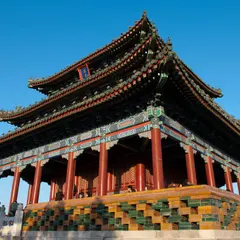
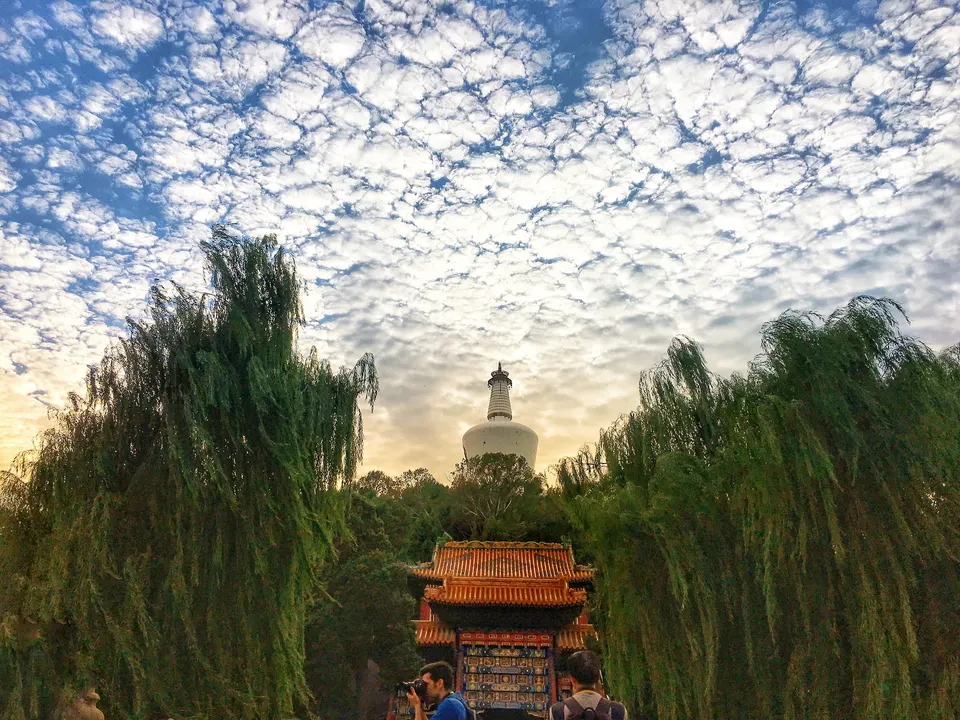
Beihai Park is the oldest imperial garden in Beijing. From 1179, under the Jin dynasty, rocks were piled on the old Yaoyu islet until an artificial hill was formed, Qionghua Island, “Jade Flower”; around 1267 Kublai Khan took it as the centre to lay out Dadu, the core of present-day Beijing. In 1651 a Tibetan-style stupa, the White Dagoba, took the site of a collapsed hall at the summit, and the Ming and Qing dynasties added pavilions over the water, a glazed brick wall with dragons and a pavilion lined with calligraphy stones.
The contrast lies in the fate of its pieces. A jade jar of about 3,500 kg that served wine at Kublai Khan's banquets ended up as a pickle crock in a Taoist temple; the porous rocks of the island, brought from present-day Kaifeng, counted according to tradition as tax payment for whoever carried them; and the lake where the Qing court organised competitions on ice opened to the public on 1 August 1925 for an entrance fee of one jiao.
Highlights
- Round City — Kublai Khan's jade jar, of about 3,500 kg, which ended up as a pickle crock
- White Dagoba — Tibetan stupa of 1651 at the top of Qionghua Island, rebuilt after two earthquakes
- Yuegulou pavilion — 495 engraved stones with works by 134 Chinese calligraphers
- Five-Dragon Pavilions — Five Ming pavilions of 1602 joined by walkways over the lake
- Nine-Dragon Wall — Seven-colour glazed brick with nine dragons on each face
In the heart of Beijing, a lake covering more than half the grounds surrounds an island crowned by a white stupa: this is Beihai Park (北海公园, Beihai Gongyuan), the oldest imperial garden in Beijing. Today it is a public park with rental boats in summer and skating in winter, but for centuries it was the emperors’ pleasure garden and, even earlier, the point from which the city was laid out.
The history of Beihai Park begins with the Jin dynasty. From 1179 (the Beijing press moves the start of works back to 1166) rocks were piled on the old Yaoyu islet to raise an artificial hill, Qionghua Island, crowned by the Guanghan hall; the lake came to be called Xihua and the residence the Daning palace. Around 1267 Kublai Khan took the island as the centre for laying out his new capital, Dadu, the core of present-day Beijing. In 1602 the Ming built the Five-Dragon Pavilions on the north shore, in 1651 the White Dagoba took the summit and in 1770 the Wanfolou pavilion was built, which held ten thousand gold Amitayus Buddhas: troops of the Eight-Nation Alliance took them all in 1900 and the building was demolished afterwards.
The lake also had a winter life. In the Qing period, after the solstice, the court chose from among the Eight Banners and the imperial guard more than a thousand skaters, up to 1,600 according to the rule, who around the Laba festival competed on the ice of Taiye Lake; from the Yilantang hall of Beihai it was watched by Qianlong and, later, Cixi. On 1 August 1925 the former imperial garden opened to the public (some text says 1922). To know what to see in Beihai Park and to read its architecture, from the Round City to the north shore, the audio guide follows it in five stops and 75 minutes of narration, following the thread of a garden that was the compass of a capital and a store of stones and objects torn from other eras.
To the east, from the summit of Jingshan Park the White Dagoba can be seen over the lake, and to the northwest of the city the Summer Palace, the last great imperial garden of Beijing, repeated the idea of an excavated lake whose earth raises a hill.
The jar of Kublai that ended up a crock
Round City (团城)
Summary of this stop
Beside the south gate, the Round City (Tuancheng) is a circular walled enclosure that occupies the old Yuandi islet, with the Chengguang hall at the centre. Beneath a stone pavilion rests the Dushan Dayuhai jade jar, carved from a single piece of dark jade: 0.7 metres tall and about 3,500 kilos in weight. In 1265 Kublai Khan had it taken up to the summit of Qionghua Island, to the Guanghan hall, and used it as a wine vessel at banquets with his ministers.
Its biography does not end there. After being lost, some Taoist monks of the Zhenwu temple, beside the Xihua gate, used it as a pickle crock, until the Qianlong emperor bought it at a high price and installed it in this stone pavilion, with two poems of his own engraved. From the Round City the Qionghua Island can be seen opposite, the same one that around 1267 served Kublai Khan as the centre for laying out Dadu.
The enclosure also keeps a plant legend. Popular tradition says that one summer Qianlong, stifled by the heat of the Chengguang hall, ate beneath an old pine east of the building; a breeze came and the emperor, imitating the First Emperor of Qin, named the tree “Marquis of Shade”. The white-barked pines next to it, more than 30 metres tall, he called “Generals of the White Robe”, in memory of General Xue Rengui. Tradition attributes their planting to the Jin period and the Marquis is reckoned at about 800 years old. In front of the jar, the audio guide follows the trail of how an object from an imperial banquet ended up in a temple pantry.
A stupa on a fallen hall
White Dagoba (北海白塔)
Summary of this stop
The Yong’an bridge joins the south shore to the island, and beyond it the stairway of halls of the Yong’an temple climbs toward the White Dagoba, visible from the whole lake and from Jingshan. At the summit there had earlier been the Jin-era Guanghan hall, which collapsed in 1579 and was never rebuilt. In 1651, the eighth year of the Shunzhi emperor, this Tibetan-style stupa was raised on its site, 35.9 metres tall according to Chinese and official sources (others give 40), and the palaces in the south of the island were turned into a temple. About its motive there is no agreement: some sources link it to a lama’s request and others to the visit of the Fifth Dalai Lama that same year.
The stupa collapsed twice in earthquakes, in 1679, in the Kangxi reign, and again under Yongzheng (the date of that second quake varies between 1730 and 1731 depending on the source), and each time it was rebuilt: the present form is that of the Yongzheng period. The Tangshan earthquake of 1976 damaged its finial. In the upper part of the island there still stands a small bronze figure of an immortal with a tray: it is said that Qianlong had it raised, copying the Han emperor Wu, to collect the “sweet dew” with which imperial medicines for prolonging life were mixed.
The summit also had a military use. In November 1653, on the proposal of the Minister of War Gadahun, Shunzhi had five signal cannon and five masts installed on the hill as an alarm system for the capital; the gunners could fire only on seeing a gold plaque bearing the imperial order, kept in the palace. On the terrace, the narration tells how that alarm worked and who could bring the plaque.
Rocks from another capital, stones with writing
Yuegu Tower (阅古楼)
Summary of this stop
The slopes of Qionghua Island are covered with Taihu rocks, porous and twisted, with grottoes and passages: remains of the Jin-era construction. Sources say that the Jin emperor Shizong (Wanyan Yong) had a great quantity of them brought from Bianliang, present-day Kaifeng, former capital of the Song; one source attributes the work instead to Zhangzong. They are known as “Genyue stones”, after the garden that the Northern Song emperor Huizong had filled with Taihu rocks some sixty years earlier, and as “stones that count as grain”, because, according to tradition, the hard labour of hauling them could replace the payment of taxes.
For centuries only texts supported that origin. In 2019 Beihai and Tianjin University compared these rocks with those of Longting Park in Kaifeng and those of gardens in Suzhou and Wuxi; the preliminary result, presented in November of that year, concluded that the Taihu rocks of the mid-slope of the island and of Yingtai are Genyue stones.
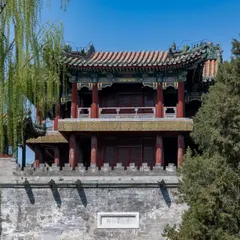
At the west foot of the island, the Yuegulou pavilion, two storeys with a crescent plan, lines its interior walls with 495 engraved stones bearing the calligraphic repertoire Sanxitang Fatie, which gathers works by 134 calligraphers from the Wei and Jin dynasties. In 1747 Qianlong commissioned the reproduction of the three rare pieces by Wang Xizhi that give the collection its name. In front of the pavilion, the audio guide explains why these stones say as much as the letters engraved on them.
Five pavilions and a song in a boat
Five-Dragon Pavilion (五龙亭)
Summary of this stop
On the west part of the north shore, five pavilions joined by zigzag walkways reach out into the water: these are the Five-Dragon Pavilions, built in 1602, the 30th year of the Ming emperor Wanli. Each has its own name: Longze, Chengxiang, Zixiang, Yongrui and Fucui. Raised for the court, today they are seen from the rental boats that cross the lake. Very close stands the Iron Screen, a screen wall of the Yuan period so called because its stone looks like iron in colour and texture; it stood before an old temple outside the Jiande gate of Dadu and was moved here in 1947.
The lake also has its song. In the spring of 1954, the lyricist Qiao Yu had been stuck for days on the commission from director Yan Gong for “Flowers of the Motherland”, the first film of New China about the happy life of children. One day he rented a boat at Beihai with his girlfriend, Tong Qi; seeing a group of young pioneers rowing past, the idea came to him, he went ashore and wrote the lyrics sitting on the grass. Thus was born “Let Us Row the Oars”, his first work for New China. On the walkways, the narration brings that afternoon of oars back to the lake.
Glazed dragons and a train for dinner
Nine-Dragon Wall (北海九龙壁)
Summary of this stop
On the north shore rises the Nine-Dragon Wall, made entirely of seven-colour glazed brick, with nine large dragons among clouds and waves on each of its two faces. Chinese sources date it to 1756, in the Qianlong period, and give it 25.86 metres in length, 6.65 in height and 1.42 in thickness; other sources speak of 1402 and somewhat different measurements. Counting the small dragons of the eaves and tiles, the total figure ranges between 633 and 635 depending on who counts. It began as a screen before the gate of the Arhat Hall, which burned, and was left afterwards as the screen of the Dayuanjingzhi hall: it is the last piece of a vanished complex.
A train once passed along this same shore. Between 1885 and 1888 the dowager empress Cixi rebuilt the Three Seas with Navy funds, laid a railway along the west and north shores of the lake and had a small station built opposite the Jingxinzhai, the garden-within-the-garden of ponds, rockwork and pavilions in the southern Chinese style, so as to arrive by train at her banquets. Less than four decades later, on 1 August 1925, a one-jiao coin was enough to enter the former imperial garden. In front of the wall, the audio guide closes the route with the day Beihai became the property of all Beijing.