Ming wall
Mutianyu Great Wall Audio Guide (Mutianyu Changcheng)
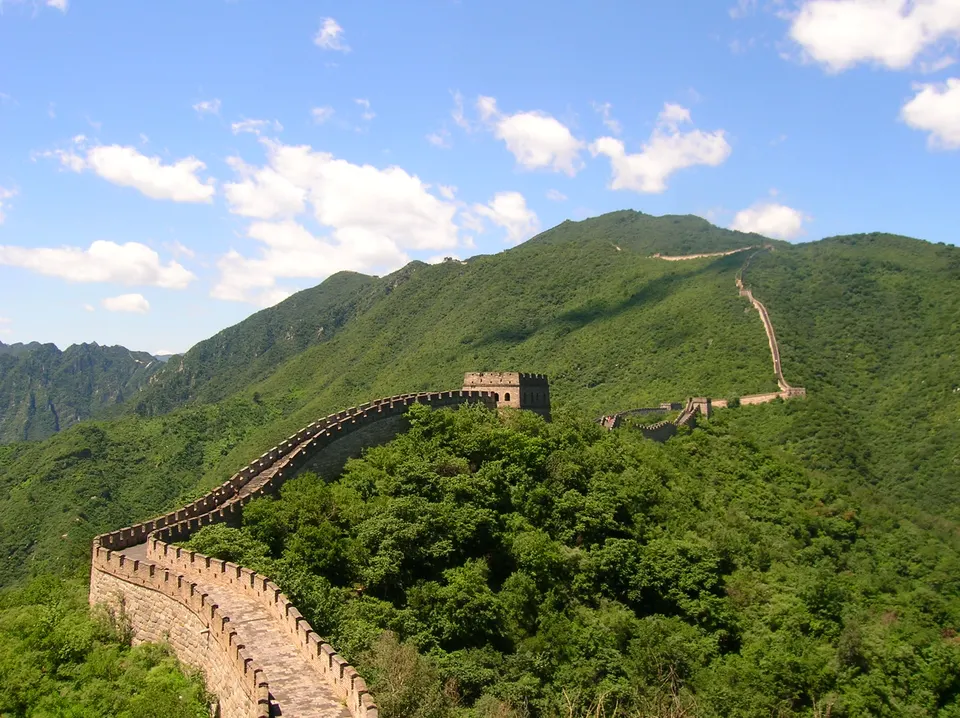
A Ming section of granite in the Huairou mountains, north of Beijing, with battlements on both sides, a tower every hundred metres and a gate of three twin towers, climbing the mountain to the dizzying loop of the Ox Horn.
- 120 min of audio
- Ming fortification
The Mutianyu Great Wall rests on a Northern Qi wall of the mid-sixth century, over whose course General Xu Da raised the present one at the start of the Ming dynasty. In 1404, the second year of the Yongle emperor, the Mutianyu pass was founded, with the three-tower gate of the Zhengguantai. After the Mongol assault of 1543, the court created the Chang military region in 1550 and Mutianyu became its first pass from the east, devoted to protecting the capital and the imperial tombs. Its rarest feature is the battlements on both parapets: the section was designed to fight in both directions.
The contrast lies in who walks it today. The wall built to close the pass to Mongol horsemen became a showcase before Bill Clinton, who in 1998 described it as “not a wall to keep people out”, and before Michelle Obama, who in 2014 came down from it on a toboggan. At the foot, in the village, the American Jim Spear and his wife, Liang Tang, turned the abandoned school into a restaurant and glass workshop, The Schoolhouse, after a conversation with a neighbour who sold T-shirts to tourists got them a house beneath the wall.
Highlights
- Tower 14 — Cable car arrival at 640 m and a view of the Ox Horn loop
- Zhengguantai (tower 4) — The pass gate of 1404: three towers joined on a single platform
- Battlements on both sides — A section built to fight outward and inward
- Dajiaolou (tower 1) — The three-wall corner and the legend of the bald-tail wall
- Steel toboggan — 1,580 m of descent down the slope, the same one Michelle Obama rode in 2014
In the Huairou mountains, north of Beijing, the Mutianyu Great Wall (慕田峪长城, Mutianyu Changcheng) does not resemble the endless postcard: it is a concrete frontier, of granite, with battlements on both parapets, a tower roughly every hundred metres and a gate of three twin towers, climbing the mountain to the dizzying loop of the Ox Horn. It covered the capital and the Ming Tombs from the north, and was designed to fight in both directions, something rare on the Great Wall.
The history of the Mutianyu Great Wall comes in layers. Underneath lies a Northern Qi wall of the mid-sixth century; on top Xu Da, a general, raised the present one at the start of the Ming dynasty (some sources date his work to 1368, others place his works in the area from 1371), and for decades it was a wall of stone and earth without a gate, until in 1404 the pass was founded. In 1543 a Mongol assault killed its commander; in 1550 Mutianyu became the first pass from the east of the Chang military region, and the high walls and hollow towers are attributed to the decades of works of Tan Lun and Qi Jiguang. In 1981 it was chosen as the second section opened to tourism in Beijing, after Badaling; since 1988 it has been open to the whole public and since 2022 it has been under restoration with traditional materials and techniques after the damage from the 2021 rains.
To know what to see on the Mutianyu Great Wall and to read its architecture, the audio guide follows the walkway in five stops and two hours of narration: from the cable car arrival at tower 14 to the low gate of the Zhengguantai, the corner tower at the east end and the toboggan exit. Along the way appear a stele on which a name is missing, a wall that according to tradition cost the life of the man who directed it and details off the itinerary, such as the Lovers’ Pine on the climbing path: a single trunk that a metre above the ground splits into two crowns of different species, a Masson pine and a Chinese pine.
The same dynasty that armoured the capital in this way saw its end inside Beijing, in Jingshan Park, where the last Ming emperor hanged himself in 1644. On the way back to the city, the Summer Palace, to the northwest, is the other great visit outside the centre.
A tower every hundred metres to the Ox Horn
Tower 14, cable car arrival
Summary of this stop
The cable car, 723 metres long, ends beside tower 14, at 640 metres above sea level, on a broad esplanade with open views. It is a hollow tower with a ring plan, that of the character 回, and arrow slits on its four sides. From here the wall lends itself to being measured rather than mythologised: between the Dajiaolou tower, number 1, and number 20 there are 25 towers, platforms and sentry boxes in only 3,000 metres, roughly one every hundred metres. The figures vary with the source, which also speaks of 22 towers in 2,250 metres, and two numberings coexist: that of the site, from 1 to 23, and that of the heritage inventory, from 86 to 108.
West of tower 20, the wall climbs to the summit, crowns it with a tower, plunges down the slope and climbs again to a little over 940 metres (one source puts the peak at 1,039), drawing a great horn-shaped loop: the Niujiaobian, the “edge of the ox horn”. On either side, the unrestored sections of Jiankou and Yingfei Daoyang, “the eagle flies face up”, rest on bare rock with slopes of about 50 degrees and an almost vertical passage of steps just a few centimetres deep.
Closer by, the stone is a reminder that work continues. The torrential rains of 2021 caused damage in the visitable section, and since 2022 a restoration in three phases over five years has been repairing 23 towers and 2,523 metres of wall. Its last phase has kept the upper section of the “Heroes’ Slope”, between towers 19 and 20, closed since April 2026, and is due to finish at the end of 2026; the first ten metres remain open and towers 21 to 23 are reached by an outer path. On the esplanade, the audio guide teaches how to read that horizon tower by tower.
Layers of wall and a name that is missing
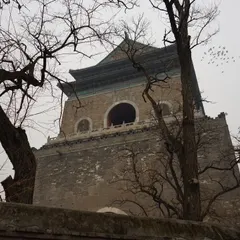
Hollow brick tower
Summary of this stop
Under the brick vault of a hollow tower, the wall reveals itself as made in layers: the Northern Qi course of the sixth century, Xu Da’s work at the start of the Ming and, on top, the high walls and hollow towers attributed to the decades of works of Tan Lun and Qi Jiguang. Qi Jiguang, a veteran of the fight against Japanese pirates on the southeast coast, commanded between 1568 and 1583 the Ji military region, whose wall ran more than 880 kilometres from Shanhaiguan to Mutianyu.
His role in this particular section, however, is disputed. The Ji region ended right at Mutianyu, and Mutianyu had previously passed to the Chang region; some sources credit him with reinforcing walls and hollow towers on all the important sections of the Ming wall without specifying works of his here. A stone complicates the story further: during works, the staff of the site found a stele 85 centimetres tall and 15 thick, with 301 characters engraved in early autumn of 1569, the third year of the Longqing era, listing those responsible for the work on the Huairou section, from Governor-General Tan Lun down to the officers and foremen of lower rank.
Qi Jiguang’s name does not appear in that list. It has been suggested that he perhaps did not take part in the Huairou work, but nobody has settled it, and at Mutianyu it is counted as one of the wall’s mysteries. Under the vault, the audio guide lays out the possible explanations for that absence.
The low gate where Chen Shun fell
Zhengguantai (tower 4)
Summary of this stop
Down the slope, the pass gate appears where it is least expected: low, at only 483 metres above sea level, and easy to leave off the route for anyone going up by cable car. It is the Zhengguantai, tower number 4: three towers joined on a single platform, the central one larger than the side ones, with a stone plaque reading 正关台, two storeys and a connected ground floor with room for about a hundred people. The early Ming had left a wall of stone and earth here with no gate or passage; in 1404, the second year of the Yongle emperor, the Mutianyu pass was officially founded.
Being the gate also made it the most exposed point. In October 1543 the Mongol Duoyan horsemen assaulted the pass and killed its commander, Chen Shun; they withdrew only when reinforcements from the deputy commander Wang Jizu arrived. Between towers 4 and 5 stands a Ming iron cannon 89 centimetres long and 9 in calibre, tilted about 30 degrees with its muzzle still facing the outside of the wall; another example is displayed in the visitor centre.
From this platform would also come, according to the most widespread popular explanation, the very name of the place: it was earlier called Motiangu, the “valley that brushes the sky”, because on looking up the wall winds upward as if reaching the sky, and over time Motian was pronounced Mutian and “gu”, valley, was changed to “yu”, gully. Another, less documented version attributes it to a general named Tian Mu, beloved by his soldiers and by the peasants he helped to clear land. In front of the gate, the audio guide reconstructs the assault of 1543.
The three-wall corner and the bald-tail wall
Dajiaolou (tower 1)
Summary of this stop
At the high point of the east end, the Dajiaolou, tower number 1, is a corner tower where three walls meet: the one going toward Badaling, the one going toward Gubeikou and a branch to the south. Two military regions touched here, Ji and Chang. The latter was born of the attack of 1543: in 1550 the Ming court created the Chang region, which stretched 460 li from Mutianyu to Juyongguan, and Mutianyu became its first pass from the east, devoted to protecting the capital and the imperial tombs.
Hence the toothed parapets outside and inside the walkway: sawtooth battlements and, beneath them, square loopholes with an arched top. On most sections of the Great Wall only the outer side carries battlements; Mutianyu, which covered the capital and the Ming Tombs from the north, was designed to fight in both directions.
To the southeast juts out the branch that looks like a mistake: a wall of about 1,000 metres, with one hollow tower and one solid one, that stops dead. The locals call it the “Tuweiba bian”, the “bald-tail wall”. A local tradition says that, after the death of Grand Secretary Zhang Juzheng in 1582, it was directed by an officer of Qi Jiguang’s who refused to pay a bribe to an official of the Ministry of War, and that the latter accused him of having laid out the wall badly and of corruption and had him executed. More than ten years later, a new frontier general is said to have checked that the work was sound and ordered a stele erected that cleared his name; it stood for more than three hundred years, until the Cultural Revolution, and only its base remains. Beside the corner tower, the audio guide explains why that cut-off wall made sense.
The wall that is descended by toboggan
Steel toboggan
Summary of this stop
Near tower 6 begins the most unexpected descent on a wartime frontier: a steel toboggan 1,580 metres long that snakes down the wooded slope to the foot of the valley, with single-seat carts and a hand brake. Behind it lies a political decision. In autumn 1981 Vice Premier Chen Muhua chose Mutianyu as the second section of the Great Wall open to tourism in Beijing, after Badaling; the State Council approved its restoration in 1983, it opened to selected visitors in 1986 and to the whole public in 1988.
Since then the section has served as a showcase. On 28 June 1998 Bill Clinton walked the wall during his trip to China and described it as a symbol that China shows the world, “not a wall to keep people out”. On 23 March 2014 Michelle Obama and her daughters Malia and Sasha came down from it on the toboggan, while photographers waited for them in the car park.
That day the cameras were positioned to leave out of frame the great inscription still traced on the slope opposite the wall, visible from the walkway: the characters 忠于毛主席, “Loyalty to Chairman Mao”. At the toboggan exit, the audio guide closes the route with the slogan that was left out of the photos.