Monumental square
Tiananmen Square Audio Guide
Beijing's great esplanade is not as old as it looks: until 1914 it was an imperial courtyard closed to the public, and its enormous emptiness was laid out in 1958-1959. To the north it is presided over by the Tiananmen Gate, the balcony of imperial edicts from which Mao proclaimed the People's Republic in 1949.
- 45 min of audio
- Imperial and modern history
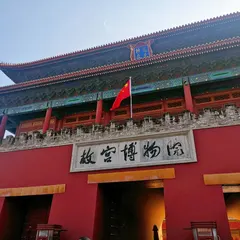
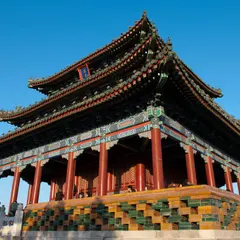
The Tiananmen Gate began in the Yongle reign as the Chengtianmen, a wooden portico; after a lightning fire in 1457 it was rebuilt in 1465 as a gate tower nine bays wide and five deep with a double roof. Li Zicheng's rebels burned it in 1644, and the Qing dynasty rebuilt it and in 1651 renamed it Tiananmen, a name that abbreviates the formula “receive the mandate of heaven and pacify the country”. From its balcony the Ming and Qing emperors promulgated their edicts. At its feet, the square is a twentieth-century creation: the Republic opened it in 1914, communist China enlarged it in 1958-1959 between the Great Hall of the People and the present National Museum, and Mao's Mausoleum completed it in 1977.
For centuries the tower was forbidden ground and, after 1949, only leaders and guests climbed it. According to the account collected from those years, in September 1984 an old man signing himself “Huaxing” wrote to General Secretary Hu Yaobang asking that it be opened to the people: for more than thirty years he had been looking at it from below and dreaming of climbing to the “heart of the heart of the motherland”. On 1 January 1988 the tower opened to the public, and the first ticket, at 10 yuan, went not to a dignitary but to Gao Xiwu, a 75-year-old retired accountant who was already waiting first at the ticket window shortly after seven. More than 2,000 visitors went up that day.
Highlights
- Tiananmen Gate — Nine-bay tower rebuilt in 1465, renamed in 1651 and secretly reconstructed in 1969-1970
- Portrait of Mao — On the balcony since the 1949 proclamation and replaced every year before National Day
- Flagpole — Raised at dawn in 46 seconds, the length of one performance of the anthem
- Monument to the People's Heroes — A 37.94 m granite obelisk with eight great reliefs at its base
- Mao's Mausoleum — Built in 1976-1977 where the Gate of China stood, on the axis of Beijing
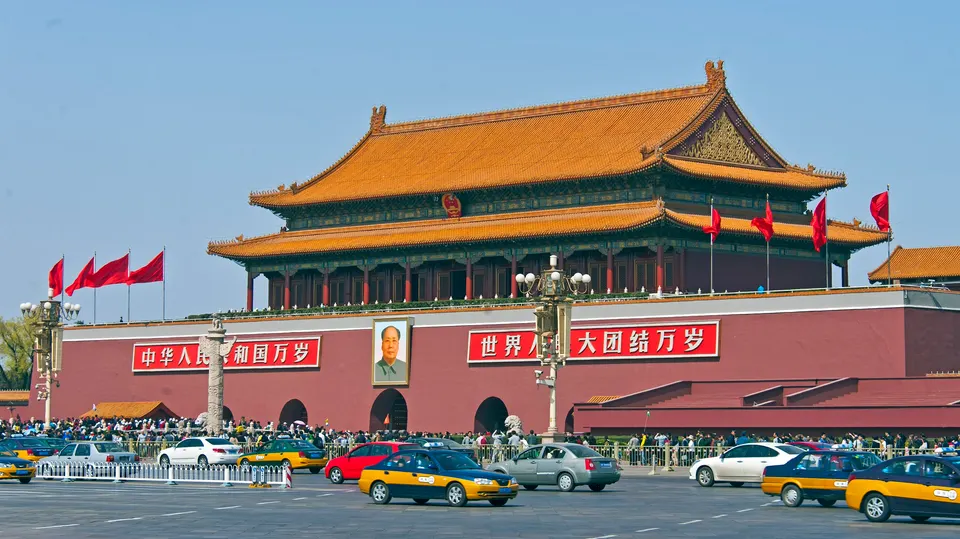
In the centre of Beijing, on the north-south axis that organises the city, Tiananmen Square (天安门广场) extends from the Tiananmen Gate to the massive Zhengyangmen gate, also called Qianmen. On the west it is closed off by the Great Hall of the People; on the east, by the National Museum of China, the former Museum of the Revolution; in between rise the Monument to the People’s Heroes and Mao’s Mausoleum. To the north, on a tall red base with five passageways, the double-roofed tower of yellow tiles displays the national emblem between the eaves and, above the central passageway, Mao’s portrait.
The history of Tiananmen Square is that of one axis serving different regimes. The gate began in the Yongle reign — in 1417 according to some sources, in 1420 according to others — under the name Chengtianmen; it burned from lightning in 1457 and at the hands of Li Zicheng’s rebels in 1644, and received its present name when the Qing reconstruction was finished, in 1651 according to most sources (Beijing’s official tourism website gives 1661). In front there was no square until 1914, only a T-shaped courtyard forbidden to the people. The Republic opened it; the students of the May Fourth Movement demonstrated there in 1919; Mao proclaimed the People’s Republic from the balcony on 1 October 1949, and in 1958-1959 the esplanade was enlarged to hold more than 500,000 people. It was also the stage of the 1989 protest, which students and workers kept up from 15 April to 4 June, until the army took the square on the night of 3 June.
To know what to see in Tiananmen Square and to read its architecture, from the marble bridges of the imperial gate to the mausoleum built where the Gate of China stood, the audio guide follows the axis in a straight line in five stops and 45 minutes of narration, with one underlying idea: this enormous emptiness is a recent work raised over a courtyard closed to the people, and every regime has used the same balcony and the same axis to speak to the crowd and to silence it.
The gate opens the axis that continues north through the Forbidden City to the hill of Jingshan Park; to the southeast, the Temple of Heaven holds the other great ritual stage of the emperors.
The gate that burned twice
Tiananmen Gate
Summary of this stop
In front of the gate, the old moat of the Imperial City is crossed by the Golden Water Bridges, of white marble: one for each passageway of the tower, and the central one, wider, reserved for the emperor. Pairs of stone lions stand guard beside them, those of the Yongle-era bridge, and in front of and behind the gate rise the huabiao, white marble columns about 10 metres tall carved with dragons and clouds. According to popular belief, the mythical animal that crowns each one, the wangtianhou, one of the nine sons of the dragon, watches over the sovereign: those on the Forbidden City side face north to remind him not to shut himself away in luxury, and those outside face south to ask him to return soon to his post.
The vermilion tower is a survivor. It began as the Chengtianmen, a wooden portico of the paifang type; in 1457 lightning set it on fire and in 1465, under the Chenghua emperor, it was rebuilt as a gate tower nine bays wide and five deep with a double roof, the form it keeps. In 1644 Li Zicheng’s rebels burned it, and legend has it that it all began with an arrow: irritated by the name of the “Gate That Receives Heaven”, Li shot at the character 天, “heaven”, the arrow lodged below it and, taking a remark about the mandate of heaven as mockery, he ordered it set on fire. The Qing dynasty rebuilt it from 1645 and in 1651 gave it the name Tiananmen, which abbreviates the formula “receive the mandate of heaven and pacify the country”.
What is seen today is, moreover, a reconstruction. Between 1969 and 1970 the tower was dismantled entirely and raised again hidden behind scaffolding, officially presented as a “renovation”; Zhou Enlai ordered the work kept secret. The new tower came out 83 centimetres taller, from 33.87 to 34.7 metres according to the most cited figures, with the same outward appearance. In front of the bridges, the audio guide tells how the word “heaven” that Li Zicheng’s arrow failed to reach is still in the name of the gate today.
The balcony that speaks to the crowd
Flagpole
Summary of this stop
From the flagpole, at the north end of the square, the Tiananmen balcony lies straight ahead. Under the Ming and the Qing, the most important imperial edicts were promulgated from there in the ritual called “the golden phoenix delivers the edict” (jinfeng banzhao), and the gate also hosted imperial wedding ceremonies, the consecration of banners for campaigns and the autumn review of condemned prisoners.
On 1 October 1949 Mao Zedong proclaimed the People’s Republic of China from that same balcony, and since that day a single portrait of him has hung over the central passageway, following the 1969 version, with a frame of about 6.4 by 5 metres, replaced every year before National Day. Only once did it give up its place: on 9 March 1953 a portrait of Stalin took it to mark his death. On either side, two banners: “Long live the People’s Republic of China” and “Long live the great unity of the peoples of the world”. At the foot, every day at sunrise and sunset, the flag is raised and lowered on a 30-metre pole, installed in 1991 in place of the 22-metre one of 1949; since 1 January 2018 the raising has lasted 46 seconds, the length of a single performance of the anthem.
A gesture on that balcony can weigh more than an edict. On 18 August 1966, as Mao received more than a million young people from on high, the student Song Binbin tied a Red Guard armband around his arm; on learning her name, which evokes refinement, Mao told her “you should be militant”, and on 20 August the Guangming Daily published the article “I Put the Red Armband on Chairman Mao”, signed with the pen name Song Yaowu, “wants to fight”. That encounter is considered the trigger of the so-called Red August, whose dead in Beijing official statistics later put at 1,772 (1980) and at 10,275 (1985); in 2014 Song apologised for the violence of the Red Guards. Opposite the balcony, the audio guide reconstructs the few seconds of that scene.
Where a forbidden courtyard once stood
Central esplanade of the square
Summary of this stop
The centre of the square deceives: its immensity seems eternal and is recent. Until 1914 there was no esplanade here but a closed T-shaped courtyard, forbidden to the people: a passage flanked by the Qianbulang corridors, of 110 bays per side, and closed on the east and west by the Chang’an Zuomen and Chang’an Youmen gates. Those corridors occupied exactly what is now the centre of the square.
In 1914, already under the Republic, the corridors were demolished and the imperial courtyard became a public space that people could cross from one side of the city to the other. The great transformation came with the tenth anniversary of the People’s Republic: between November 1958 and August 1959, according to the most cited chronology, the square was enlarged in 11 months, following Mao’s vision, to hold more than 500,000 people. Homes and other buildings were demolished, and at its sides were raised the Great Hall of the People, on the west, and the Museum of the Revolution, today the National Museum of China, on the east, both among the Ten Great Buildings of the anniversary.
Not even its size has a single figure: Beijing’s official figures speak of 880 by 500 metres and 440,000 m², while other sources give 765 by 282 metres or 292,700 m² after the 1959 works, depending on which perimeter is measured. In the centre of the esplanade, the narration traces on the ground the vanished passage.
Eight reliefs and three protests
Monument to the People's Heroes
Summary of this stop
In the centre-south of the square stands the Monument to the People’s Heroes, a 37.94-metre obelisk made of 413 granite pieces and built between 1 August 1952 and 22 April 1958. It was designed by Liang Sicheng, with contributions from Lin Huiyin; on the north face it bears an inscription by Mao and on the pedestal eight great reliefs of revolutionary history beginning with the destruction of opium at Humen in 1839.
The newly opened square soon became the place of political protest: here the students of the May Fourth Movement demonstrated in 1919, and here in 1976 the protest broke out after the death of Zhou Enlai. The third is the best known outside China: from 15 April to 4 June 1989 students and workers occupied the square, with up to a million people on 17 May; martial law was declared on 20 May and on the night of 3 June the army entered to take it. The official death toll, 241, falls far below independent estimates, which range from several hundred to a few thousand, and inside China the episode is censored.
A scene from those weeks portrays the mistrust of the moment. On 23 May 1989 three young men from Liuyang, in Hunan, Yu Dongyue, Lu Decheng and Yu Zhijian, hung banners against autocracy and the cult of personality and threw paint-filled eggshells at Mao’s portrait. It was the students themselves who captured them, fearing they were government agents, and handed them to the police; at ten at night the stained portrait was taken down and a spare one hung, and they received sentences of 16 years, 20 years and life imprisonment. At the foot of the obelisk, the audio guide follows the thread of the three protests.
The mausoleum over a vanished gate
Mao Zedong Mausoleum
Summary of this stop
South of the monument, on the axis, rises the columned building of Mao’s Mausoleum, where his embalmed body is displayed and before which there are usually long queues. It was begun after Mao’s death, on 9 September 1976, and finished on 24 May 1977; with it the square became fully rectangular, suited to 600,000 people.
The site had a history. Between the monument and the mausoleum, where the esplanade now opens, stood the Great Ming Gate, renamed the Great Qing Gate and then the Gate of China: a ceremonial arch of three passageways, without walls, which opened only for the emperor to pass. Ordinary traffic was diverted to the sides, and to the south of it the market of the “chessboard streets” prospered. The gate was demolished in 1954 or in 1959, depending on the source.
Farther on, the massive Zhengyangmen, or Qianmen, gate of the inner city wall, closes the square to the south on the same axis as Tiananmen. From here the imperial layout can be read at a glance, and the audio guide’s last stop explains how that old axis still organises today’s square.