UNESCO heritage
Jingshan Park Audio Guide (Coal Hill)
A mountain raised by hand with earth from the Forbidden City's moat to guard the palace from the north: from its summit the axis of Beijing can be read at a glance, and on its east slope the last Ming emperor hanged himself in 1644.
- 45 min of audio
- Central Axis viewpoint
Jingshan Park began around 1420, in Yongle's time, when the earth dug for the Forbidden City's moat and for the Taiye and Nanhai lakes was heaped on the old Yuan mound of Qingshan, together with the rubble of the demolished Yuan palace. Everything was moved by hand and with animals until a five-peaked hill was formed, christened Wansui Shan, which occupied the position of the Xuanwu, the Dark Warrior who guards the north: the imperial palace needed a mountain at its back and Beijing had none. In 1750 Qianlong crowned the ridge with five pavilions, and in 2024 the hill entered the World Heritage list as part of the Central Axis of Beijing.
The mountain made to protect a dynasty ended up witnessing its end. In 1644, with Li Zicheng's troops inside the city, the Chongzhen emperor hanged himself from a pagoda tree on the east slope. The Qing later chained the tree as guilty, the Red Guards stripped it of bark and branches in 1966 and the one seen today arrived transplanted in 1996. Even the sign marking the spot has changed its wording with the times: from “hanged himself” to “died for his country”, and in 2015 the park announced it would return to the former.
Highlights
- Wanchun Ting — Three-eaved pavilion on the highest peak, right on the central axis of Beijing
- South view — The yellow roofs of the Forbidden City lined up from the Gate of Divine Might
- Chongzhen's pagoda tree — The tree the Qing chained as guilty of the last Ming emperor's death
- Steles of 1931 and 1944 — One was a well cover and the other a stone table before returning beside the tree
- Shouhuang Hall — Hall of imperial portraits, French headquarters in 1900 and children's palace until 2013
North of the Forbidden City, on the far side of the moat and of the street that has separated them since 1928, rises Jingshan Park (景山公园), the hill in Beijing also known as Coal Hill. It is not a natural relief: it is an artificial mountain of five peaks, about 45.7 metres in relative height according to the most repeated figure (an official tourism page gives 44.6 metres for the central peak), crowned by five pavilions and turned into the viewpoint from which the central axis of the old city is taken in at a glance.
The history of Jingshan Park can be told through its names. Around 1420, under the Yongle emperor, the earth from the moat and the imperial lakes was heaped on the old Yuan mound of Qingshan and the new hill was named Wansui Shan, “Mount of Ten Thousand Years”; for its role as guardian of the palace from the north it was also called the Feng Shui Hill. In 1655 the Shunzhi emperor renamed it Jingshan, “Mount of the View” or “high mount”, but the popular name, Meishan or Coal Hill, lived on beside the official one. Where that coal comes from is not clear: one version attributes it to stockpiles ordered at the start of the Ming to withstand a siege by the Yuan remnants, another reduces it to an old rumour about an emperors’ hiding place, and neither rests on a document of the period. Nor does the “thousand-year history” sometimes attributed to it belong to this hill: it corresponds to the earlier mound, of the Liao-Jin period.
Opened as a public park in 1928 and declared a World Heritage Site in 2024 along with the rest of the Central Axis of Beijing, Jingshan is also a neighbourhood park: its esplanades gather choirs and dances of older neighbours, and each spring it displays tens of thousands of peonies, a tradition that goes back to the Yuan period, when the imperial garden surrounded a “golden hall” with more than a hundred plants up to five feet tall. To know what to see in Jingshan Park and to read its architecture, from the south gate to the summit and from the summit to the great hall in the north, the audio guide follows the hill in five stops and 45 minutes of narration, following the thread of a mountain built to protect some emperors that ended up being their viewpoint, their final stage and their loudspeaker.
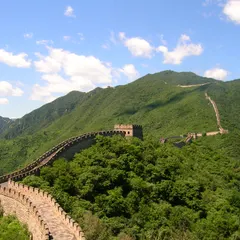
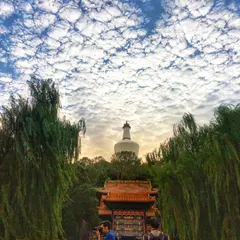
From the summit can be seen to the south the Forbidden City, whose moat gave the earth for the hill, and to the northwest the White Dagoba of Beihai Park. The dynasty that raised the hill had armoured the capital on the north with wall sections such as the Mutianyu Great Wall.
A mountain taken from the moat
Qiwang Pavilion (绮望楼)
Summary of this stop
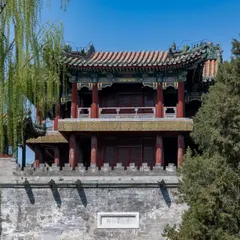
At the foot of the south slope, facing the entrance gate, stands the Qiwang Lou, a two-storey building with double eaves of yellow tiles and a broad front terrace, which was the Confucian temple of the Jingshan school. Behind it the climb begins, and with it the first surprise of the place: everything underfoot was brought here.
Around 1420, during the Yongle reign, the earth dug for the Forbidden City’s moat, the Tongzi He, and for the Taiye and Nanhai lakes was heaped on the old Yuan mound, together with the rubble of the demolished Yuan palace. Everything was moved by hand and with animals until a five-peaked hill was raised. Its first name, Wansui Shan, lasted until 1655, when Shunzhi renamed it Jingshan; the nickname Coal Hill survived both.
The hill remained tied to the palace well into the twentieth century. In 1924 Feng Yuxiang’s troops occupied it and placed cannon on it to force Puyi out of the Forbidden City. In 1928 Jingshan opened as a public park under the Palace Museum, and that same year the new Jingshan street, laid out north of the moat, separated it for ever from the palace it had served. In front of the Qiwang Lou, the audio guide’s narration begins with the moat the visitor has just left behind.
Chongzhen’s guilty pagoda tree
Chongzhen Emperor Suicide Site (崇祯自缢处)
Summary of this stop
On the east slope, a pagoda tree enclosed by a railing marks one of the bitterest episodes of Chinese history. On the 19th day of the third lunar month of 1644, with Li Zicheng’s troops already inside Beijing, the Chongzhen emperor left the Forbidden City by the Gate of Divine Might and hanged himself from an old pagoda tree with a twisted trunk on this slope. He was 33 and accompanied only by the eunuch Wang Cheng’en, who died with him. Tradition fixes the place here, although the chronicles of the time do not agree: one speaks of a Shouhuang pavilion that did not yet exist, another of a hat workshop and another of a crabapple tree.
Official Ming history preserves, as a documented tradition, the message the emperor left written on the lapel of his robe: he blamed himself for having drawn down the wrath of Heaven, accused his ministers of having deceived him and asked the rebels to vent their fury on his body but not harm a single inhabitant. The body was not found until three days later.
What came afterwards turned the tree into a character. The Qing declared it guilty, called it zuihuai, “the guilty pagoda tree”, chained it with iron and made princes and officials dismount and pass before it on foot; the chain was taken away in 1900 by troops of the Eight-Nation Alliance. In 1966 the Red Guards tore off bark and branches as souvenirs, the tree died and was felled in 1971. In 1981 a sapling from the south slope was planted in its place, and in 1996 it was replaced by a pagoda tree more than 150 years old transplanted from No. 7 Beishuncheng street: the one seen today is not that of 1644. Even the sign has changed: around 2011 it went from “place where he hanged himself” to “place where he died for his country”, and in 2015 the park itself announced a return to the old name. Beside the tree, the audio guide reconstructs the emperor’s last hours and what he left written on his robe.
Two steles that were a cover and a table
1931 and 1944 steles beside the pagoda tree
Summary of this stop
To one side of the pagoda tree stand two stone steles that have survived humiliating uses. The first, with the inscription 明思宗殉国处, “place where the Ming emperor Sizong died for his country”, was calligraphed by Shen Yinmo for the Palace Museum and is known as the stele of 1931: it was removed in 1944, split in two in 1955 and used as a well cover until it reappeared in 1990. The second, the tercentenary one, of 1944, was knocked down in 1955, turned into a stone table during the Cultural Revolution and restored on 7 May 2004, the 19th day of the third month of the jiashen year.
A disputed reading circulates about the first: the character “Ming” that opens the inscription carries on its left not the sun sign (日) but the eye sign (目), and according to that version Shen Yinmo changed the stroke on purpose, as a gesture of contempt and resistance toward the Japan that was then pressing on northern China.
The second holds a better documented episode. In 1944, the jiashen year and the tercentenary of the Ming fall, a committee of Beijing notables wanted to hold a great tribute to Chongzhen on the hill. Wang Kemin, chairman of the Japanese-controlled North China Political Council, indicated that the event be postponed and the ceremony was not held; even so the stele was raised, with a text of almost a thousand characters by the bibliophile and former Minister of Education Fu Zengxiang which, in praising an emperor who preferred to die rather than flee, veiledly urged resistance to the invader. That same year Guo Moruo published in Yan’an his essay on the jiashen tercentenary, which Mao Zedong took as a historical lesson. In front of the two stones, the narration unravels how praise for a dead emperor became a message for the living.
The axis of Beijing beneath the Wanchun Ting
Wanchun Pavilion (万春亭)
Summary of this stop
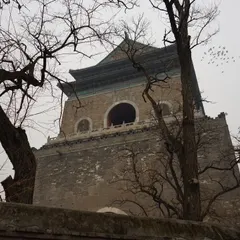
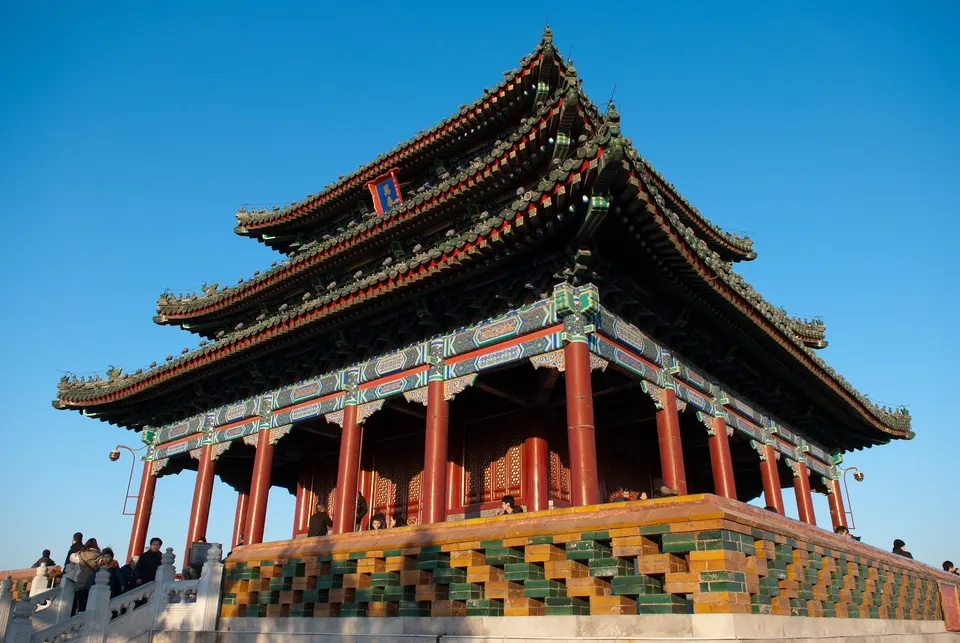
On the highest peak, right on the central axis of the old city, rises the Wanchun Ting, a square pavilion with three eaves of yellow tiles edged in green. From its terrace the architecture of Jingshan Park makes sense: to the south, the yellow roofs of the Forbidden City follow one another in line, with the Gate of Divine Might and the moat right in front; to the north, the axis continues with Shouhuang Hall and, farther off, the Drum and Bell Towers; to the west appears the white dagoba of Beihai Park.
The reason for this mountain lies in that view. The hill occupies the position of the Xuanwu, the Dark Warrior who guards the north among the four celestial animals: the imperial palace needed a mountain at its back and, since Beijing had none, one was built. The five pavilions on the ridge were raised in 1750, under Qianlong, on the foundations of Ming pavilions; from east to west they are Zhoushang, Guanmiao, Wanchun, Jifang and Fulan, two round ones with peacock-blue tiles at the ends and two octagonal ones with green tiles beside the central one. Each housed one of the five Buddhas of the five directions.
Today the four side ones are empty. In 1900 Japanese, French and Russian soldiers of the Eight-Nation Alliance looted the hill, took four of the five images and burned the Jifang pavilion. The gold-lacquered wooden Vairocana of the Wanchun lost an arm to sabre blows that year and was destroyed during the Cultural Revolution: the great seated figure that occupies the pavilion today dates from 1998. On the terrace, the audio guide runs along the axis of Beijing from south to north, building by building.
Portraits, ashes and a children’s palace
Shouhuang Hall (寿皇殿)
Summary of this stop
On the descent down the north slope appear rectangular granite blocks with the underside shaped like a saddle: they covered the underground irrigation channel used in the Yuan, Ming and Qing periods. At the foot, on the same axis, lies the Shouhuang Hall complex, with its pailou arches, a three-passage gate guarded by stone lions and a great nine-bay hall with a double-eaved roof.
The original hall stood on the northeast skirt of the hill, and there in 1661 rested for a hundred days the coffin of the Shunzhi emperor, cremated before the hall with the fire lit by the monk Maoxi Xingsen; the ashes remained there until 1663. In 1749 Qianlong demolished that small three-bay Ming hall and rebuilt it in a single season, from spring to winter, just behind the hill and on the north-south axis: a complex of 21,256 m² where the portraits of the deceased emperors were venerated.
On 23 October 1900 the naval officer and writer Pierre Loti pushed open its heavy doors looking for lodgings for General Henri Nicolas Frey; French troops made it their headquarters and emptied it of its imperial portraits and seals, part of which Frey donated to the French state between 1925 and 1934. From 1955 to 2013 the complex was the Beijing Children’s Palace, with the great hall turned into an auditorium with a stage and a screening room. After years of restoration, with golden bricks fired using rice husk, it reopened in 2018. At its gate, the audio guide’s last stop closes the full circuit of the hill, from ancestor worship to World Heritage.