Qing princely residence
Prince Gong's Mansion Audio Guide (Gongwangfu)
The largest Qing princely residence left in Beijing was built by the richest man in the empire and inherited by the prince who negotiated with the West: beside Shichahai lake, a single house gathers the fall of a favourite, a treasure sold off cheap and a character for fortune written by an emperor.
- 75 min of audio
- Qing architecture
Around 1777, in the time of the Qianlong emperor, his favourite Heshen built on the west shore of Qianhai lake his private residence, the Hedi or He mansion; from 1780 the residence of the tenth princess, Hexiao, the emperor's youngest daughter, betrothed to Heshen's son, was added to it. In 1799 the Jiaqing emperor ordered him to commit suicide and confiscated more than 800 million taels of silver from him. Half a century later the house passed to Yixin, Prince Gong, and from him took the name Gongwangfu. Its architecture gathers ceremonial courtyards, nanmu halls, a 156-metre building with windows of different silhouettes and a walled garden of rocks, ponds and pavilions.
The contrast lies in what came afterwards. In 1912 a grandson of Prince Gong sold almost the whole collection to a Japanese antiques dealer and in 1913 536 pieces were auctioned in New York; in 1921 the house was mortgaged to the Church. From 1950 it was occupied by academies, offices, a factory installed in the theatre and 121 families, and the last occupant did not agree to leave until the night of 31 December 2002, after negotiating until eleven.
Highlights
- Xijin Zhai — Nanmu partitions identified with the hall that figured among the charges against Heshen
- Houzhao Lou — 156 m, 108 rooms and high windows shaped like a pomegranate, a fish or a bat
- Western Gate — White marble arch imitating the European gateways of the Yuanmingyuan
- 福 stele — The character for fortune in Kangxi's hand, set into the Miyun Dong grotto
- Grand Theatre — Enclosed opera hall of 685 m², about 200 seats and painted wisteria
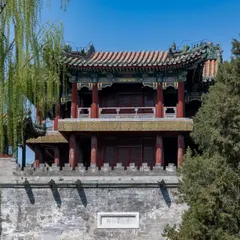
Beside Shichahai lake, in the Beijing of the hutongs, stretches Prince Gong’s Mansion (恭王府, Gongwangfu), the largest princely residence of the Qing dynasty preserved in the city. Behind its gateway follow the ceremonial courtyards, the nanmu halls, a 156-metre building that serves as a wall between the house and the garden and, at the back, the walled garden of rocks, ponds and pavilions, the Cuijin Yuan. Few houses in Beijing condense so much: in it the history of the Qing can be followed from the luxury of their height to the cheaply sold inheritance of their end.
The history of Prince Gong’s Mansion begins with Heshen, the Qianlong emperor’s favourite, who built his private residence here, the Hedi or “He mansion”. Sources do not agree on the date: some give 1777, others place the works between 1776 and 1785, and another ties it to the 1780 order to build here the residence of the tenth princess, Hexiao, finished in 1788, and describes the whole as a princess’s mansion extended over Heshen’s house. In 1799, with Qianlong dead, the Jiaqing emperor brought the favourite down and confiscated goods worth more than 800 million taels of silver. The house passed to Yonglin, Qianlong’s last son, and in 1850 was assigned to Yixin, Prince Gong, the court’s negotiator with the foreign powers, who gave it the name it keeps. A Qing-era literary tradition placed the garden of “Dream of the Red Chamber” in Shichahai, and the scholar Zhou Ruchang proposed that Cao Xueqin’s family house stood here before Heshen: a disputed hypothesis, without documentary proof.
The twentieth century emptied the house. Besides the great sale of 1912, the prince’s grandsons gradually parted with its treasures: around 1935 the painter Puru had sold the “Zhaoye bai”, Han Gan’s Tang-era portrait of a horse, which left China and is today in the Metropolitan Museum in New York; and in late 1937, after his mother’s death, he put up for sale Lu Ji’s “Pingfu tie”, the oldest surviving calligraphic text by a known author in China. It was bought by the collector Zhang Boju, who donated it to the Palace Museum in 1956. To know what to see in Prince Gong’s Mansion and to read its architecture, from the golden studs of the gateway to the garden’s opera theatre, the audio guide follows the complex in six stops and 75 minutes of narration, with the thread of a house whose most lasting fortune ended up being a character written in stone.
In the same district of lakes and hutongs, the Drum and Bell Towers marked the hour of the capital. Another prince’s mansion, that of the future Yongzheng emperor, ended up turned into the Lama Temple, and the court that Prince Gong served rebuilt with Cixi the Summer Palace.
Nine by seven golden studs
Main gate Yigong Men
Summary of this stop
The main gateway, the Yigong Men, is a three-passage portal guarded by two stone lions. Its red doors carry golden studs in rows of nine by seven, the grid reserved for first-rank princes: before crossing the threshold, the door itself announces the rank of whoever lived inside.
The name read today is that of Prince Gong, but the house is older. Yixin, sixth son of the Daoguang emperor and half-brother of the Xianfeng emperor, received it in 1850 and moved into it in 1852, the second year of the Xianfeng reign; some sources give 1851 and another attributes the gift to Cixi in the Tongzhi era, which did not begin until 1862. Before him, the owner had been Heshen, who in 1780 received the imperial order to build here the residence of the tenth princess, Hexiao, Qianlong’s youngest daughter, betrothed to his son. The works were basically finished in 1788, and after Heshen’s fall the princess went on living in the eastern half of the estate.
Behind the grid of studs there beats, therefore, the ambition of a favourite who married into the imperial family. In front of the gateway, the audio guide tells how that wedding led Heshen to build a house fit for a princess.
The nanmu hall that condemned Heshen
Nanmu partitions of the Xijin Zhai
Summary of this stop
On the west axis of the residence, the Xijin Zhai keeps partitions and shelves carved in nanmu wood in the style of the Ningshou palace in the Forbidden City. That luxury, reserved for the emperor, figured as the thirteenth of the twenty charges brought against Heshen in 1799: having a nanmu hall whose shelves and partitions copied those of the imperial palace. Several sources identify this hall with that one; another places it in the Jiale Tang of the central axis, whose plaque is attributed to Qianlong without a signature or seal to prove it.
The fall was swift. With Qianlong dead, the Jiaqing emperor accused Heshen of corruption, ordered him to commit suicide on 22 February 1799 and confiscated goods valued at more than 800 million taels of silver, about fifteen years of state revenue. That same year the house passed to Yonglin, the seventeenth and last son of Qianlong, with the title of Prince Qing.
Among the carved partitions, wood stops being decoration and becomes evidence for the prosecution. In front of the Xijin Zhai, the audio guide reconstructs how the richest favourite in the empire ended up condemned over a hall.
Ninety-nine and a half empty rooms
Houzhao Lou
Summary of this stop
The Houzhao Lou separates the residence from the garden: a grey two-storey building of 156 metres, the longest of Beijing’s princely mansions (other sources give 160 or 165 m), with 88 windows on the rear façade and 108 rooms, although it is known as “the 99 and a half rooms”. From the garden side the upper-floor windows can be seen, each with a different silhouette: round, pomegranate, fish, bat, book scroll. The legend that makes it Heshen’s “treasure tower”, with each window indicating what the room behind held, has no documentary basis.
More popular is the game of the bats. In Chinese, “bat” sounds like “fortune”, and it is said that 9,999 are hidden in the mansion among carvings, paintings and ornaments. In the window called “Fuqing youyu” a great bat hangs head down with a frame in its mouth shaped like a qing, the musical stone whose name sounds like “celebration”; in other ornaments, five bats surround a peach of longevity. Hence the house’s nickname: the garden of ten thousand fortunes.
The irony is that fortune did not hold on to what was inside. In 1912 Puwei, a grandson of Prince Gong, sold the Japanese antiques dealer Yamanaka Sadajirō almost the whole collection of bronzes, jades and porcelains to finance the Qing restoration, and the New York auction of 1913 sold the 536 pieces of the catalogue for 280,435 dollars. In 1921 he mortgaged the residence to the Catholic church of Xishiku for 80,000 silver dollars, and in 1932 the Fu Jen Catholic University took the property by settling the debt with 108 gold ingots; other versions speak of a mortgage to the Benedictines or a purchase in 1937. The mansion was a university seat until 1951. Beneath the windows, the audio guide follows the trail of that scattered collection.
A European gate for the Sixth Foreign Devil
Western Gate Xiyang Men
Summary of this stop
On the central axis of the garden, the Western Gate, the Xiyang Men, is a rococo-style white marble arch: the only Western-style building in the garden. It imitates the European gateways of the Yuanmingyuan, the imperial palace burned by Anglo-French troops, and carries two mottoes engraved, “Jing han tai gu” outside and “Xiu yi heng chun” inside.
The gate holds the contradiction of its owner. Yixin, Prince Gong, negotiated in 1860 the Convention of Beijing with the British, French and Russians, pushed for the creation of the Zongli Yamen, China’s first foreign affairs office, and in 1861 allied with Cixi in the Xinyou coup. His openness to the West earned him among conservatives the nickname Guizi Liu, “the Sixth Foreign Devil”. He died in 1898.
A prince who had to strike deals with the very armies that burned his family’s palace had one of that palace’s gateways copied at the entrance to his garden. In front of the arch, the audio guide tells what that gate means in the house of the Sixth Foreign Devil.
The ten-thousandth fortune beneath the rock
福 stele in the Miyun Dong grotto
Summary of this stop
Past the gate, the Dule Feng, a Taihu rock of about five metres, serves as a screen facing the entrance; behind it opens the Fu Chi, the bat-shaped pond. At the centre of the garden rises the Dicui Yan rockwork, crowned by the Yaoyue Tai, the terrace for inviting the moon, the highest point of the complex. Inside its grotto, the Miyun Dong, is set a stele 1.29 m long and 54 cm wide with the character 福, “fortune”, about 59 by 33 cm, sealed with the seal “Kangxi yubi zhi bao”. Most sources attribute it to the calligraphy of the Kangxi emperor; one gives it as Qianlong’s work. It is the most venerated object in the mansion, and visitors touch the character as they pass to attract good luck.
Legend has it that Qianlong gave Heshen this “first longevity fortune under heaven”, and that the favourite had thousands of Taihu rocks piled up until they formed a dragon lying on the city’s “dragon vein”, with the stele hidden in its lair. When Jiaqing’s men confiscated the house in 1799 they wanted to take it away, but removing it would have cut the dragon vein and scattered the luck, so they covered it with stones and rubble. Hidden readings are attributed to the character, “many fields, many sons, much talent and long life”, and according to the account, after it reappeared in 1962, Zhou Enlai dubbed it “the first fortune of China”. The story linking the stele to Empress Xiaozhuang’s illness in 1673, to its disappearance from the palace and to that discovery of 1962 lacks known documentation.
With the stele, according to popular belief, the count of the 9,999 bats is closed: the ten-thousandth fortune would not be a bat but the character written by an emperor. In the grotto, the audio guide explains why nobody dared to wake the rock dragon.
Painted wisteria on a surviving stage
Grand Theatre Da Xilou
Summary of this stop
In the east wing of the garden, the Grand Theatre, the Da Xilou, was built in the Tongzhi era (1862–1874) for the performances of Prince Gong and his guests. It is a completely enclosed opera theatre, of 685 m² under three linked roofs and with about 200 seats: a stage one metre high to the south, a courtyard of tables and armchairs, and columns, walls and ceiling painted with wisteria so that the audience feels it is attending the show beneath a pergola. The voice reaches the whole hall without amplification.
That it still stands is something of a miracle. From 1950 the mansion was occupied by academies, dormitories of the Ministry of Public Security and 121 families, and in the theatre itself a cold-air equipment factory operated until 1984. The eviction, pushed from 1979 on Zhou Enlai’s commission, dragged on for more than two decades: the last occupant agreed to leave on the night of 31 December 2002 after negotiating until eleven. The garden had opened in 1988 and the full residence opened in August 2008 (on the 20th or the 24th, depending on the source). That same month the Jiangsu Kunqu Theatre performed its programme “Floating Dreams” here for a week, and each year, around the second Saturday of June, Cultural and Natural Heritage Day, the hall hosts a season of guqin and kunqu opera.
Spring brings another custom. Puru, a grandson of Prince Gong born in the mansion in 1896, recovered the garden and lived in it from 1924 to 1937; when the crabapples, the haitang, bloomed, he invited old loyalists of the dynasty and men of letters at night to contemplate the flowers and compose poems under palace lanterns, and sometimes he himself would go up on the theatre stage. In the Fu Jen University period, the rector Chen Yuan convened the gathering under the name of the “Haitang Poetry Club” of “Dream of the Red Chamber”, and Chen Yinke, Gu Sui and Yu Jiaxi passed through it. The “Haitang Gathering” resumed in 2011 on Zhou Ruchang’s proposal and is still held: its fourteenth edition took place at the mansion on 31 March 2025, with guqin, kunqu and poems recited beneath the blossoming haitang. The audio guide’s last stop tells, in front of the stage, how a prince without an empire kept on versifying while his world disappeared.