Imperial sanctuary
Temple of Heaven Audio Guide (Tiantan)
The enclosure where the Ming and Qing emperors offered sacrifices to Heaven is laid out like a map of the cosmos, round to the north, square to the south and counted in nines; since 1918 it has been a park where hundreds of neighbours practise tai chi every morning.
- 90 min of audio
- Imperial rites
The Temple of Heaven was founded in 1420, the eighteenth year of the Yongle emperor, as the Altar of Heaven and Earth (Tiandi Tan). In 1530 the Jiajing emperor separated the cults, moved Earth to an altar of its own in the north of Beijing and the enclosure was left dedicated to Heaven alone; some sources push the change of name to 1534. Its wall encloses about 2.73 km², square in the south like the Earth and semicircular in the north like Heaven, on ground that rises from south to north. Along that axis follow the Hall of Prayer for Good Harvests, the Imperial Vault of Heaven and the Circular Mound Altar, which Qianlong enlarged in 1749 (1750 according to another source) with greenish-grey stone and white marble balustrades.
The most photographed hall in the enclosure is not the original: lightning reduced it to ashes in 1889 and the Guangxu emperor read the fire as a warning from Heaven. In 1900 the Eight-Nation Alliance set up its headquarters inside the temple, and in 1914 (1913, according to other sources) a president of the Republic held the last sacrifice to Heaven here. In 1918, the sanctuary where a single man spoke with Heaven opened its doors as a public park.
Highlights
- Hall of Prayer for Good Harvests — 38 m of wood without nails on 28 columns that mark the seasons, months and solar periods
- Danbi Bridge — The raised causeway of the sacred axis and, beneath it, the tunnel the people called the Ghost Gate
- Echo Wall — 193.2 m of circular wall that carries a voice from one side of the courtyard to the other
- Circular Mound Altar — Nine rings of slabs, from 9 to 81, around the Heart of Heaven Stone
- Long Corridor — Neighbours' morning tai chi in the park opened in 1918
Behind a wall that is square to the south and curved to the north stretches the Temple of Heaven (天坛, Tiantan), the great sanctuary where the emperors of the Ming and Qing dynasties offered sacrifices to Heaven. Its roughly 2.73 km² are laid out like a map of the cosmos: Earth square to the south, Heaven round to the north, ground that rises from one end to the other and measurements that return again and again to the number nine. Since 1 January 1918 it has been a park, and every morning it is filled by hundreds of neighbours, mostly retirees, practising tai chi among woods of old cypresses.
The history of the Temple of Heaven begins in 1420, when the Yongle emperor founded here the Altar of Heaven and Earth, where the two were worshipped together. In 1530 the Jiajing emperor built a separate Altar of Earth in the north of Beijing and the enclosure, now for Heaven alone, came to be called Tiantan (the date of the name change varies between 1530 and 1534 depending on the source). That same year the Circular Mound Altar was born for the winter solstice sacrifice, and in 1545 the great round hall with its triple eaves, then called Daxiang Dian, was finished. The Qianlong emperor later left his mark: he enlarged the Circular Mound Altar in 1749 and in 1751 renamed the hall Qiniandian. Then came the lightning of 1889, the headquarters of the Eight-Nation Alliance in 1900 and the last sacrifice to Heaven, held by President Yuan Shikai in 1914 (at the winter solstice of 1913, according to other sources).
Away from the axis, the enclosure holds pieces that tradition surrounds with stories. In front of the main hall of the Palace of Abstinence, where the emperor purified himself and fasted before the sacrifice, a small stone pavilion held a little bronze man one and a half chi tall with an ivory tablet calling for “three days of abstinence”; the custom goes back, it is said, to 1370 and to the founder of the Ming, Zhu Yuanzhang. Whom it represents nobody has settled: the most widespread tradition says Wei Zheng, the counsellor who dared to rebuke the Tang emperor Taizong, and others see in it the eunuch Gang Bing or the court musician Leng Qian. On the lawn east of the Altar of Prayer, the Seven Star Stones are in fact eight: there is talk of fallen stars, of a Taoist counsel to Jiajing to protect the southeast of the great hall and of an eighth stone that Qianlong is said to have added as a message of unity between Manchus and Chinese. And outside the west wall of the Imperial Vault grows the Nine-Dragon Cypress, whose twisted trunk, according to legend, is nine serpents that the Qianlong emperor saw disappear over the wall.
To know what to see in the Temple of Heaven and to understand its architecture, the audio guide follows the sacred axis from north to south in five stops and an hour and a half of narration: from the Long Corridor to the Hall of Prayer for Good Harvests, the Danbi Bridge, the Echo Wall and the Circular Mound Altar, following the thread of an enclosure designed so that a single man could speak with Heaven and occupied today by the voices of anyone.
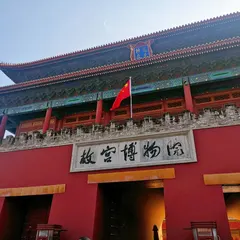
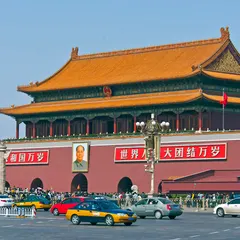
The other pole of imperial power lies about three kilometres to the north: the Forbidden City, where lived the emperors who came here to speak with Heaven, behind the gate of Tiananmen Square.
Tai chi in the courtyard of the Son of Heaven
Long Corridor (Changlang)
Summary of this stop
The Long Corridor is a covered walkway of painted beams in the northern part of the enclosure, and at first light it works as the neighbourhood’s meeting point. Every morning hundreds of people, mostly retirees over 60, practise tai chi in the park. One of the groups, Ye Guirong’s “Cypress Grove”, gathers about 30 people at 7:40 for an hour and a half of Yang style.
The scene has something of a paradox. This enclosure was founded by the Yongle emperor in 1420 as the Altar of Heaven and Earth, a closed space where the sovereign worshipped Heaven and Earth together. The opening had a date and an author: in May 1914 the Minister of the Interior Zhu Qiqian proposed opening Beijing’s imperial grounds to the public and put the Temple of Heaven first on the list. On 1 January 1918 it opened as a park.
Beside the corridor, the audio guide tells how a sanctuary reserved for a single man became the neighbours’ morning courtyard.
A wooden calendar born of lightning
Hall of Prayer for Good Harvests (祈年殿)
Summary of this stop
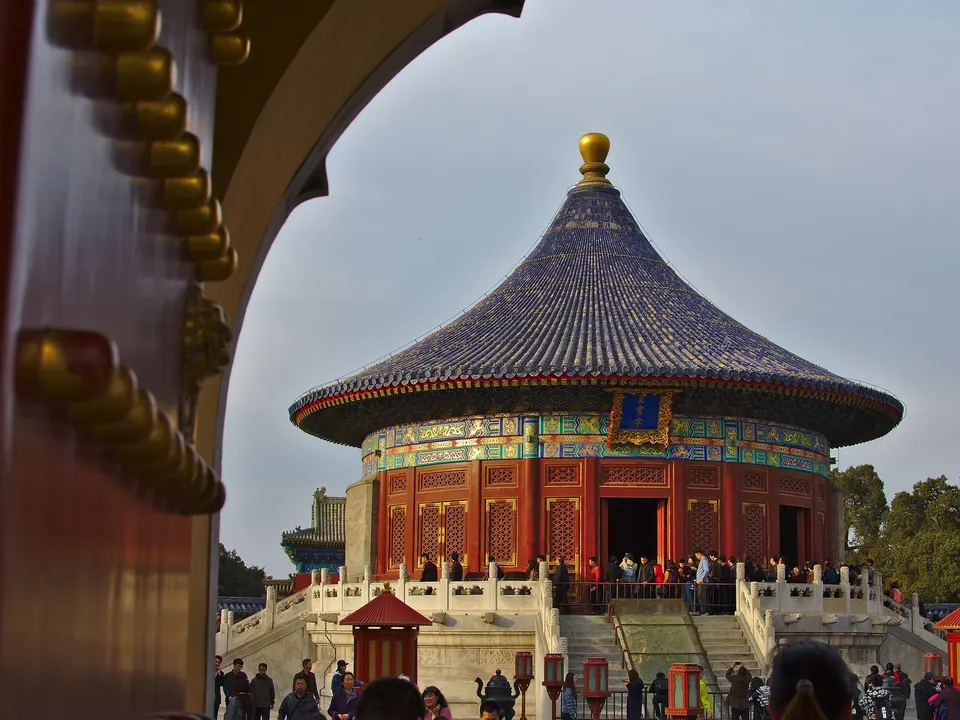
From the south gate, the Hall of Prayer for Good Harvests rises on a three-tiered white marble terrace with balustrades: a circular building about 38 metres high, made of wood without nails, with a triple roof of blue tiles and a golden finial. Through the door appear the red columns with gold decoration that hold it up, 28 in all, and each group has a meaning. The four central ones, called the “dragon wells”, are 19.2 metres tall and 1.2 in diameter and stand for the four seasons; the 12 of the middle ring, the months; and the 24 of the two rings, the solar periods of the year. The diameter of the hall, by contrast, varies widely depending on the source consulted.
The roofs tell their own story. When it was finished in 1545 under the name Daxiang Dian, the hall had blue tiles above, yellow in the middle and green below; Qianlong renamed it Qiniandian in 1751 and in 1752 the three eaves changed to the blue of Heaven.
But the hall seen today is another one. On 5 September 1889 lightning set it on fire and reduced it to ashes while soldiers and the city’s firemen fought the flames. The Guangxu emperor issued a decree in which he took the fire as a “solemn warning” from Heaven; two officials of the Court of Sacrificial Worship were accused of negligence, and the American minister in Beijing, Charles Denby, sent the decree to Washington explaining that there misfortunes were read as a sign of the sovereign’s guilt. Reconstruction began the following year and is usually presented as a faithful copy, although the newspaper Beijing Wanbao points to materials and technique inferior to those of Qianlong’s time and somewhat different proportions. In front of the door, the narration reconstructs that night of fire and what the emperor read in it.
The emperor above, the Ghost Gate below
Danbi Bridge (丹陛桥)
Summary of this stop
The Danbi Bridge is a long raised stone causeway, flanked by cypresses, that links the Hall of Prayer to the north with the Imperial Vault and the Circular Mound Altar to the south. From its midpoint the whole plan can be understood: the enclosure, of about 2.73 km², has its wall square on the south side, representing Earth, and semicircular on the north, representing Heaven, and the ground rises from south to north so gently it is hardly noticed.
Beneath the solemn avenue a vaulted tunnel runs from east to west. According to popular tradition, before the great ceremonies the animals destined for sacrifice were led through that passage to the Pavilion of Slaughter (Zaishengting), where they were put to death. As none came out alive, the people nicknamed the tunnel “Guimenguan”, the Ghost Gate, the name of the threshold of the underworld in Chinese tradition.
The sacred axis also knew foreign armies. In 1900, during the Boxer crisis, British and American troops of the Eight-Nation Alliance entered Beijing through the Yongdingmen gate and the alliance set up its headquarters inside the Temple of Heaven. In 1994 the chief of staff of the Indian Army, General Joshi, returned to China a 26-centimetre Ming chime bell of gilded bronze that had reached India as booty; the temple itself now keeps it. On the bridge, the audio guide tells what happened above and below this causeway.
A wall that whispers and a telephone slab
Imperial Vault of Heaven (皇穹宇)
Summary of this stop
The Imperial Vault of Heaven is a small circular building with a single blue eave on a marble base, held up by 16 columns in two rings. Around it runs the Echo Wall, a circular wall of polished brick 3.72 metres high, 61.5 in diameter and 193.2 in circumference. Whoever speaks with their mouth close to the wall is heard at a distant point on the other side of the courtyard, which is why the place works as an instrument that anyone can play.
The path in front of the Vault is paved with eighteen slabs. The first three, counted from north to south, are the Echo Stones, called the stone of Heaven, of Earth and of Man. The eighteenth, at the south end, kept its secret until 1995: during acoustic tests in the park with Heilongjiang University, intended to check Tang Dingyuan’s explanations, technicians and professors discovered that from that slab one can clearly hear whoever speaks in the northeast or northwest corner, behind the side halls. It is about 36 metres in a straight line and about 50 following the wall, yet the voice arrives as if it sounded from about 7. Since then it has been known as the Dialogue Stone (Duihuashi).
In the courtyard, the narration explains what the wall does to the voice and where exactly that slab nobody suspected lies.
The altar of nine rings
Circular Mound Altar (圜丘坛)
Summary of this stop
The Circular Mound Altar is an open-air altar of three stone terraces with white marble balustrades and staircases of nine steps on all four sides. It began in 1530, the year the Jiajing emperor separated the cults and the enclosure was left for Heaven alone, as the stage of the imperial sacrifice at the winter solstice. Under the Ming it was a three-tier altar faced with blue glazed ceramic; Qianlong enlarged it in 1749 (1750, according to another source) and swapped the glazing for greenish-grey “mugwort leaf” stone, the look it has today.
At the centre of the upper terrace lies the Heart of Heaven Stone, 80 centimetres across, surrounded by nine rings of slabs: 9 in the first, 18 in the second and so on up to 81 in the ninth, 406 pieces in all. The nine, repeated in the steps and in the rings, orders the whole altar.
Here too the temple’s ritual history came to a close. In 1914, two years after the abdication of the last emperor, the President of the Republic Yuan Shikai held a sacrifice to Heaven here in Ming rite on his way to proclaiming himself emperor: it was the last ceremony of its kind in the temple, although some source moves it earlier to the winter solstice of 1913. Soon afterwards the enclosure would become everyone’s. On the central stone, the audio guide closes the route with that last sacrifice.