UNESCO heritage
Summer Palace Audio Guide (Yiheyuan)
A hand-dug lake whose earth raised a hill, a garden burned in 1860 and rebuilt for Cixi with funds collected in the name of the fleet, and a stone boat that has never sailed: the last great imperial garden of Beijing.
- 120 min of audio
- Imperial garden
The Summer Palace began in 1750, when the Qianlong emperor, for his mother's sixtieth birthday, ordered the old West Lake widened and the excavated earth heaped on a neighbouring hill. The result covers about 2.9 km², three quarters of it water: Kunming Lake, of 2.2 km² and entirely artificial, and Longevity Hill, about 60 metres high, with the Tower of Buddhist Incense on its south slope and the 728-metre Long Corridor at its foot. Since 1998 it has been a World Heritage Site.
Behind the postcard lies a harsh story. British and French troops burned it in 1860; between 1884 and 1895 it was rebuilt for the dowager empress Cixi with money collected in the name of the Beiyang fleet, and ten years after receiving the name Yiheyuan it served as a prison for the Guangxu emperor. On its west shore a stone boat dressed as a Western steamer is still stranded, finished a year before the naval defeat of 1894 against Japan.
Highlights
- Kunming Lake — 2.2 km² dug by hand and a hill of about 60 metres made from its earth
- Tower of Buddhist Incense — Three octagonal storeys on a 20-metre stone base
- Long Corridor — 728 metres of walkway and more than 14,000 paintings on its beams
- Seventeen-Arch Bridge — 150 metres and the winter solstice light between its arches
- Marble Boat — A 36-metre hull with paddle wheels that has never sailed
At the Summer Palace (颐和园, Yiheyuan), almost nothing is natural. Three quarters of its roughly 2.9 km² is water, and that water fills Kunming Lake, of 2.2 km² and dug entirely by hand; with the earth that came out of it grew Longevity Hill, about 60 metres high. It is the last great imperial garden of Beijing, a World Heritage Site since 1998, and today receives some 10 million visitors a year.
The history of the Summer Palace begins in 1750. To prepare his mother’s sixtieth birthday, the dowager empress Chongqing, the Qianlong emperor ordered the old West Lake widened, renamed it Kunming in memory of the pond where the Han emperor Wu trained his navy, and heaped the excavated earth on Jar Hill (Wengshan), which came to be called Longevity Hill (Wanshou Shan). In 1860, during the Second Opium War, British and French troops burned the garden, which was then called Qingyiyuan, the “Garden of Clear Ripples”. Between 1884 and 1895 Prince Chun (Yixuan) rebuilt it for the dowager empress Cixi with funds collected in the name of the Beiyang fleet, and in 1888 it received its present name, Yiheyuan, the “Garden of Preserved Harmony”. How much naval money it cost is disputed: there are figures of up to 22 million taels of silver, others of 5 to 6 million and a version according to which only the bank interest on the fund was used, not its capital; nor is there agreement that this spending explains the naval defeat of 1894 against Japan.
The grounds also hold corners off the main route. Behind the hill, along the back lake, Qianlong had Suzhou Street built, a shopping street in the style of that city’s canals, with more than 60 buildings and more than 200 counters; according to documented tradition, the shopkeepers were eunuchs and palace maids who ran a make-believe trade to amuse the emperor and his consorts. Razed twice in the nineteenth century, it was rebuilt on its original plan and reopened in 1990. To know what to see in the Summer Palace and to read its architecture, from the bronze ox on the east shore to the Marble Boat, the audio guide follows the garden in six stops and two hours of narration, following the thread of a landscape manufactured for a court that saw it burn, rebuilt it with a fleet’s money and shut its own emperor inside it.
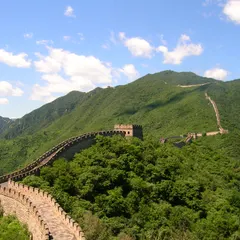
Its excavated lake has an older precedent in the city centre, Beihai Park. The diplomat of that court, Prince Gong, left his home beside Shichahai lake, Prince Gong’s Mansion, and farther north, in the Huairou mountains, the Mutianyu Great Wall is the other great visit outside the centre.
The ox that gazes at the weaver girl
Bronze Ox (铜牛)
Summary of this stop
On the east shore of the lake, beside the Kuoru pavilion, rests a reclining bronze ox, cast in 1755. On its back is engraved the “Inscription of the Golden Ox”, which explains why it was cast. The body points east and the head west, so the animal looks across the water toward the Gengzhitu complex, “Ploughing and Weaving”, on the opposite shore. The reading in circulation, which remains disputed, turns the lake into the Milky Way: on one side the herdsman, on the other the weaver girl, who can only meet on the seventh day of the seventh month. Behind it lies Ban Gu’s old verse on the Han dynasty’s Kunming pond, “on the left the Herdsman, on the right the Weaver Girl, like the River of Heaven without shores”, although Qianlong himself wrote in 1755 that the pair “is no more than an ornament of the landscape”. Popular tradition adds that the ox, chained, struggled so hard to cross that it broke its tail; what can be verified is that the tail broke twice in Republican times and that two repair joints can be seen at its root.
Beside it begins the Seventeen-Arch Bridge, of 1750: 150 metres of stone to Nanhu Island, with hundreds of lions on its parapets. Because of its northwest-southeast orientation, around the winter solstice the setting sun enters through the seventeen arches and lights up their inner walls, the so-called “gold passing through the arches”. The phenomenon does not appear in the historical records, and it remains open whether the builders sought it on purpose or it is a chance effect. Legend also says that the stone closing the largest arch was carved by a shaggy old man whom the stonecutters took for mad, and that the old man was Lu Ban, the patron of carpenters and stonecutters, come down from heaven to help them.
Beside the ox, the audio guide reads the landscape in reverse: the lake and the hill as one great earthwork moved by an emperor for his mother.
The emperor imprisoned by the lake
Hall of Jade Ripples (玉澜堂)
Summary of this stop
The Hall of Jade Ripples (Yulantang) is a courtyard on the lakeshore within the garden rebuilt for Cixi. That reconstruction, paid for with funds collected in the name of the Beiyang fleet, did not stretch to everything: mostly the south slope of the hill, the face looking onto the water, was rebuilt, the lake was walled in and in 1888 the whole received the name Yiheyuan.
Ten years later, the garden changed function. After the 1898 coup that ended the Hundred Days’ Reform, Cixi kept the Guangxu emperor confined here. The back door was bricked up and walls were raised to cut off the passages; those walls are still inside the side pavilions, in plain view. In this courtyard, the narration tells how a pleasure hall beside the lake became an emperor’s cell.
A tower on a demolished pagoda
Tower of Buddhist Incense (佛香阁)
Summary of this stop
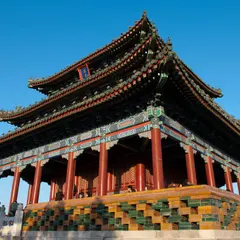
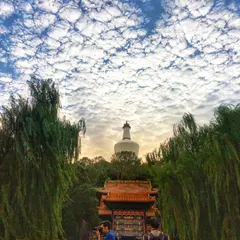
At the centre of the south slope rises the Tower of Buddhist Incense (Foxiang Ge), octagonal, of three storeys and yellow glazed roofs with a green border, on a 20-metre stone base; visible from almost the whole lake. Its height changes with the source: about 40 metres in some, 41 in others and 36.44 above the base in others. From its terrace the whole artifice can be understood, because the hill underfoot, about 60 metres high, was formed from the earth taken out of the lake.
The tower occupies the place of another work that was never finished. There stood the Yanshou Ta, a nine-storey pagoda that Qianlong ordered demolished when it had reached the eighth, to raise in its place a pavilion inspired by the Yellow Crane Tower of Wuchang.
A short way off, on the western part of the hill, the Bronze Pavilion (Baoyun Ge) holds a dark episode. It had 12 bronze doors and 20 bronze windows with 70 lattices in the shape of a water-chestnut flower; after the lootings of 1860 and 1900 10 windows and 31 lattices were missing, and in 1940 the park administration dismantled the remaining 39 to keep them in a storeroom. The windows reappeared in Paris: in 1993 the American businessman Maurice Greenberg, through American International Group, bought the 10 windows with about 20 lattices and returned them free; in 1995 a retired French authentication expert handed over another lattice, and in 2024 one more came back that the collector Li Lei had seen in an auction catalogue in France. According to the curator Wei Lijia, nothing is known of the last nine. On the terrace, the audio guide follows the trail of those pieces.
The headless Buddhas of the summit
Sea of Wisdom Temple (智慧海)
Summary of this stop
At the top of the hill, the Sea of Wisdom Temple (Zhihuihai) is a temple without timber beams, faced with five-colour glazed brick and covered by more than 1,000 Buddhas in relief. On the lower half of the walls many appear headless: their heads were knocked off with chisels during the Cultural Revolution (1966-1976).
Behind it, the north slope shows another wound, an older one. Complexes such as the Xumi Lingjing hall and the Gaichun garden, burned in 1860, were never rebuilt: platforms, stairways and foundations remain, in contrast with the south slope rebuilt for Cixi. Two destructions from two different centuries at a single point; in front of the temple, the narration explains why one face of the hill was rebuilt and the other was not.
Painted beams and a last stroll
Yuzao Xuan pavilion on the Long Corridor
Summary of this stop
The Long Corridor (Changlang) runs 728 metres and 273 sections at the foot of the hill, facing the lake, with four intermediate pavilions. Its beams carry more than 14,000 paintings with scenes of history, fiction and landscape, although the figure swings between more than 8,000 and more than 17,000 depending on what is counted as a painting. The scenes were repainted in 1959 and in 1979; in the restoration begun in 2020, with a 3D digital survey, the master Li Yanzhao painted again, having already worked on the 1979 campaign.
One of the pavilions, the Yuzao Xuan lookout, opens onto the water. From it the scholar Wang Guowei drowned himself in Kunming Lake on 2 June 1927. The cause of his suicide remains unresolved, and the confusion grew from a posthumous memorial forged by Luo Zhenyu. At the lookout, the audio guide puts that grave note to the stroll beneath the painted beams.
A stone boat with paddle wheels
Marble Boat (清晏舫)
Summary of this stop
Stranded on the west shore, the Marble Boat (Qingyan Fang) dates from 1755 and has a hull of large 36-metre blocks. Its Chinese pavilion burned in 1860 and in 1893 was rebuilt in wood painted to imitate marble, with a two-storey Western-style cabin and paddle wheels carved on the sides, under the name “clear river, calm sea”. A boat that does not sail, dressed as a Western steamer a year before the naval defeat against Japan.
The imperial garden afterwards had a very different life. After the abdication the Qing kept it as private property of the imperial family, sold tickets to the public from 1914 and in 1924, with Puyi expelled, it became a municipal park. And every winter, when Kunming Lake freezes, it becomes the largest natural open-air rink in Beijing: in the 2026 season, opened on 17 January, the usable surface was around 160,000 m², with entry piers at Yulantang, the bronze ox, Paiyundian and the West Dike. Besides skating, Beijingers glide on traditional one- or two-seat sleds or on ice bikes, and the wardens measure the thickness of the ice every morning at 8, before opening, and at 14:00, the warmest hour. The audio guide’s last stop closes before the boat the story of a garden that belonged to the court and today belongs to those who stroll in it.