Tibetan Buddhist temple
Lama Temple Audio Guide (Yonghegong)
The mansion where a prince who became emperor lived and where another was born, turned in 1744 into Beijing's great Tibetan Buddhist monastery: yellow palace tiles, a golden urn for choosing reincarnations and an 18-metre sandalwood Maitreya amid the incense smoke.
- 60 min of audio
- Tibetan Buddhism
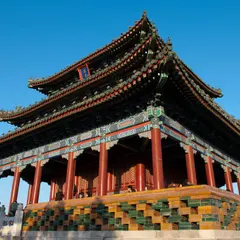
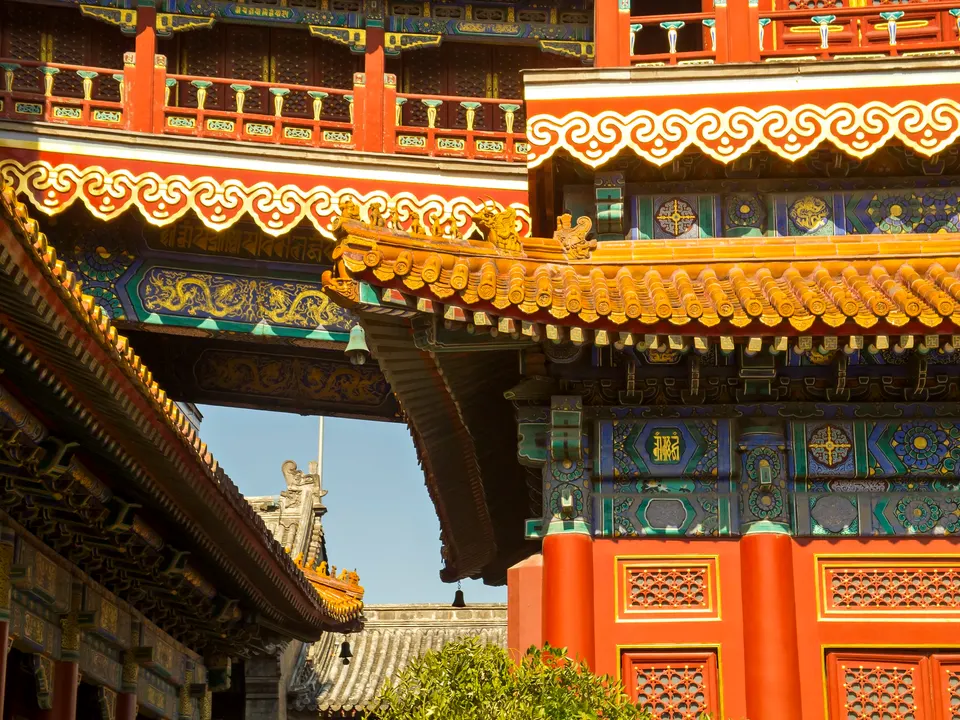
In 1694 the Kangxi emperor ordered built in the northeast of the inner city, on former quarters of the Ming court eunuchs, the residence of his fourth son, Yinzhen, known as the Fourth Lord's mansion. There the future Qianlong emperor was born in 1711 and there Yongzheng's coffin rested from 1735 to 1737. In 1744 Qianlong turned it into a monastery of the Gelug school of Tibetan Buddhism, consecrated in January 1745: an axis of halls with imperial yellow tiles running from south to north and ending at the Wanfuge, the three-storey pavilion of the sandalwood Maitreya.
The contrast lies in what stays alive inside an imperial monument. In the courtyards where the Qing court drew lots for reincarnations, worshippers now advance with the three sticks of incense that the temple hands out free; in 2023 it became the fashionable temple of young Chinese, who ask for luck at work and queue to buy bracelets made from the ash of that same incense. And at the start of the year the lamas still perform the cham, the masked exorcism dance that Beijingers call “beating the ghosts”.
Highlights
- Laba porridge cauldron — The bronze by the drum tower that still serves in the distribution of the twelfth lunar month
- Stele pavilions — The 1792 Discourse on the Lamas in four languages and the story of the golden urn
- Yongyou Hall — Prince Yinzhen's chamber and the place where his coffin rested, in the mansion where Qianlong was born
- Falun Hall — Tsongkhapa, the 1954 pulpits and a rosewood mountain with five hundred arhats
- Wanfuge — An 18-metre standing Maitreya carved from a single white sandalwood trunk
In the northeast of Beijing’s old inner city, three glazed-roof arches open the way to the Lama Temple (雍和宫, Yonghegong), the capital’s great imperial monastery of Tibetan Buddhism. Before it was a temple it was a house: in 1694 the Kangxi emperor ordered built here the residence of his fourth son, Yinzhen, the future Yongzheng emperor, and in 1711 Hongli, who would reign as Qianlong, was born within its walls. The compound was at once the residence of an emperor before he reigned and the birthplace of another, and today it still smokes with incense.
The history of the Lama Temple takes a turn in 1744, when Qianlong turned the palace into a monastery of the Gelug school, under the Tibetan name Ganden Jinchagling, and populated it with five hundred lamas from Tibet, Mongolia and the capital itself. From then on the compound also worked as a tool of government: here was kept one of the two golden urns with which the Qing court drew lots for the reincarnations of great lamas. What happened after 1949 is disputed: one version speaks of decades of closure and of a protection during the Cultural Revolution attributed to Zhou Enlai, while other data, such as the state works of 1950-1952, the sermons of 1954 or the abbots appointed up to 1965, contradict a total closure. Since February 1981 it has once again been an active place of worship.
To know what to see in the Lama Temple and to read its architecture, from a palace with yellow tiles to a monastery with small Tibetan turrets on the roof, the audio guide follows the axis from south to north in six stops and an hour of narration: from the Laba porridge cauldron to the steles in four languages, from the hall where an emperor’s coffin rested to the Mountain of Five Hundred Arhats, up to the 18-metre sandalwood Maitreya. It is the thread of a prince’s house turned into an emperor’s political machine, and of that machine turned, against all odds, into a temple where Beijing still asks for luck.
Before it was a temple it was a prince’s mansion; Prince Gong’s Mansion, beside Shichahai lake, shows a Qing princely residence that never ceased to be one. About two kilometres to the west, the Drum and Bell Towers close the central axis of Beijing.
Concrete columns in the Fourth Lord’s mansion
Imperial road and entrance arches
Summary of this stop
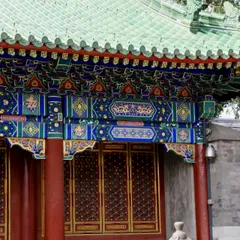
The visit begins in a courtyard closed on the south by a great screen wall, with three pailou, the ceremonial wooden arches with coloured glazed roofs. From them the imperial road, the Niandao, runs straight toward the Zhaotai gate. It is an entrance on the scale of a palace rather than a temple, and it has its explanation: in 1694 the Kangxi emperor ordered built here, on former quarters of the Ming court eunuchs, the residence of his fourth son, Yinzhen. At first it was known as the “Fourth Lord’s mansion”; that prince would end up reigning as Yongzheng.
The arches also keep a twentieth-century loss. Their pillars were of gilded nanmu wood and, during the Japanese occupation of Beijing, they were replaced by concrete columns, which are the ones holding up the coloured roofs today.
From here, moreover, begins a code of gestures that many worshippers repeat at every threshold: among them runs the advice not to cross through the centre door, the “empty gate” (kongmen), because whoever passes through it would make the journey in vain. On the imperial road, the audio guide tells how a prince’s house ended up as an emperor’s political instrument.
Six cauldrons of porridge for all Beijing
Laba porridge cauldron
Summary of this stop
Past the Zhaotai gate, beside the drum tower, appears an enormous bronze vessel shaped like a jar: the Laba porridge cauldron. In the Qing period, the eastern palace of the Yonghegong housed a workshop of great cauldrons devoted to this dish. The fire was lit on the 7th day of the twelfth lunar month, by dawn on the 8th six cauldrons were ready and the sixth was shared out among the people of Beijing. The cauldron is still used in the annual distribution.
Beside the same gate is the stand where the temple hands out eco-friendly incense for free: it does not admit sticks brought from outside and asks that three be offered, not bundles. It is the rule of a place that, after the state works of 1950-1952 and its inclusion in 1961 on the first list of protected national monuments, reopened in February 1981 as an active temple and in 1983 was declared a key Buddhist temple of the country. Today it receives crowds: at the 2026 Chinese New Year it sold 40,000 online tickets a day and organised the visit in one direction, from south to north.
The ash of those sticks has a second life. In 2023 the Yonghegong became the fashionable temple of young Chinese: on 26 February that year tens of thousands of people, many of them university students or newcomers to work, queued to ask for good luck, and the Buddhas of work and fortune drew more prayers than the one of love. The longest queues, however, were at the temple shops, where bracelets made from the ash of the incense burned by worshippers are sold, which people have blessed and wear as an amulet. Beside the cauldron, the audio guide tells the joke that circulates about one of those bracelets.
A golden urn to choose reincarnations
Stele of the Discourse on the Lamas
Summary of this stop
In front of the main halls, two pavilions hold Qianlong’s steles, written in Chinese, Manchu, Mongolian and Tibetan, one language on each face. The one of 1744 marks the conversion of the palace into a monastery of the Gelug school, which housed five hundred lamas under a great lama and four demchi. The other bears the “Discourse on the Lamas” (Lama Shuo), more than 2,100 characters that the emperor wrote in his own hand in 1792. The same four languages recur on the plaques with the temple’s name above the doors.
That same year the court imposed the draw from the golden urn to recognise the reincarnated children of the great lamas. Qianlong had two urns made: one for the Jokhang in Lhasa and another for the Yonghegong, intended for the reincarnations of Mongolia, Qinghai and Gansu. The stone in four languages thus shows the other face of the monastery: an instrument with which an emperor governed Mongols and Tibetans, to the point of drawing lots from an urn for who was a lama’s reincarnation.
In the same courtyard a great bronze incense burner smokes without rest, beside a bronze model of Mount Sumeru, the centre of the Buddhist universe. It is said in Beijing that the burner was cast in Qianlong’s time from Xuande-era incense burners of the Ming dynasty taken from the imperial palace, and that for that reason it counts among the city’s “three wonders”, together with the great jade bowl of Beihai and the Nine-Dragon Wall; it is tradition, not certainty. In front of the stele, the audio guide unpacks what the emperor left written about the lamas.
The coffin that turned the roofs yellow
Yongyou Hall
Summary of this stop
The main hall, the Yonghegong Hall, was the mansion’s reception hall and today houses the Buddhas of the Three Ages and the eighteen arhats. Farther north lies the Yongyou Hall, formerly Prince Yinzhen’s chamber, which now holds Buddhas of long life and medicine. The house also had its domestic side: in 1711, in a room called Ruyi of the Eastern Study Courtyard, Hongli was born, son of Yinzhen and future Qianlong emperor.
When Yongzheng died in 1735, his coffin rested in the Yongyou Hall until 1737. One of the explanations for the yellow glazed tiles of the main halls, the colour reserved for the emperor, points to that wake; another source attributes it to Qianlong, who is said to have replaced turquoise tiles to give the temple imperial rank. Whatever the reason, the yellow of the roofs is the trace that an emperor lived here.
A dark legend is also associated with the prince who lived in these rooms. Tradition says Yinzhen could not bear the shrill of cicadas while meditating or reading and sent some servants to catch them with long bamboo poles smeared with glue, whence would come the name “Sticky Pole Office” (Niangan chu). The legend adds that, in the struggle of Kangxi’s sons for the throne, those cicada catchers became a network of spies with headquarters in the Yonghegong, armed with the xuedizi, a cage able to tear off heads at a distance. There is a trace of the corps of guards with poles; the secret base in the temple is popular tradition and the xuedizi comes from Qing-era novels, not from history. In front of the Yongyou Hall, the audio guide separates history from myth.
Five hundred arhats behind the 1954 pulpits
Mountain of Five Hundred Arhats
Summary of this stop
The Falun Hall, the prince’s former bedroom, is the monastery’s great prayer hall: a cross-shaped plan and five small Tibetan-style pavilions on the roof, representing Mount Sumeru. Inside, in the half-light, rises the bronze statue of Tsongkhapa, whose school is that of the monastery, between two wooden pulpits.
From those pulpits the Dalai Lama and the Panchen Lama preached in 1954, during their stay in Beijing. The line goes back a long way: the monastery was consecrated on 20 January 1745 in a ceremony presided over by the third Changkya, Rolpé Dorje, the lama who had arrived in Beijing in 1724 to be a study companion of Prince Hongli and who directed the conversion of the palace into a temple.
Behind Tsongkhapa, behind protective glass and in dim light, rises the Mountain of Five Hundred Arhats: a rosewood relief almost 5 metres high, 3.5 long and 30 centimetres thick, peopled by five hundred figures of gold, silver, copper, iron and tin. In the hall, the audio guide follows the thread that links an emperor’s study companion with the pulpits of 1954.
An 18-metre Maitreya from a single trunk
Sandalwood Maitreya of the Wanfuge
Summary of this stop
The last building on the axis is also the tallest: the Wanfuge, of three storeys, joined by raised covered walkways to the side pavilions Yongkangge and Yansuige. Inside rises a standing Maitreya 18 metres tall carved from a single white sandalwood trunk. According to the most detailed version of its origin, the Seventh Dalai Lama obtained in Gorkha, in present-day Nepal, in exchange for numerous treasures, a trunk 3 metres in diameter that travelled through Tibet and Sichuan to Beijing, where the craftsmen of the Imperial Household carved it as a figure of 26 metres: 18 above ground and 8 buried.
Other sources present it as a gift from the Dalai Lama brought from Tibet over three years, Guinness gives it as carved in two years and finished in 1750, and the measurements do not agree between one source and another either. The materials of another Wanfuge also reached the temple: in 1748 it was ordered that the pavilion of that name on Jingshan hill be dismantled and its timber, bricks, tiles and stones moved to the Yonghegong, and to take them out a great gate was opened in the north wall of Jingshan.
Maitreya also stars in the temple’s most spectacular ritual, the cham, the masked exorcism dance that the lamas perform at the start of the year and that Beijingers call “dǎ guǐ”, “beating the ghosts”. Under Qianlong it became a great official ceremony. In the old version, a white ghost and a black one cleared the way with sticks and lashes among the audience; the demon made itself visible as a deer that nobody managed to catch until Maitreya, in the guise of the laughing monk Budai, captured it, and a dough effigy burned at the temple gates. By 1916 admission was already charged to see it and after 1924 the Yonghegong remained the only stage of the dance in Beijing. It was interrupted after 1949, revived only once in 1957, returned in 1987 and still gathers tens of thousands of spectators. In front of the Maitreya, the audio guide closes the route with the journey of that trunk to Beijing.