Romanesque
Royal Basilica of San Isidoro Audio Guide (Real Colegiata Basílica de San Isidoro de León)
Beneath an austere stone church lies the Royal Pantheon, a small room with a vault covered in 12th-century frescoes. Its nickname, the “Sistine Chapel of the Romanesque”, sums up the astonishment.
- 40 min of audio
- Romanesque architecture
The Royal Basilica of San Isidoro is one of the great works of Spanish Romanesque. The present complex was raised mostly in the 11th and 12th centuries, tied to the monarchy of the Kingdom of León, and the church is dedicated to Isidore of Seville, whose remains reached León in 1063, in the time of King Ferdinand I and Queen Sancha.
The contrast is that of a sober church outside and a Royal Pantheon painted in vivid colours inside. In that room, at the foot of the church, numerous Leonese kings, queens and infantes lie beneath a vault of exceptional preservation and an agricultural calendar that runs through the twelve months of the year.
Highlights
- Royal Pantheon — a vault with 12th-century Romanesque mural paintings
- Agricultural calendar — the twelve months through the tasks of the countryside
- Chalice of Doña Urraca — a medieval cup of gold and precious stones
- Lamb Gate and Forgiveness Gate — notable Romanesque reliefs
- Stretch of wall beside the church — part of the old enclosure of León
What to see in the Royal Basilica of San Isidoro in León begins with understanding its weight in the history of the kingdom. It is one of the great works of Spanish Romanesque, raised mostly in the 11th and 12th centuries and linked to the Leonese monarchy, and today it holds the title of Royal Collegiate Church and Basilica. It was a cultural and religious centre of the first rank in medieval León, and its place on the Camino de Santiago reinforced its prestige and influence for centuries.
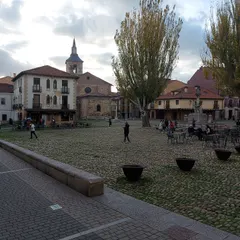
The history of San Isidoro in León is covered in four stops: the portals and the wall, the Royal Pantheon, the agricultural calendar and the treasury. The full experience comes from walking it with the audio guide, which gives at each point the context that a simple glance does not reach. Against the Gothic of Leon Cathedral, it is the other great medieval jewel of the city, and the Plaza del Grano keeps the scale of medieval León.
A basilica of kings
Royal Basilica of San Isidoro
Summary of this stop
The visit starts in front of the portals and a stretch of the old Roman and medieval wall of León, into which the complex is partly integrated. From there the royal origin of the church can be read: a basilica tied to the monarchy of the Kingdom of León, of which the present complex preserves above all the work of the 11th and 12th centuries.
The church is dedicated to Isidore of Seville. His remains were moved to León in 1063, in the time of King Ferdinand I and Queen Sancha, an event that marks the birth of the devotion that gives the basilica its name. That history explains why the architecture of San Isidoro in León, sober stone outside, holds an interior of such importance.
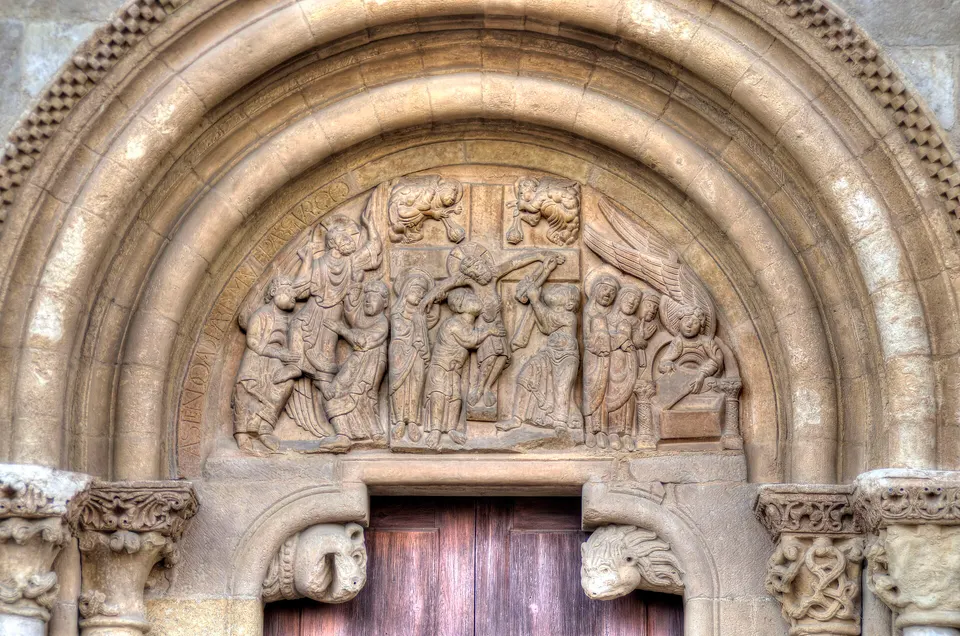
Some of the oldest and most notable Romanesque reliefs of the complex’s portal are found at the Lamb Gate and the Forgiveness Gate. The narration saves for the place itself the details that make this opening more than a façade.
The sky of the Pantheon
Royal Pantheon of San Isidoro
Summary of this stop
The Royal Pantheon is the most famous space of the complex: a room at the foot of the church where numerous Leonese kings, queens and infantes were buried. Its vault is covered in 12th-century Romanesque mural paintings, in vivid colours and of exceptional preservation.
That state of preservation explains the nickname “Sistine Chapel of the Romanesque”. It is a widespread popular label that serves to convey the importance of the paintings; it implies no relationship with the Sistine Chapel in Rome nor any technical equivalence, and only underlines their exceptional value within the Romanesque.
It is also said that in the Pantheon some people lower their voices without meaning to. The room is low and intimate and so covered in paint that many visitors describe it as stepping inside an illuminated book rather than a crypt of kings. The columns with carved capitals that support the room complete a scene that the audio guide goes through unhurriedly.
The twelve months
Agricultural calendar of San Isidoro
Summary of this stop
Among the paintings of the vault, a famous agricultural calendar stands out. It represents the twelve months of the year through the tasks of the countryside and is a unique testimony of medieval life, allowing peasant life of the time to be read month by month.
The stop turns the vault into a kind of painted almanac: each scene links a moment of the year with a specific job. It is an unusual way of approaching the Middle Ages, because attention shifts from the kings buried beneath to those who sustained the kingdom with their work.
The Lamb Gate and the Forgiveness Gate complete this part of the walk with their Romanesque reliefs, among the oldest and most notable of the portal. The narration on site details what to look at and in what order.
The chalice and the mystery
Treasury of San Isidoro
Summary of this stop
The walk ends in the treasury of San Isidoro, which holds exceptional pieces of medieval goldsmithing. The best known is the so-called Chalice of Doña Urraca, a cup set in gold and precious stones.
Around the chalice circulates a disputed story: some popular research has pointed to it as one of the many candidates for the legendary Holy Grail. It is an open matter with no consensus, but seeing the piece is enough to understand why a cup like this kindles that kind of legend and turns a museum display case into a mystery.
To close the visit, the treasury links with the role of the basilica as a major stage of the Camino de Santiago as it passes through León, a context that reinforced its prestige and influence for centuries. The final detail is saved for the narration, in the treasury itself.