Sino-Portuguese old town
Thalang Road
A street of 1850 in Phuket with 151 Sino-Portuguese shophouses, a five-foot walkway, Soi Romanee, China Inn and a Sunday market.
Phuket, Thailand
Explore Phuket with 32 audio stops and researched, fact-checked narration. From Thalang Road to the Big Buddha on Nakkerd Hill, every place explains how tin, the Hokkien community and the island's resistance shaped Phuket.
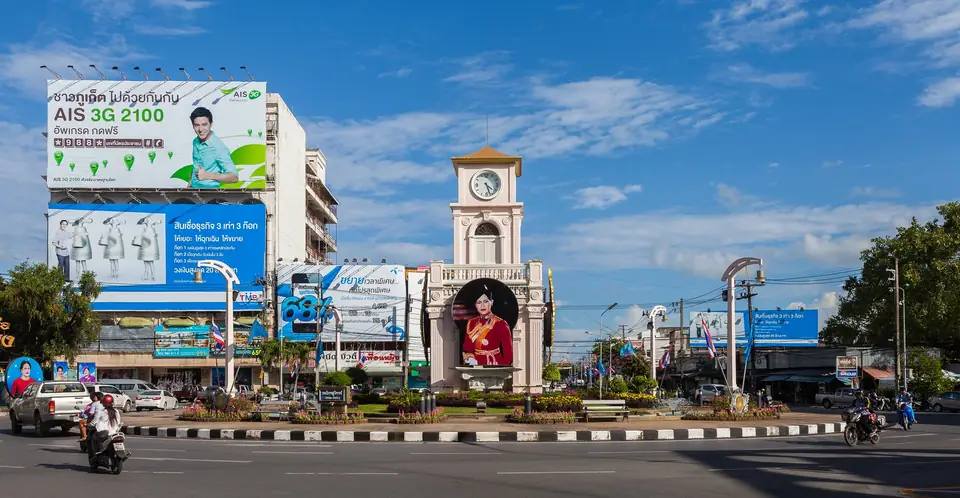
Photo: Diego Delso, CC BY-SA 3.0
Sino-Portuguese old town
A street of 1850 in Phuket with 151 Sino-Portuguese shophouses, a five-foot walkway, Soi Romanee, China Inn and a Sunday market.
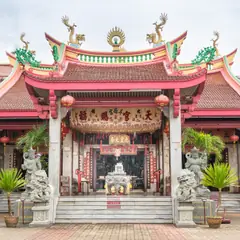
Vegetarian Festival
A Hokkien shrine in Phuket Town born from a fire, with the Go Teng pole, the firecracker tower and the Vegetarian Festival procession of mediums.
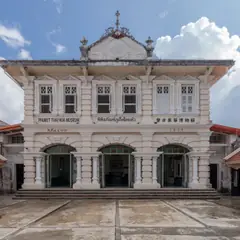
Community museum
A Sino-Portuguese Hokkien school turned community museum: red bat, recreated classroom, tin miners and the Vegetarian Festival.

Hokkien house museum
A Sino-European mansion of 1903 in Phuket, a tin-era house museum with a central pond, furniture in pairs and baba costumes, still lived in by the family.
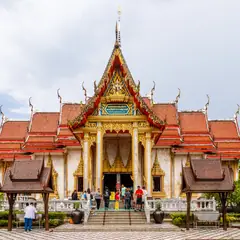
Buddhist temple
What to see at Wat Chalong: Phuket's most visited temple, the story of the revolt of 1876, the abbot gilded in his lifetime and a 60-metre chedi with a Buddha relic.
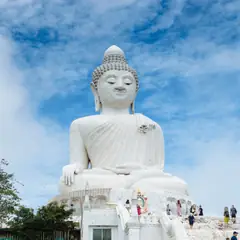
Monumental Buddha
A 45-metre seated Buddha in Burmese marble on Nakkerd Hill, with a naga staircase, views over Chalong and a recent history marked by an 18-month closure.

History of Phuket
A Thalang monument to the sisters Chan and Muk, who defended Phuket from a Burmese fleet in 1786 and whose image is the province's seal.
Phuket Audio Guide
Phuket keeps its history away from the beaches, in the old town and the interior of the island. In Phuket Town, Thalang Road gathers 151 shophouses with five-foot covered walkways, about half of them in Sino-Portuguese style, raised with tin money. Nearby, Jui Tui Shrine, rebuilt after the fire of 1907, launches the longest procession of the Vegetarian Festival every autumn; the Phuket Thai Hua Museum occupies a Hokkien school of 1934 opened as a community museum in 2008, and Chinpracha House, from 1903, is still lived in by the descendants of its builder. To the south, Wat Chalong, the island's largest and most visited temple, owes its fame to the revolt of 1876 and its abbot Chaem, and houses a fragment of a Buddha bone from Sri Lanka in a 60-metre chedi. Further on, the 45-metre Big Buddha, clad in white Burmese marble, overlooks Chalong Bay from Nakkerd Hill; in the north, in Thalang district, the Heroines Monument recalls the defence of the island against the Burmese fleet in 1786.
With the EarGuide Phuket audio guide, every place reveals its history through narration researched and fact-checked against historical sources. Unlike a free walking tour or a conventional guided visit, you set the pace, the order and the stops. No groups, no timetables, no internet connection.
No internet needed
Download the routes before you head out and explore without using data.
Smart geolocation
The narration starts by itself when you reach the point of interest.
Frequently asked questions
The EarGuide app is free. The Phuket audio guide includes 7 independent routes with a little over five hours of narration spread across 7 sites and 32 audio stops, and it is found inside the app itself.
No. EarGuide works entirely offline. Download the routes over WiFi before you set out and you can use the audio guide with no connection and no data use throughout your visit. The map shows your GPS position in real time even without coverage.
The Phuket audio guide is available in Spanish and English, with researched, fact-checked narration on the tin-era old town, the Hokkien community, the island's temples and the defence of Thalang in 1786.
The audio guide brings together 7 independent routes with a little over five hours of narration in total, from 20 to 60 minutes per route. They can be spread over two or three days: one for Thalang Road, Jui Tui Shrine, the Phuket Thai Hua Museum and Chinpracha House, another for Wat Chalong and the Big Buddha, and a third, shorter one for the Heroines Monument.
They are different experiences. The EarGuide audio guide lets you explore Phuket without timetables or groups, pause and resume whenever you like, and replay any explanation as often as you need. It suits independent travellers, families and anyone who prefers to understand the island at their own pace, with no prior knowledge of Thailand.
The Phuket audio guide covers 7 main sites: Thalang Road, Jui Tui Shrine, the Phuket Thai Hua Museum, Chinpracha House, Wat Chalong, the Phuket Big Buddha and the Heroines Monument.
Not all of it. The four sites in the old town (Thalang Road, Jui Tui Shrine, the Phuket Thai Hua Museum and Chinpracha House) are less than 700 metres from one another and can be walked. The rest are far away: Wat Chalong is about 7 kilometres from the old town and the Big Buddha about 3.5 kilometres beyond Wat Chalong, while the Heroines Monument is about 11 kilometres to the north, in Thalang district. For those three places you need a taxi, a scooter or a car.
Yes. Purchases belong to your EarGuide account, not to one app or one phone. A city unlocked in the EarGuide app is also unlocked in that city's own app, and the other way round, on both iPhone and Android. Just sign in with the same account on the other device. The store's “restore purchases” button only covers the app the purchase was made in, so signing in is what carries it across.
The Phuket audio guide is inside the EarGuide app, free and ready to use offline. Carry it in your pocket and explore the island at your own pace.
More destinations

From the chapel of the kings of Siam to the Buddha head trapped in a fig tree and the temple-mountain by the river. The old capital, with audio guides.
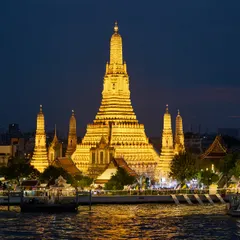
From the Emerald Buddha dressed in gold for each season to the solid gold Buddha hidden beneath stucco. Walk old Bangkok, from Rattanakosin to Chinatown and Thonburi, with audio guides.

From the sacred mountain of Doi Suthep to the market built over the royal cemetery. Explore the old capital of the Lanna kingdom with audio guides.
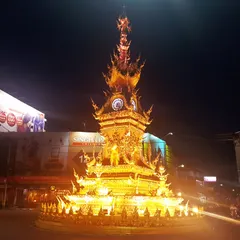
From the white temple a painter rebuilds at his own expense to the bank where Thailand, Myanmar and Laos face one another. Chiang Rai and its artists, with audio guides.

From the steel bridge over the River Kwai to a cemetery of almost seven thousand plaques and a bamboo hut built by an abbot. Kanchanaburi and the Death Railway, with audio guides.

From the limestone towers of Railay to a cemetery of fossil snails and a temple with 1,237 steps. Explore Krabi, its beaches and its Andaman coast, with audio guides.