Contemporary art
MUSAC Audio Guide (Museo de Arte Contemporáneo de Castilla y León)
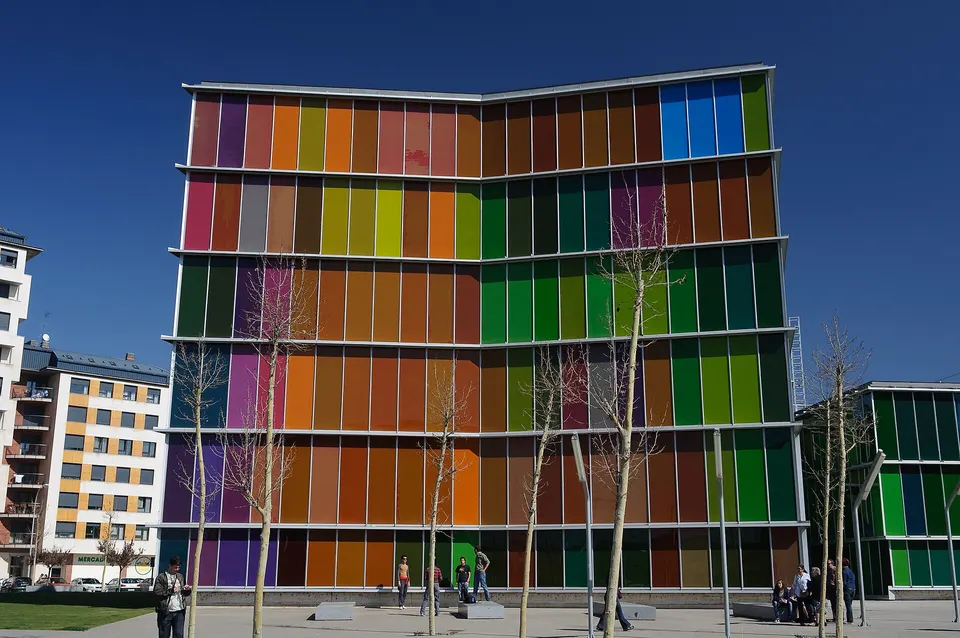
The contemporary art museum of Castilla y León shows a façade of coloured glass that pays homage to the stained glass of the cathedral. An award-winning building in Europe where medieval light is reinterpreted in a present-day key.
- 40 min of audio
- Contemporary architecture
The MUSAC, the Museum of Contemporary Art of Castilla y León, opened in 2005 in the northern expansion of León. It was designed by the studio of Luis Mansilla and Emilio Tuñón, and in 2007 it received the European Union Prize for Contemporary Architecture, the Mies van der Rohe Award, one of the most prestigious architecture awards in Europe.
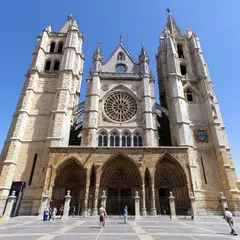
Its most striking feature is the façade: large glass panels whose colour range is inspired by one of the stained-glass windows of León Cathedral, digitised and translated into architecture. More than seven hundred years separate the two buildings, and both speak the language of light passing through coloured glass.
Highlights
- Coloured-glass panel façade inspired by a cathedral stained-glass window
- Mies van der Rohe Award for contemporary architecture of the European Union (2007)
- Open rooms with rhomboid shapes, with no single route
- Rotating temporary exhibitions of current art
- Cultural complex with the Auditorio Ciudad de León, by the same architects
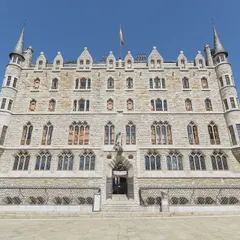
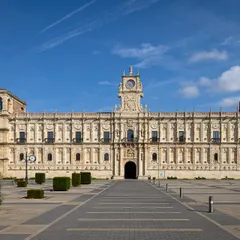
The MUSAC, the Museum of Contemporary Art of Castilla y León, is the contemporary building that best explains what to see in the northern expansion of León. It opened in 2005, the work of the architecture studio of Luis Mansilla and Emilio Tuñón, and in 2007 it won the Mies van der Rohe Award. The history of the MUSAC and its architecture are best understood by walking the place with the audio guide, which links façade, rooms and square in a single thread. On the bank of the Bernesga, from the Plateresque to the contemporary, the Convent of San Marcos offers the historical counterpoint, and Gaudí’s Casa Botines shares with the museum an interest in signature architecture in León.
A stained-glass window of the 21st century
MUSAC
Summary of this stop
In front of the museum rises a façade made of large panels of coloured glass. Its colour range is no accident: it is inspired directly by one of the stained-glass windows of León Cathedral, digitised and translated into architecture. The result is a thoroughly present-day building that looks to the city’s Gothic tradition.
The MUSAC opened in 2005 in the northern expansion and was designed by Luis Mansilla and Emilio Tuñón. In 2007 it received the European Union Prize for Contemporary Architecture, the Mies van der Rohe Award, one of the most prestigious architecture awards in Europe.
Among those who know the building, some recommend seeing it twice: by day, when the colours light up with the sun like the windows of a church, and at night, when the light comes from inside and the façade becomes a lantern of colours for the whole neighbourhood. The most surprising detail of this façade is revealed on listening to the narration right there.
Rooms for today’s art
Rooms of the MUSAC
Summary of this stop
Inside, the museum is organised as a succession of open-plan rooms with rhomboid shapes. There is no single route: the spaces chain together in an open way and are designed to host installations and changing exhibitions.
The collection gathers contemporary art centred above all on work of recent decades, with the aim of showing the most current trends. To this are added rotating temporary exhibitions, so that what is seen in the rooms changes through the year.
The circle of glass
Plaza of the MUSAC
Summary of this stop
The access square connects the museum with the nearby Auditorio Ciudad de León, also the work of Mansilla and Tuñón. Together they form a cultural complex in the north of the city, and from this open space the building can be appreciated as a whole.
With its coloured-glass façade, the MUSAC links, across more than seven hundred years, with the tradition of Gothic stained glass that made the cathedral famous. It is said that the architects took one of those windows, photographed it, extracted its range of colours and turned it into the palette of the façade; in that way, they say, the glass that lit the faithful of the 13th century shone again in an art museum of today. The audio guide saves the close of the walk for this point.