French Gothic
Leon Cathedral Audio Guide (Santa María de León)
The “Pulchra Leonina” traded its walls for almost eighteen hundred square metres of stained glass. Its interior is coloured light held up by a skeleton of stone.
- 45 min of audio
- Gothic architecture
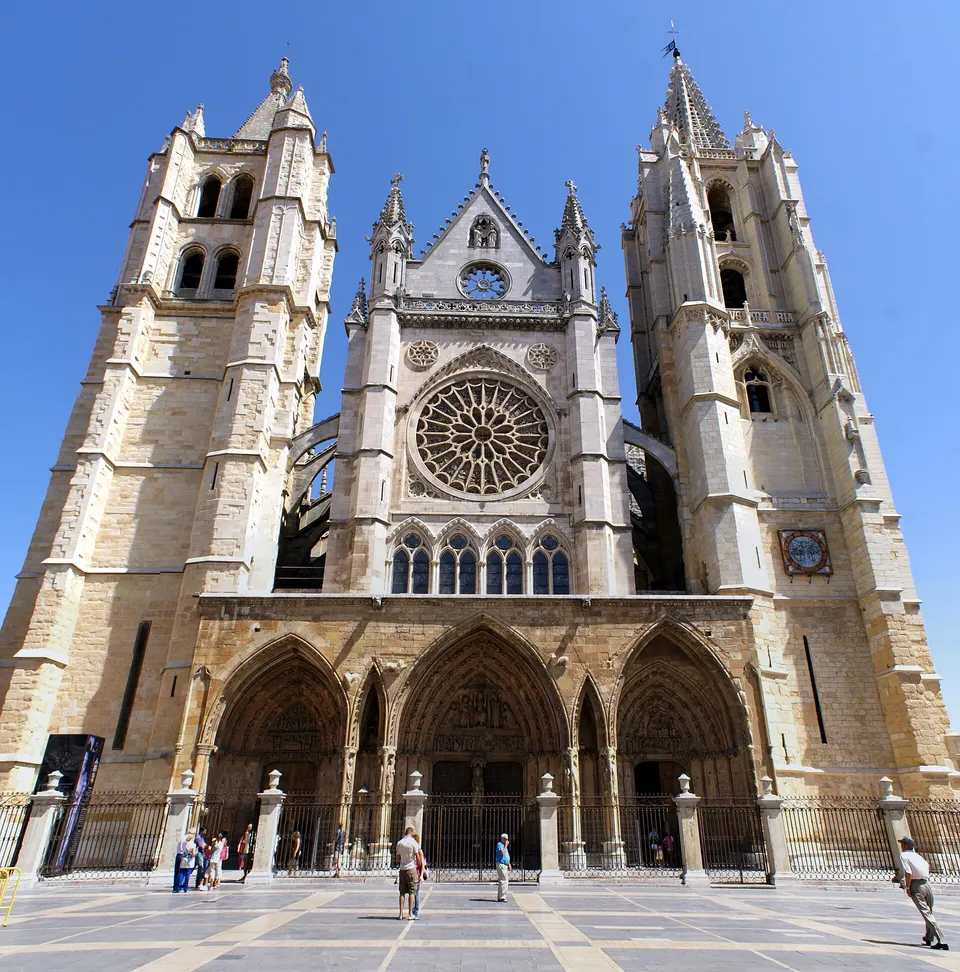
The Gothic cathedral of León, dedicated to Saint Mary, began to rise around the middle of the 13th century, about 1255, following the models of classic French Gothic. It is known as the “Pulchra Leonina”, the Beautiful Leonese, for the elegance and harmony of its architecture. It has been a National Monument since 1844, one of the first monuments to be recognised as such in Spain.
Its most famous feature is the set of stained-glass windows: about 1,800 square metres of glass spread across some 130 windows and rose windows. To open so much space to the light, the walls were reduced to a minimum and the weight passed to exterior buttresses and flying buttresses, so that the stone works almost like a skeleton that only holds up the glass.
Highlights
- Stained glass — about 1,800 m² of glass across some 130 windows and rose windows
- West façade — three Gothic portals and the Virgen Blanca
- Rose windows — the great western rose and those of the transept
- Flying buttresses and buttresses — the stone skeleton that frees the walls
- Stained glass from the 13th century to modern times — a showcase of the glazier's art
Leon Cathedral is one of the great Gothic cathedrals of Spain, and its history begins before the Gothic stone. The church was raised on plots that had once held a Roman bath complex and, later, a royal palace and an earlier Romanesque cathedral. Work on the present building began around 1255, with classic French Gothic as the model, and out of it came the “Pulchra Leonina”.
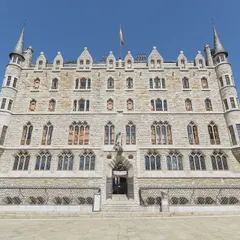
Anyone wondering what to see in Leon Cathedral will find a west façade with three sculpted portals, an interior crossed by stained glass from several centuries and an exterior bristling with flying buttresses. The history and architecture of Leon Cathedral are best understood on the spot, and the full experience comes from walking it with the audio guide, stop by stop. Together with the Romanesque of the Royal Basilica of San Isidoro, it forms the pair of great medieval works of León, and a few steps away stand Gaudí’s Casa Botines and the taverns of the Barrio Húmedo.
The Beautiful Leonese
Leon Cathedral
Summary of this stop
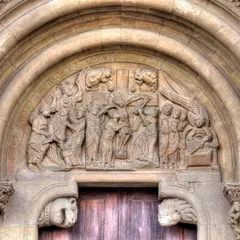
The walk starts in the square, in front of the west façade. Three large Gothic portals with abundant sculpture are arranged there, and on the central one the Virgen Blanca stands out, one of the best-known images of the church.
This stop serves to introduce the name by which the people of León know their cathedral. “Pulchra Leonina” means the Beautiful Leonese, a nickname that alludes to the elegance and harmony of its architecture, and that explains why the building is worth looking at calmly before going through the door.
How a work begun around 1255 ended up as a symbol of the city is something the narration reveals right there, with the façade in front of you.
Stepping into the light
Nave of Leon Cathedral
Summary of this stop
Once in the centre of the nave, the leading role passes from stone to glass. The great set of coloured windows runs through the whole interior and adds up to about 1,800 square metres of stained glass.
The windows range from the 13th century to modern times, so the cathedral works as a showcase of how the glazier’s art evolved over the centuries. Each window belongs to its own age, and together they make up a single atmosphere of coloured light.
Local tradition, documented, adds a way of looking: the people of León often say that the cathedral is “heard” through its light. As the sun turns, the windows light up some areas and darken others, which is why some recommend coming back at different hours, since the church is never seen the same way twice.
A wall that is not there
Chevet of Leon Cathedral
Summary of this stop
The third stop is in front of the chevet and the rose windows. The great rose of the west façade and the rose windows of the transept are among the most admired stained-glass elements of the whole.
Here the basic question of the building arises: where is the wall? To open so much space to the light, the walls were reduced to a minimum and the weight was moved to the exterior buttresses and flying buttresses. The stone is left as a skeleton that only holds up the glass.
The narration on site explains how that weight is distributed and why the interior seems more a box of light than a building of walls.
The skeleton of stone
Flying buttresses of Leon Cathedral
Summary of this stop
The end of the walk goes outside, in front of the flying buttresses. The forest of supports surrounding the cathedral is the other face of the stained glass: what lets the interior be light is what is seen here as stone.
The daring came at a price. Between the late 19th century and the 20th century the cathedral went through a deep restoration, because building with so little wall had endangered the stability of the building. Declared a National Monument in 1844, one of the first to be recognised as such in Spain, the cathedral also sits on a past of Roman baths, royal palace and Romanesque cathedral.
Finally, Leonese legend tells that a mole came out at night to undo what the workers built by day, so that the cathedral never finished rising. According to that popular tradition, when they caught it they hung its skin or an effigy of it in the church. It is a legend, not a verified fact, and it fits with how hard it must have been to build such a daring building.