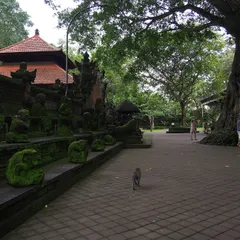
Balinese sacred forest
Sacred Monkey Forest Sanctuary
Sacred forest in Padangtegal, in Ubud, with three temples from around 1350, more than a thousand long-tailed macaques and 115 tree species.
Ubud, Indonesia
Explore Ubud with 22 audio stops and researched, fact-checked narration. From the sacred forest of the macaques to the spring of Tirta Empul, every place explains how temples, rice fields and art intertwine in Gianyar, the land that Bali calls Gumi Seni, the Land of the Arts.
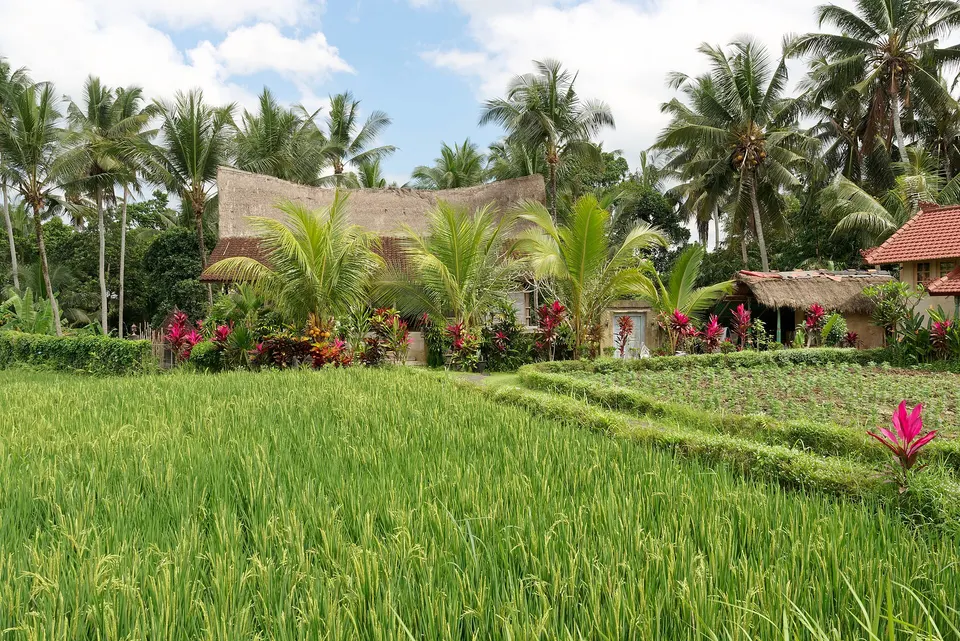
Photo: Jakub Hałun, CC BY-SA 4.0
Balinese sacred forest
Sacred forest in Padangtegal, in Ubud, with three temples from around 1350, more than a thousand long-tailed macaques and 115 tree species.
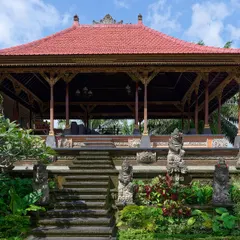
Ubud royal palace
Royal palace of Ubud rebuilt after the 1917 earthquake, with Lempad carvings, gamelan dances and the art market just across the street.
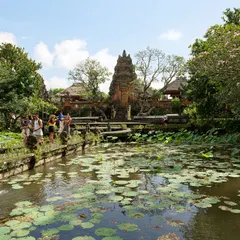
Lotus temple
Pura Taman Saraswati in Ubud: a Lempad temple of 1951-1952 dedicated to the goddess of learning, with a lotus pond, a causeway of statues and a red brick gate.

Ridge trail
What to see on the Campuhan Ridge Walk: the Wos confluence, the temple of Rsi Markandya and the grassy ridge where Walter Spies lived.

UNESCO heritage
Tegallalang Rice Terraces, north of Ubud: terraced paddies, subak channels, shrines with offerings and a UNESCO World Heritage cultural landscape.
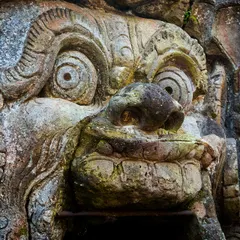
9th-century sanctuary
Goa Gajah, the Elephant Cave of Ubud: the carved giant's mouth, Ganesha and three lingams, the bathing pool found in 1954 and the Buddhist remains of the ravine.

Sacred water temple
Water temple of 962 near Tampaksiring: thirty purification spouts, the spout of poison from the legend of Indra and the source of the Pakerisan River.
Ubud Audio Guide
Ubud owes its name to ubad, Balinese for medicine, after the healing plants gathered beside its rivers. On its southern edge, the Sacred Monkey Forest Sanctuary covers some 12.5 hectares of the village of Padangtegal, where more than a thousand long-tailed macaques live among three temples raised around 1350. In the centre, the Ubud Palace, Puri Saren Agung, was restored after the 1917 earthquake, bears carvings by I Gusti Nyoman Lempad and saw the birth in 1936 of the Pita Maha artists' association, with the art market right opposite; a few steps away, Pura Taman Saraswati, designed by Lempad himself and built in 1951-1952, opens onto a lotus pond dedicated to the goddess of learning and the arts. To the west, the Campuhan Ridge Walk starts beside Pura Gunung Lebah, at the confluence of the two Wos rivers where tradition places the meditation of the priest Rsi Markandya in the 8th century and where the painter Walter Spies settled in 1927. Outside the centre, the Tegallalang Rice Terraces, some ten kilometres to the north, are watered by the cooperative subak system that UNESCO inscribed in 2012; Goa Gajah, the Elephant Cave of Bedulu, opens a great carved face over a sanctuary with Ganesha and three lingams; and in Tampaksiring the temple of Tirta Empul, founded in 962, gathers thirty spouts of sacred water at the source of the Pakerisan River.
With the EarGuide Ubud audio guide, every place reveals its history through narration researched and fact-checked against historical sources. Unlike a free walking tour or a conventional guided visit, you set the pace, the order and the stops. No groups, no timetables, no internet connection.
No internet needed
Download the routes before you head out and explore without using data.
Smart geolocation
The narration starts by itself when you reach the point of interest.
Frequently asked questions
The EarGuide app is free to download and the first route, the Sacred Monkey Forest, can be listened to for free. The other six routes — the Ubud Palace and its art market, Pura Taman Saraswati, the Campuhan Ridge Walk, the Tegallalang rice terraces, Goa Gajah and Tirta Empul — unlock together with a one-time payment, with no subscription. The unlock is tied to your EarGuide account, so it works across all EarGuide apps, on iPhone and Android.
No. EarGuide works entirely offline. Download the routes over WiFi before you set out and you can use the audio guide with no connection and no data use throughout your visit to Ubud. The map shows your GPS position in real time even without coverage.
The Ubud audio guide narration is available in Spanish and English and covers the temples, the subak rice fields and the artistic history of Ubud, researched and fact-checked against sources.
The audio guide brings together 7 independent routes with a little over six hours of narration in total, spread across 22 audio stops and from 30 to 75 minutes per route. They can be spread over two days: one for the Sacred Monkey Forest, the Ubud Palace, Pura Taman Saraswati and the Campuhan Ridge Walk, and another for Goa Gajah, the Tegallalang terraces and Tirta Empul.
They are different experiences. The EarGuide audio guide lets you explore Ubud without timetables or groups, pause and resume whenever you like, and replay any explanation as often as you need. It suits independent travellers, families and anyone who prefers to understand Bali at their own pace, with no prior knowledge of Balinese Hinduism.
The Ubud audio guide covers 7 main sites: the Sacred Monkey Forest Sanctuary, the Ubud Palace and Art Market, Pura Taman Saraswati, the Campuhan Ridge Walk, the Tegallalang Rice Terraces, Goa Gajah, the Elephant Cave, and the Tirta Empul sacred spring temple.
Only part of it. The Ubud Palace and Pura Taman Saraswati are about 200 metres from each other; the start of the Campuhan Ridge Walk is a kilometre from the palace and the Sacred Monkey Forest a little under a kilometre and a half to the south, as the crow flies. Those four routes can be linked on foot through the centre. The rest are far away: Goa Gajah is about three kilometres to the east, the Tegallalang terraces about nine to the north and Tirta Empul about twelve to the northeast, so those three need a scooter, a car or a taxi.
Yes. Purchases belong to your EarGuide account, not to one app or one phone. A city unlocked in the EarGuide app is also unlocked in that city's own app, and the other way round, on both iPhone and Android. Just sign in with the same account on the other device. The store's “restore purchases” button only covers the app the purchase was made in, so signing in is what carries it across.
The EarGuide app is free and the Sacred Monkey Forest route can be listened to for free. The other six Ubud routes unlock with a one-time payment. Offline, at your own pace.
More destinations
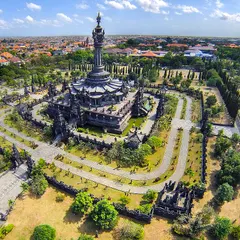
From the square where an entire court walked in white towards the Dutch rifles to the pillar with the oldest dated inscription in Bali. Explore Denpasar and Sanur with audio guides.

From the temple that guards a haunted chest to the rock of Tanah Lot, reached on foot only at low tide. Explore Seminyak's coast, its sea temples and its sunset beaches, with audio guides.

From a temple on a seventy-metre cliff, with monkeys that trade what they steal for food, to the 121-metre statue of Vishnu. Explore the Bukit peninsula with audio guides.