UNESCO World Heritage
Angkor Wat
A 12th-century Khmer temple-mountain in Siem Reap: the causeway over the moat, bas-reliefs, devatas and the 65 m central tower.
Siem Reap, Cambodia
Explore Siem Reap with 37 audio stops and researched, fact-checked narration. From the temples of Angkor to the market in the centre, the memory of the Khmer Rouge and life on the water of the Tonlé Sap, every place explains how ten centuries of empire, jungle and reconstruction overlap in a single region.
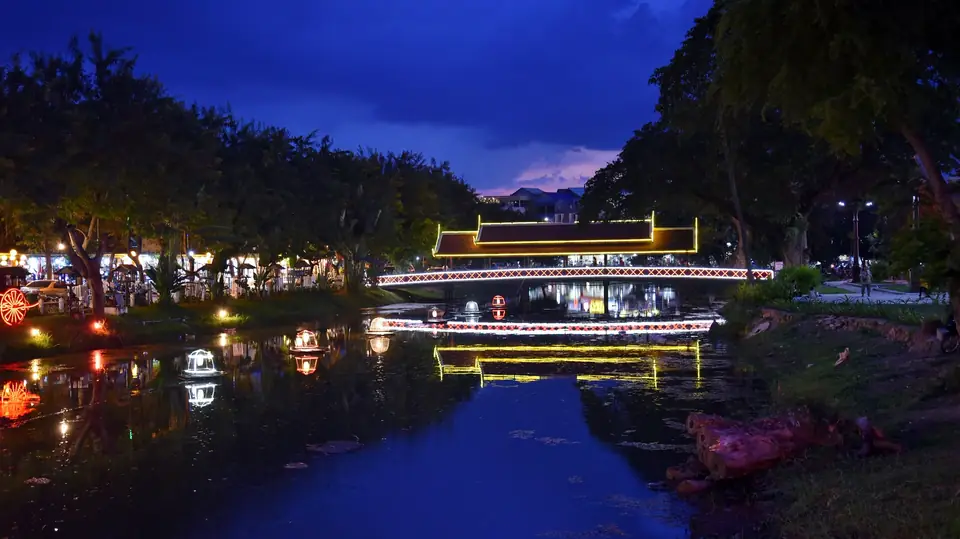
Photo: Bahnfrend, CC BY-SA 4.0
UNESCO World Heritage
A 12th-century Khmer temple-mountain in Siem Reap: the causeway over the moat, bas-reliefs, devatas and the 65 m central tower.
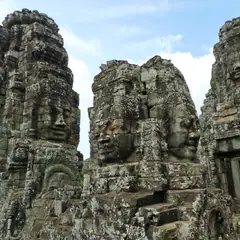
UNESCO World Heritage
What to see at the Bayon, the temple of Angkor Thom with towers of smiling faces, battle reliefs and everyday scenes of the 12th century.
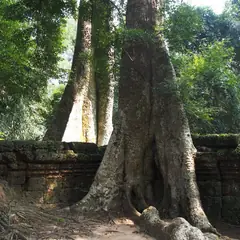
UNESCO World Heritage
A Khmer monastery of 1186 where silk-cotton and fig trees embrace galleries and towers: the stele of the 615 dancers, the king’s mother’s sanctuary and the octopus tree.

10th-century Khmer temple
A red sandstone Shaivite temple from the year 967, built by a Brahmin, with narrative pediments and Malraux’s theft.

Historic market
Siem Reap’s Old Market: silks, prahok, colonial shophouses and a riverside pagoda with centuries of memory.
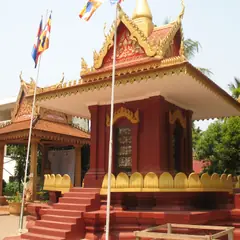
Khmer Rouge memorial
An active pagoda with a stupa of some 800 skulls, covered pits and rooms on the Khmer Rouge regime, 2 km from Siem Reap.
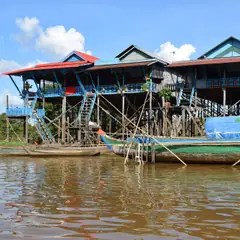
Stilt village
A village of stilt houses on the Tonlé Sap, with a painted pagoda, a flooded forest and the legend of the Naga serpent, about 30 km from Siem Reap.
Siem Reap Audio Guide
Siem Reap grew after the Franco-Siamese treaty of 1907 a few kilometres from the old Khmer capital, and from it seven very different places branch out. Angkor Wat, raised between 1122 and around 1150 under Suryavarman II, reproduces Mount Meru in stone with five towers in a quincunx, a moat 190 m wide and 49 m of frieze with the Churning of the Sea of Milk. The Bayon, the state temple of Jayavarman VII at the centre of Angkor Thom, preserves 37 face towers with some 200 smiling faces and a kilometre of reliefs where a naval battle coexists with markets and a cockfight. Ta Prohm, founded in 1186 as a monastery dedicated to the king’s mother, was left almost as the École française d’Extrême-Orient found it, with tetrameles roots over its galleries, and Banteay Srei, consecrated in 967 and built by a Brahmin in red sandstone, is the only major temple of Angkor not raised by a king. In the city, the Old Market (Psar Chas) alternates stalls of silk and Buddhas with aisles of prahok and dried fish, and Wat Thmei, an active pagoda, keeps a stupa with some 800 skulls of the Khmer Rouge’s victims between 1975 and 1979. About 30 km to the southeast, Kampong Phluk rises on 6 to 9 metre stilts on the shore of the Tonlé Sap, with a forest that is submerged in the rainy season.
With the EarGuide Siem Reap audio guide, every place reveals its history through narration researched and fact-checked against historical sources. Unlike a free walking tour or a conventional guided visit, you set the pace, the order and the stops. No groups, no timetables, no internet connection.
No internet needed
Download the routes before you head out and explore without using data.
Smart geolocation
The narration starts by itself when you reach the point of interest.
Frequently asked questions
The EarGuide app is free. The Siem Reap audio guide includes 7 independent routes with about eight and a half hours of narration spread across 7 sites and 37 audio stops, and it is found inside the app itself.
No. EarGuide works entirely offline. Download the routes over WiFi before you set out and you can use the audio guide with no connection and no data use throughout your visit. The map shows your GPS position in real time even without coverage.
The Siem Reap audio guide is available in Spanish and English, with researched, fact-checked narration on the Khmer empire of Angkor, the legacy of the Khmer Rouge and life on Tonlé Sap lake.
The audio guide brings together 7 independent routes with about eight and a half hours of narration in total, from 30 to 120 minutes per route. They can be spread over several days: one for Angkor Wat, the Bayon and Ta Prohm, another for Banteay Srei, another for the Old Market and Wat Thmei in the city, and a separate trip to Kampong Phluk.
They are different experiences. The EarGuide audio guide lets you explore Siem Reap without timetables or groups, pause and resume whenever you like, and replay any explanation as often as you need. It suits independent travellers, families and anyone who prefers to understand the city at their own pace, with no prior knowledge of Cambodia.
The Siem Reap audio guide covers 7 main sites: Angkor Wat, the Bayon, Ta Prohm, Banteay Srei, the Old Market (Psar Chas), Wat Thmei (memorial of the Killing Fields) and Kampong Phluk, the stilt village on the Tonlé Sap.
No. The sites are spread far apart, so the usual way to get around is by tuk-tuk or taxi. In the city, the Old Market and Wat Thmei are about 3 km apart in a straight line. Angkor Wat, the Bayon and Ta Prohm lie between 3 and 4 km from one another and about 7 to 10 km from the centre. Banteay Srei is about 20 km in a straight line from the Bayon and Ta Prohm, and Kampong Phluk about 20 km from the city to the southeast; there the tour is done by boat. What you do walk is each site on the inside.
Yes. Purchases belong to your EarGuide account, not to one app or one phone. A city unlocked in the EarGuide app is also unlocked in that city’s own app, and the other way round, on both iPhone and Android. Just sign in with the same account on the other device. The store’s “restore purchases” button only covers the app the purchase was made in, so signing in is what carries it across.
The Siem Reap audio guide is inside the EarGuide app, free and ready to use offline. Carry it in your pocket and explore the region at your own pace.