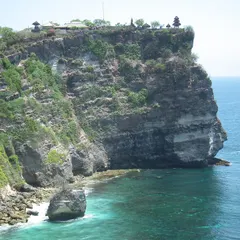
Sea temple on the cliff
Uluwatu Temple
Sea temple on a seventy-metre cliff in southern Bali: a directional temple, macaques that trade what they steal and the Kecak dance at sunset.
Uluwatu, Indonesia
Explore the Bukit peninsula with 22 audio stops and researched, fact-checked narration. From the temple on the cliff edge to the Nusa Dua Water Blow, every place explains how a dry limestone plateau brings together sea temples, legendary waves, fishermen and resorts.
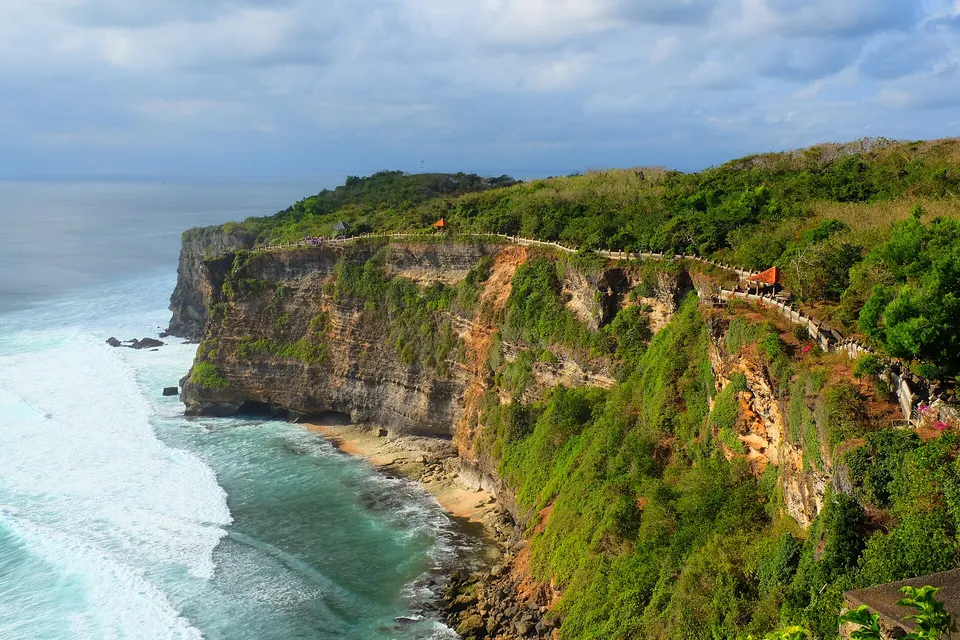
Photo: Paskuu, CC BY-SA 4.0
Sea temple on the cliff
Sea temple on a seventy-metre cliff in southern Bali: a directional temple, macaques that trade what they steal and the Kecak dance at sunset.
Surf cove
Uluwatu cove between limestone cliffs: the access crack, the Padang Padang Left wave or Balinese Pipeline, the Rip Curl Cup and the shooting of Eat Pray Love.
Cradle of surfing in Bali
The cave beach beneath the Uluwatu cliffs where the story of surfing in Bali began in 1972, with five waves in a row facing its mouth.
Hindu monument and myth
The 121-metre statue of Vishnu on Garuda, the torso that waited twenty years in Wisnu Plaza, Garuda's head and the limestone pillar corridor of the Lotus Pond.
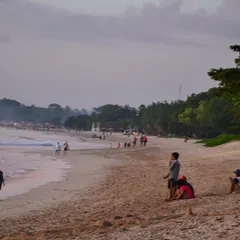
Fish market and grilled seafood
Jimbaran Bay in Uluwatu: the Kedonganan fish market at dawn, fishermen's cafés with seafood grilled over coconut husks and sunset on the beach.
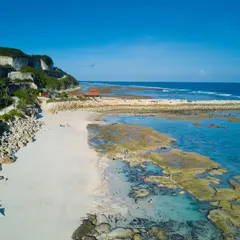
Cliffs and ritual
Ungasan beach beneath white limestone cliffs, with a reef lagoon and the name of the Balinese rite of purification.
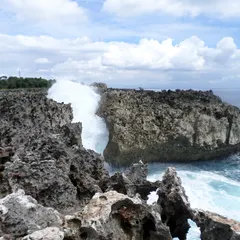
Natural phenomenon
Nusa Dua Water Blow: a natural sea geyser in the limestone of Peninsula Island, with a viewpoint over the Indian Ocean in the Nusa Dua tourist enclave.
Uluwatu Audio Guide
Uluwatu occupies the southwestern tip of the Bukit peninsula, a dry, stony limestone plateau very different from Bali's green interior. At the point, Uluwatu Temple, Pura Luhur Uluwatu, leans over a cliff of about seventy metres: it is the only Balinese sea temple that is also one of the directional temples that hold the island's spiritual balance, its macaques have become famous for trading what they steal for food, and its amphitheatre hosts the Kecak dance every evening at six, which the painter Walter Spies and the dancer Wayan Limbak turned in the 1930s into a drama of the Ramayana. Very close by, Suluban Beach, also called Blue Point, is reached through a cave and faces the Uluwatu reef, which surfing discovered in 1972 with the film Morning of the Earth; Padang Padang Beach, a cove of about 110 metres reached down a crack in the rock, has the left-hand wave nicknamed the Balinese Pipeline and appeared in the film Eat Pray Love. Inland, the Garuda Wisnu Kencana Cultural Park raises a 121-metre statue of Vishnu on Garuda, designed by Nyoman Nuarta and inaugurated in 2018 after 28 years of work. On Jimbaran Bay the Kedonganan fish market supplies the beach cafés that grill the day's catch over coconut husks, a custom the fishermen themselves began; Melasti Beach, reached by a road cut into the cliff, takes its name from the purification ceremony held by the sea before Nyepi, and in Nusa Dua, the two islands, the Water Blow throws the swell of the Indian Ocean through a crack in Peninsula Island when the tide rises.
With the EarGuide Uluwatu audio guide, every place reveals its history through narration researched and fact-checked against historical sources. Unlike a free walking tour or a conventional guided visit, you set the pace, the order and the stops. No groups, no timetables, no internet connection.
No internet needed
Download the routes before you head out and explore without using data.
Smart geolocation
The narration starts by itself when you reach the point of interest.
Frequently asked questions
The EarGuide app is free to download and the first route, Uluwatu Temple, can be listened to for free. The other six routes — Padang Padang Beach, Suluban Beach and Blue Point, the Garuda Wisnu Kencana Cultural Park, Jimbaran Bay, Melasti Beach and the Nusa Dua Water Blow — unlock together with a single payment, with no subscription. The unlock is tied to your EarGuide account, so it works across all the EarGuide apps, on iPhone and on Android.
No. EarGuide works entirely offline. Download the routes over WiFi before you set out and you can use the audio guide with no connection and no data use throughout your visit. The map shows your GPS position in real time even without coverage.
The Uluwatu audio guide is available in Spanish and English, with researched, fact-checked narration on Bali's sea temples, the surfing of the Bukit peninsula and its fishing villages.
The audio guide brings together 7 independent routes with almost eight hours of narration in total, from 40 to 90 minutes per route. They can be spread over two days: one for the west coast, with Padang Padang Beach, Suluban Beach and Uluwatu Temple at Kecak time, and another for the Garuda Wisnu Kencana Cultural Park, Melasti Beach, Jimbaran Bay and the Nusa Dua Water Blow.
They are different experiences. The EarGuide audio guide lets you explore Uluwatu without timetables or groups, pause and resume whenever you like, and replay any explanation as often as you need. It suits independent travellers, families and anyone who prefers to understand the place at their own pace, with no prior knowledge of Bali.
The Uluwatu audio guide covers 7 main sites: Uluwatu Temple and the Kecak amphitheatre, Padang Padang Beach, Suluban Beach and the Blue Point cliffs, the Garuda Wisnu Kencana Cultural Park, Jimbaran Bay with the Kedonganan fish market, Melasti Beach and the Nusa Dua Water Blow with Peninsula Island.
Not all of it. Uluwatu Temple, Suluban Beach and Padang Padang Beach lie together on the west coast, between one and a half and three kilometres from one another in a straight line. The other four sites are spread across the peninsula: the Garuda Wisnu Kencana Cultural Park is about nine kilometres from the temple, Melasti Beach and Jimbaran Bay are about four or five kilometres from the park, and the Nusa Dua Water Blow, on the east coast, is more than fifteen kilometres from the temple. Reaching them takes a scooter, car or taxi.
At several sites, yes. Uluwatu Temple has a ticket booth at the entrance, where each visitor is given the sarong and sash required to walk the precinct. Padang Padang Beach, Melasti Beach, which charges entry and parking on the cliff road, and the Water Blow viewpoint charge a small entrance fee, and the core of the Nusa Dua enclave has checkpoints and an access fee for visitors.
Yes. Purchases belong to your EarGuide account, not to one app or one phone. A city unlocked in the EarGuide app is also unlocked in that city's own app, and the other way round, on both iPhone and Android. Just sign in with the same account on the other device. The store's “restore purchases” button only covers the app the purchase was made in, so signing in is what carries it across.
The EarGuide app is free and the Uluwatu Temple route can be listened to for free; the other six unlock together with a single payment. Offline, at your own pace.
More destinations
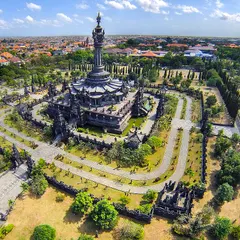
From the square where an entire court walked in white towards the Dutch rifles to the pillar with the oldest dated inscription in Bali. Explore Denpasar and Sanur with audio guides.
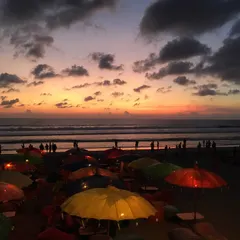
From the temple that guards a haunted chest to the rock of Tanah Lot, reached on foot only at low tide. Explore Seminyak's coast, its sea temples and its sunset beaches, with audio guides.

From the sacred forest of over a thousand macaques to the spring where the Pakerisan River is born. Explore Ubud, its temples, its rice terraces and its royal palace with audio guides.