Death Railway
Bridge on the River Kwai
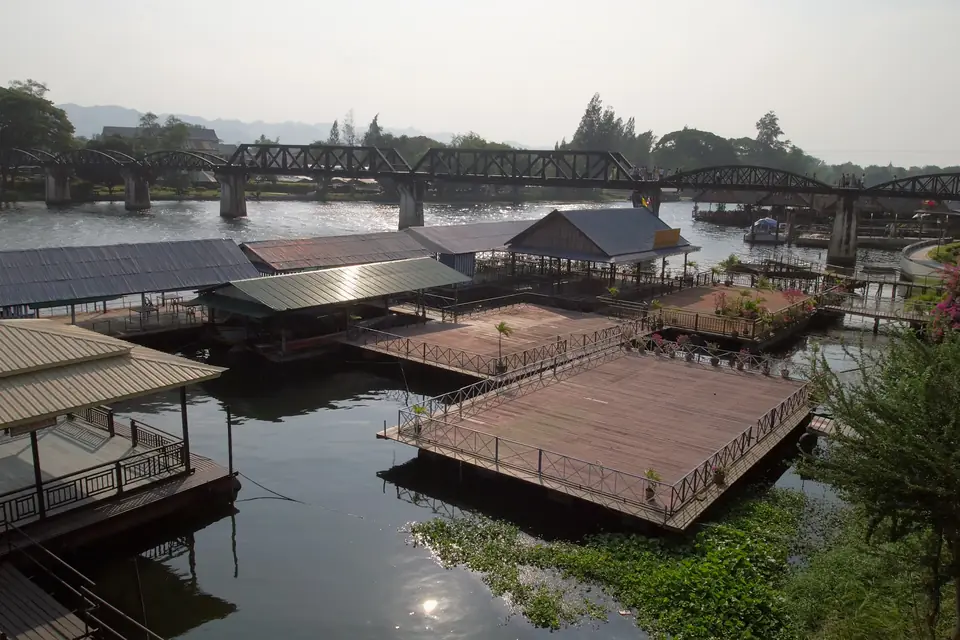
A railway bridge of 1943 in Kanchanaburi: spans from Java, scars of the 1945 bombings and the train that still crosses it.
Kanchanaburi, Thailand
Explore Kanchanaburi with 31 audio stops and researched, fact-checked narration. From the Tamarkan bridge to the war cemetery and Rama III's wall, every place explains how a border town became bound to the memory of the Death Railway.
Death Railway
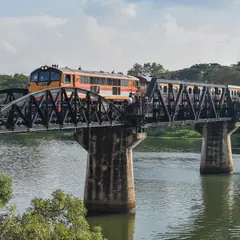
A railway bridge of 1943 in Kanchanaburi: spans from Java, scars of the 1945 bombings and the train that still crosses it.
War memory
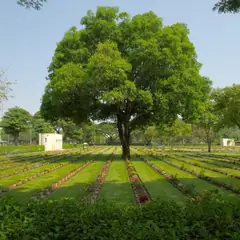
The largest cemetery of Death Railway prisoners: bronze plaques on grass, the cremated men of Nieke and the Cross of Sacrifice.
War museum
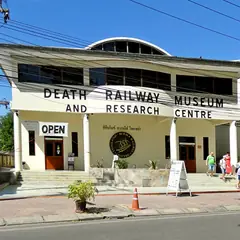
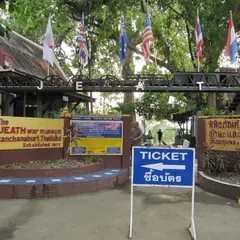
A private two-storey museum beside Kanchanaburi's war cemetery: a rice wagon, a 9-metre model of the Kwae valley and a wall of spikes that counts the dead of the Death Railway.
Memory of the Death Railway
A bamboo and thatch museum inside a Buddhist temple in Kanchanaburi, with prisoners' paintings, an Allied bomb and a shrine made from a warship.
Frontier history
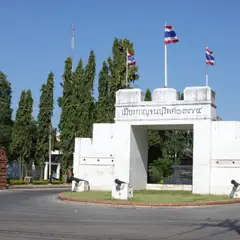
What to see at the Kanchanaburi City Gate: the last remnant of Rama III's wall, with cannons, a stretch of brick and the story of the frontier that came down to the river.

Old town
A shopping street of Sino-Western shophouses, Boonpong's shop and the temple of Wat Thewa Sangkharam, in the old town of Kanchanaburi.

Cave temple
A cave temple in Kanchanaburi with grottoes of Buddhas and Hindu gods, a golden chedi and views of the Khwae Noi river and the Chungkai camp.
Kanchanaburi Audio Guide
Kanchanaburi sits at the meeting of the two Khwae rivers, where Rama III moved the city around 1831, and the war of 1942-1945 left a second layer on that layout. The Bridge on the River Kwai, of 1943, assembles eleven curved spans from a bridge dismantled in Java, with two angular spans that replaced those brought down by the bombings of 1945, and the train still crosses it every day. On the main avenue, the War Cemetery holds 6,982 burials under bronze plaques flush with the lawn, and across from it the Thailand-Burma Railway Centre, opened in 2003, offers a 9-metre topographic model, a rice wagon and a wall of sleepers where each spike represents five hundred people dead. The JEATH Museum, a bamboo hut that the abbot of Wat Chai Chumphon built in 1977, is the oldest of the railway museums. The City Gate keeps the only standing remnant of Rama III's enclosure, Pak Phraek Street lines up Sino-Western shophouses where a shopkeeper secretly helped the prisoners, and Wat Tham Khao Pun opens grottoes of Buddhas above the Khwae Noi river, on the hill that gave its name to the Chungkai camp.
With the EarGuide Kanchanaburi audio guide, every place reveals its history through narration researched and fact-checked against historical sources. Unlike a free walking tour or a conventional guided visit, you set the pace, the order and the stops. No groups, no timetables, no internet connection.
No internet needed
Download the routes before you head out and explore without using data.
Smart geolocation
The narration starts by itself when you reach the point of interest.
Frequently asked questions
The EarGuide app is free. The Kanchanaburi audio guide includes 7 independent routes with five hours of narration spread across 7 sites and 31 audio stops, and it is found inside the app itself.
No. EarGuide works entirely offline. Download the routes over WiFi before you set out and you can use the audio guide with no connection and no data use throughout your visit. The map shows your GPS position in real time even without coverage.
The Kanchanaburi audio guide is available in Spanish and English, with researched, fact-checked narration on the Death Railway, Rama III's city and the memory of the Allied prisoners.
The audio guide brings together 7 independent routes with five hours of narration in total, from 25 to 75 minutes per route. They can be spread over two days: one for the war cemetery, the Thailand-Burma Railway Centre, the JEATH Museum, the City Gate and Pak Phraek Street, and another for the Bridge on the River Kwai and Wat Tham Khao Pun.
They are different experiences. The EarGuide audio guide lets you explore Kanchanaburi without timetables or groups, pause and resume whenever you like, and replay any explanation as often as you need. It suits independent travellers, families and anyone who prefers to understand the city at their own pace, with no prior knowledge of Thailand.
The Kanchanaburi audio guide covers 7 main sites: the Bridge on the River Kwai, the Kanchanaburi War Cemetery, the Thailand-Burma Railway Centre, the JEATH War Museum, the City Gate, Pak Phraek Street and Wat Tham Khao Pun.
Only in part. The War Cemetery and the Thailand-Burma Railway Centre are side by side, about 100 metres apart. The JEATH Museum, the City Gate and Pak Phraek Street form another group, less than a kilometre from one another, and the cemetery is a little over a kilometre in a straight line from the street. The Bridge on the River Kwai is about 2.5 km from the museum area and 3-4 km from the Gate and Pak Phraek Street, and Wat Tham Khao Pun is about 3.5-4.5 km from almost everything, so for both a taxi, tuk-tuk or motorbike is advisable.
Yes. Purchases belong to your EarGuide account, not to one app or one phone. A city unlocked in the EarGuide app is also unlocked in that city's own app, and the other way round, on both iPhone and Android. Just sign in with the same account on the other device. The store's “restore purchases” button only covers the app the purchase was made in, so signing in is what carries it across.
The Kanchanaburi audio guide is inside the EarGuide app, free and ready to use offline. Carry it in your pocket and explore the city at your own pace.
More destinations

From the chapel of the kings of Siam to the Buddha head trapped in a fig tree and the temple-mountain by the river. The old capital, with audio guides.

From the Emerald Buddha dressed in gold for each season to the solid gold Buddha hidden beneath stucco. Walk old Bangkok, from Rattanakosin to Chinatown and Thonburi, with audio guides.

From the sacred mountain of Doi Suthep to the market built over the royal cemetery. Explore the old capital of the Lanna kingdom with audio guides.
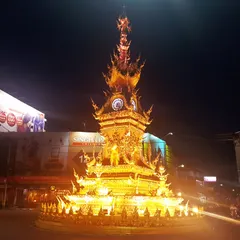
From the white temple a painter rebuilds at his own expense to the bank where Thailand, Myanmar and Laos face one another. Chiang Rai and its artists, with audio guides.

From the limestone towers of Railay to a cemetery of fossil snails and a temple with 1,237 steps. Explore Krabi, its beaches and its Andaman coast, with audio guides.

From the tin-era Sino-Portuguese shophouses to the 45-metre Buddha above Kata. Explore Phuket, its shrines and its history, with audio guides.