Plateresque and Camino de Santiago
Convent of San Marcos Audio Guide (Hostal de San Marcos)
A Plateresque façade over a hundred metres long, carved like a goldsmith's work, which was a pilgrims' hospital, a war prison and is today a Parador.
- 35 min of audio
- Plateresque architecture
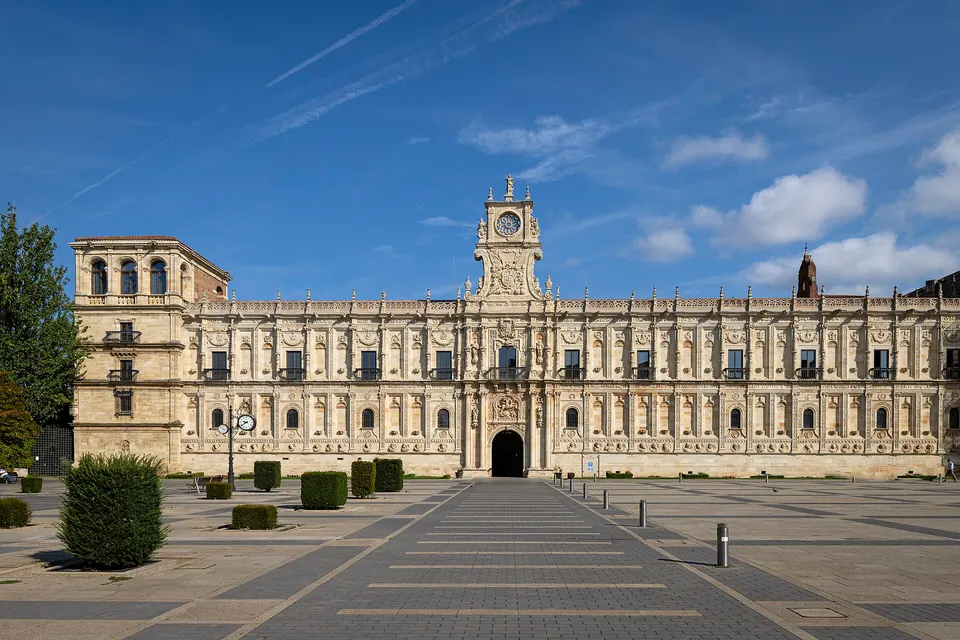
The San Marcos complex was born in the Middle Ages as the seat and hospital of the Order of Santiago, beside the Bernesga river, to tend to the pilgrims of the Camino. The present building was raised mostly in the 16th century, from 1513, and ranks among the masterpieces of Spanish Plateresque. Anyone looking for what to see at the Convent of San Marcos finds a façade covered in reliefs, medallions and fine decoration in golden stone.
Contrast is the key to the place. The same golden stone that shines as silversmith's work on a grand scale was, during the Civil War, a prison and a concentration camp. Today the building brings together a Parador, a church and a museum, and in the square a barefoot bronze pilgrim welcomes those who arrive in León along the Camino.
Highlights
- Plateresque façade more than a hundred metres long
- Medallions with busts of historical and legendary figures
- Church with notable choir stalls, sacristy and cloister
- Sculpture of the barefoot pilgrim in the square
- Pilgrims' hospital, war prison, Parador and Museo de León
The history of San Marcos in León begins as the seat and hospital of the Order of Santiago, a refuge for the pilgrims who followed the Camino beside the Bernesga river. From the medieval origin one moves to the great 16th-century building, begun in 1513, which is now considered one of the masterpieces of the Plateresque style. In a single complex live together a Parador de Turismo, a church with its cloister and the Museo de León. The architecture of San Marcos is best walked with the audio guide, which arranges façade, medallions, memory and pilgrim in three stops. On the same Ordoño II axis stands Casa Botines, and on the bank of the Bernesga, from the Plateresque to the contemporary, one reaches the MUSAC.
A hundred metres of goldsmithing
Convent of San Marcos
Summary of this stop
The visit begins in the square, in front of the façade. At this point more than a hundred metres of wall unfold, covered in reliefs, medallions and fine decoration carved in golden stone, with the look of a goldsmith’s work on a grand scale.
Behind that luxury lies a simple origin tied to Saint James: the hospital of the Order of Santiago that took in the pilgrims of the Camino. The building seen today was raised mostly from 1513, and that continuity between medieval hospital and Renaissance palace explains much of its character.
The square also keeps a custom that, according to the story, is repeated by those who arrive in León on foot: stopping in front of the pilgrim sculpture to rest for a moment. The most surprising detail of this façade is saved for the narration on site.
Faces in the stone
Façade of San Marcos
Summary of this stop
The second stop goes along the medallions. Across the wall runs a long series of busts of historical and legendary figures, from figures of Antiquity to Hispanic heroes, each enclosed in its stone frame.
The name of the Plateresque helps in reading them: the style is called that because its very fine decoration recalls the work of the plateros, the silversmiths. That idea explains the minuteness of each relief and the sense of monumental jewellery.
The walk continues into the complex, with the church and its notable choir stalls, the sacristy and the former cloister of the convent.
The pilgrim and the wound
Pilgrim of San Marcos
Summary of this stop
The last stop pauses beside the sculpture of a seated, barefoot pilgrim resting next to a cross. It has become an iconic image of the Camino as it passes through León, and according to tradition pilgrims often have their photo taken with him, or sit beside him as beside a travelling companion.
The same building holds a harsh memory. During the Spanish Civil War, San Marcos was used as a concentration camp and prison, an episode remembered by a plaque in its surroundings. Among those held here, the poet and writer Victoriano Crémer is remembered, who left a testimony of his captivity in “El libro de San Marcos”.
Since the middle of the 20th century, part of the complex has worked as a Parador de Turismo, one of the most emblematic hotels of the Spanish network, and another part houses the Museo de León, with pieces of art and archaeology. Hotel, church and museum thus share a building that makes one look at the same façade with two eyes at once.