War memory
Kanchanaburi War Cemetery Audio Guide (Don Rak War Cemetery)
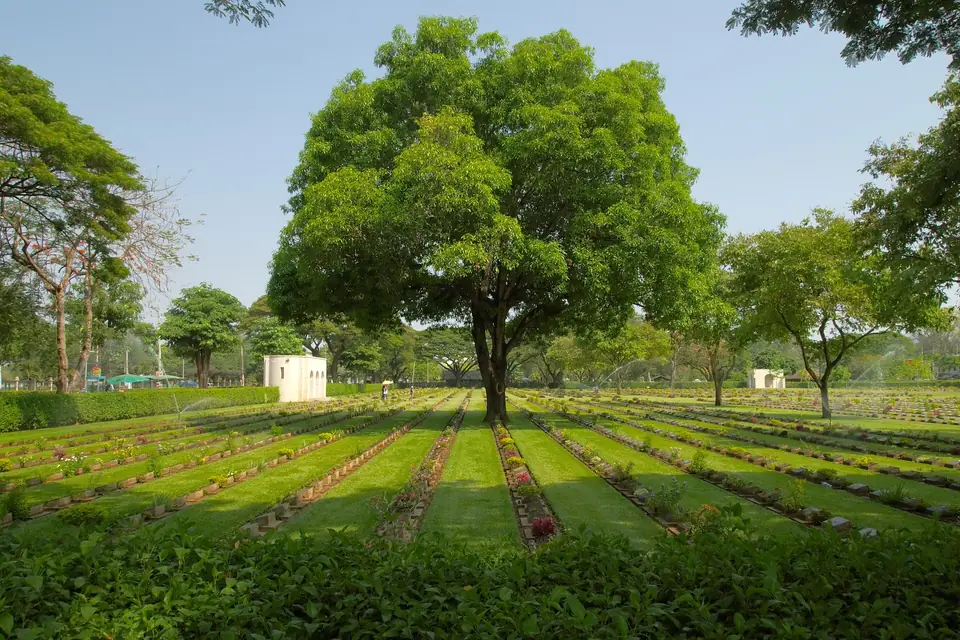
Almost seven thousand bronze plaques flush with the lawn, on land given by the Thai people, right on Kanchanaburi's main avenue. It is the largest cemetery of prisoners of the Death Railway.
- 35 min of audio
- Death Railway
After the war, the British Army Graves Service created the cemetery beside the old Kanburi prisoner base camp and moved to it the graves of the southern section of the railway, between Bangkok and Nieke. The site holds 6,982 burials, mostly British, Dutch and Australian, and is laid out as a lawn cemetery: trimmed grass and a brass plaque over each grave.
The architect Colin St Clair Oakes, of the Imperial War Graves Commission, designed the stone portico and the shelter pavilion that frame the site. Among the plaques, the last line was chosen by each family, and some are surprising in their lightness. Locals call it “Pa Cha Angkrit”, the English cemetery.
Highlights
- 6,982 burials of British, Dutch, Australian and other nations
- Land given by the Thai people, according to the tablets in the portico
- Two collective graves for about 300 cremated men from Nieke
- Epitaphs chosen by the families on each bronze plaque
- Cross of Sacrifice and remembrance ceremonies every 25 April and 11 November
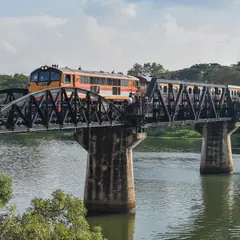
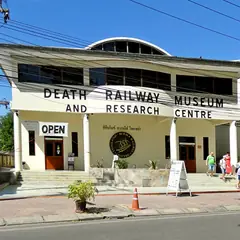
What to see at the Kanchanaburi War Cemetery, also known as Don Rak, begins with its scale: it is the largest cemetery of prisoners of the Death Railway, the Burma-Siam railway whose construction began in June 1942 and which became operational in December 1943 with 424 km of track. About 13,000 prisoners of war died during the works, buried at first along the route. After the war, the British Army Graves Service gathered the graves of the southern section here, and reburials were already under way in 1946. The Thai government and the Allies agreed on 24 August 1954 to create the two Allied cemeteries of Kanchanaburi, Don Rak and Chungkai; the sources differ on the exact date the site took its final form, probably because they describe different phases. The history of this place is truly experienced by walking it with the audio guide, plaque by plaque. The graves are better understood alongside the work that caused them, the Bridge on the River Kwai, and across from the cemetery stands the Thailand-Burma Railway Centre, which tells the prisoners’ story. To continue with the history of the city, the Kanchanaburi City Gate is about 1.3 km away.
Three arches and a gift from the Thai people
Kanchanaburi War Cemetery (DonRak)
Summary of this stop
The walk starts at the entrance building, a stone portico with a triple arch, two steps, benches and bronze panels, which cuts off the noise of Saeng Chuto Road, the city’s main avenue. The bilingual tablets, in Thai on the left and English on the right, dated 1939-1945, declare that the land is a gift from the Thai people as the perpetual resting place of the sailors, soldiers and airmen buried there. A trilingual plaque, in English, Thai and Dutch, completes the set.
The portico and the shelter pavilion that frame the site were designed by Colin St Clair Oakes, an architect of the Imperial War Graves Commission who began an inspection tour of Ceylon, Siam, Malaya and Singapore in November 1945. Inside the building is also the Kanchanaburi Memorial, with the names of 11 soldiers of the Indian Army buried in Muslim cemeteries in Thailand whose graves could not be maintained.
A short step from here stood the Kanburi base camp. According to documented tradition, in 1944 Australian and Dutch prisoners gathered there beside their palm-leaf-roofed huts for a rare open-air concert, and someone photographed them in secret, at risk to everyone. The most surprising detail of that image is best told in the narration itself, under the portico.
Huxtable, 23 years old, and the last line
Commonwealth bronze plaques
Summary of this stop
From the portico, the central axis opens between rows of identical bronze plaques flush with the ground, with the Commonwealth sections on either side of the entrance and the Dutch section at the far end. Behind that geometry lies a massive transfer: the graves collected along the railway were reburied here one by one. Each plaque carries a name, unit, age, date, country and a last line with an epitaph.
One example is Lieutenant Adrian Anthony Huxtable, of the 88th Field Regiment, Royal Artillery, who died of dysentery on 5 July 1943 aged 23. Buried first in the Tonchan South field cemetery, he was reburied in Kanchanaburi on 1 March 1946.
Those last lines were chosen by the families, and some are surprising in their lightness. According to documented tradition, in plot 4 a 25-year-old gunner is remembered as “our dear boy” who lives and laughs in God’s eternal spring, and in plot 2 a 23-year-old corporal bears a phrase about a youth that will shine undimmed through the years. In a cemetery born of cholera, dysentery and hunger, looking for these phrases row by row is a very intimate way of reading it.
Two graves for three hundred men from Nieke
Pavilion and graves of the Nieke cremated
Summary of this stop
On the left side of the site, the shelter pavilion holds on its panels the names of about 300 men who died in the Nieke camp, most of them in the cholera epidemic of May-June 1943. They were cremated, and in front of the pavilion, in plot IX, their ashes rest together in two collective graves. The sources differ slightly on the origin and timeline of the outbreak, but agree on the essentials: the disease forced the dead to be burned.
From this point the scale of the railway can be measured. The figures speak of about 13,000 prisoners of war dead in the construction of the railway, and of no American being buried here, because their remains were repatriated to the United States. The graves along the line were concentrated only in Kanchanaburi, Chungkai and Thanbyuzayat.
There is also the great absence of the site: the Asian forced labourers, some 90,000 civilian dead, have no graves at Don Rak. Their memory lies in the monument to the unknown workers and soldiers in the Wat Yuan cemetery, also in Kanchanaburi.
The cross of the “English cemetery”
Cross of Sacrifice
Summary of this stop
The central axis ends at the Cross of Sacrifice, at the point farthest from the entrance, with a seating area behind it. To its right, the Stone of Remembrance carries the inscription “Their bodies are buried in peace; but their name liveth for evermore”. The plaques of unknown soldiers, bearing the legend “A Soldier of the 1939-1945 War, known unto God”, correspond to 139 unidentified Commonwealth dead.
The people of Kanchanaburi call the place “Pa Cha Angkrit”, the English cemetery, although almost half of those buried are Dutch and Australian. The count by nation gives 3,569 identified from the United Kingdom, 1,896 from the Netherlands, 1,362 from Australia, 12 from India, 2 from New Zealand and 1 from Canada, plus one non-war grave; the overall figures vary depending on how the unidentified and the cremated are counted. It is also known as the United Nations cemetery.
The cross is also the setting for living rites: every year Australian and New Zealand Anzac Day is held on 25 April and the British Remembrance Day on 11 November. The children of the prisoners still come. According to documented tradition, in 2015 a group of 34 Australians gathered here for a simple service, some wearing the medals of fathers they never knew, and thank-you notes still turn up among the plaques. A daughter learned there, thanks to a researcher, of what illnesses and where her father had died, and the story of that grave under a single poppy closes the tour in the audio guide.