Memory of the Death Railway
JEATH War Museum Audio Guide (Wat Chai Chumphon)
A bamboo and thatch hut built in 1977 by a Buddhist abbot holds the oldest memory of the prisoners of the Death Railway in Kanchanaburi. It was a temple, not a state, that made it.
- 40 min of audio
- War memory
The museum occupies the grounds of Wat Chai Chumphon, popularly known as Wat Tai, the southern temple. The head abbot, the Venerable Phra Theppanyasuthee, built it in 1977 as a replica of a prison-camp hut, with raised, cramped bamboo bunks. On its walls hang photographs, illustrations, letters and original drawings by those who suffered through the building of the railway.
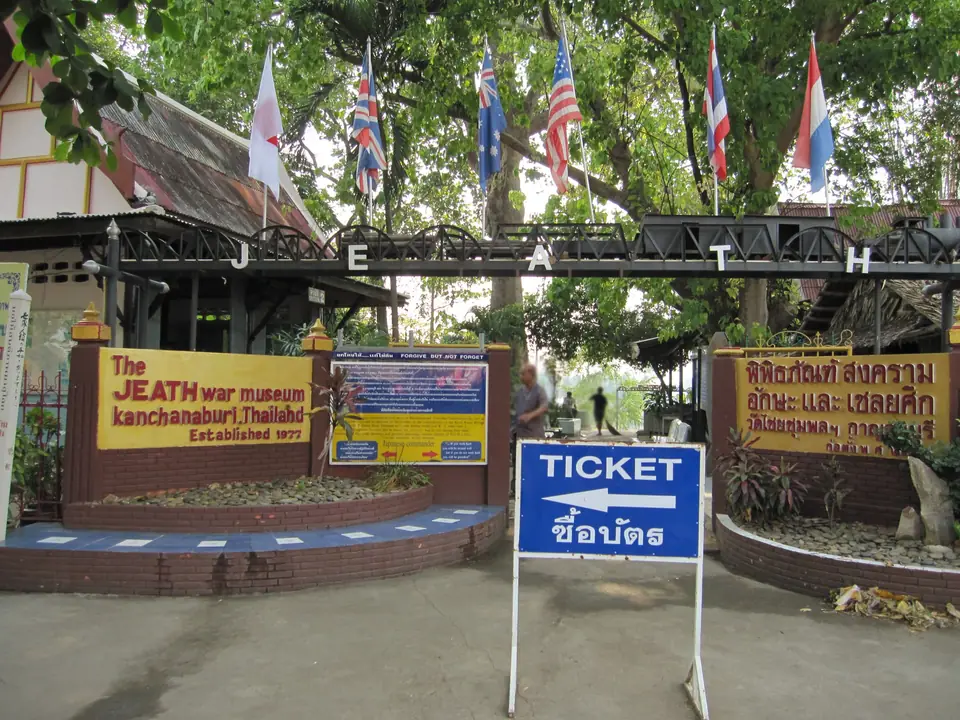
The name JEATH combines the initials of Japan, England, Australia or America, Thailand and Holland, the nations opposed in that undertaking. Founded in 1977, it is the oldest of the Death Railway museums in Kanchanaburi and for years was the only place in the city that remembered the prisoners. The visit continues through the temple, with a shrine made from a Second World War boat, an old chedi and an ubosot with murals.
Highlights
- Bamboo and thatch hut — replica of a barrack with raised bunks
- Paintings by former prisoners (1942-1943) of ulcers and maggot-infested huts
- Unexploded Allied bomb dropped on the bridge over the River Kwai
- Shrine made from a Second World War boat dredged from the river
- Old chedi, a monument registered in 1935, and an ubosot of around 1827 with murals
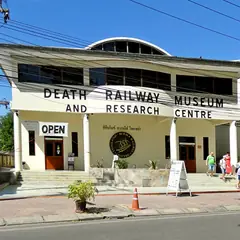
The JEATH War Museum, in Thai the Wat Tai War Museum, is the first museum in Kanchanaburi dedicated to the prisoners of the Death Railway. It was built in 1977 by the abbot of Wat Chai Chumphon within the grounds of his own temple, hence its humble air: bamboo, palm leaves and a central aisle between bunks. It stands beside the meeting point of the Khwae Yai and Khwae Noi rivers, about 4.5 km south of the Bridge on the River Kwai.
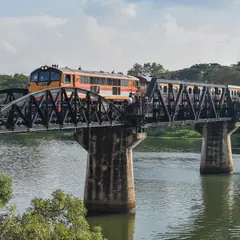
Anyone looking for what to see at the JEATH War Museum finds a short, dense visit: the history of JEATH and its founding, the replica of the barrack, the prisoners’ paintings, an Allied bomb, the boat shrine and the surrounding temple, founded in 1785 according to the National Office of Buddhism. The full experience comes from walking the grounds with the audio guide. Given its theme, it pairs with the Bridge on the River Kwai, whose construction was lived through by the prisoners the museum remembers, and with another temple marked by the war, Wat Tham Khao Pun. In the old town by the river, Pak Phraek Street completes the area.
Five letters on the JEATH sign
JEATH War Museum
Summary of this stop
The sign at the entrance shows the name of the museum and its acronym: Japan, England, Australia or America, Thailand and Holland, the nations opposed in the building of the railway. The abbreviation reads like a riddle, because it reveals who appears in those five letters and who does not.
Some analyses point out that the acronym names five nations but leaves out most of the victims, the Asian forced labourers. It is a debate that goes with the name from the first glance.
Behind the sign lies the story of why it was an abbot, the Venerable Phra Theppanyasuthee, and not a government who raised here in 1977 the first memorial to the prisoners. It should also not be confused with the Kanchanaburi World War II Museum, beside the bridge, which uses the same JEATH label but has no connection to this one. The full explanation is kept for the narration on the spot.
Bamboo bunks at hip height
Bamboo and thatch (attap) hut
Summary of this stop
The hut reproduces a thatched prisoners’ barrack: a long bamboo hall with a leaf roof and raised bunks on both sides of a central aisle. It turns a statistic into physical space, with half-light, dry cane and little room to move.
On the walls hang photographs and illustrations of life in the camps. In this section, which recreates the quarters of the Allied prisoners and the building of the railway, tourists are not allowed to take photos.
Painted ulcers and a bomb that did not go off
Prisoners' paintings and Allied bomb
Summary of this stop
The walls are covered with enlarged photos, drawings, paintings and press clippings, in English and some in Dutch. The paintings by former Death Railway prisoners, from 1942-1943, show tropical ulcers and maggot-infested huts in detail; some scenes are very raw.
Among the relics on display is a large casing of an unexploded Allied bomb, dropped to destroy the bridge over the River Kwai, alongside original letters and drawings. Its exact origin allows for nuance: another description considers it only supposedly of the type used by the United States in those bombings, with no certainty that it came from the bridge.
Among the clippings are news items about former prisoners who, decades later, returned to Kanchanaburi to see the bridge and this museum again. According to documented tradition, not all of them look kindly on the tourism that has grown around them. That episode is completed with the audio guide.
A war boat pulled from the river
War boat shrine
Summary of this stop
Beside the museum, the grounds of Wat Chai Chumphon hold a shrine built from a Second World War boat dredged from the river. The war returns from the water, with a hull converted into a place of worship.
The place lies on the banks of the wide river, near the meeting of the Khwae Yai and the Khwae Noi and far from the famous bridge, in a much quieter corner than the usual circuit.
The chedi where the troops gathered
Wat Chai Chumphon Chana Songkhram
Summary of this stop
The temple is known as Wat Tai, the southern temple, because it lay south of the city wall; the memory of the elders attributes its construction to Phraya Ta Daeng. Its full name, Wat Chai Chumphon Chana Songkhram, was founded in 1785 according to the National Office of Buddhism, although the Ministry of Tourism’s tourist directory sees no certain history and believes it dates from the Ayutthaya period. It received the royal grant of consecrated land in 1941.
According to tradition, the name Chai Chumphon recalls that the Thai army gathered its soldiers beside the old chedi for a rite to the guardian spirits before going out to fight, and that it raised the chedi as a sign of victory. The chedi has been registered as a historic monument since 1935.
Beside it stands the old ubosot, from around 1827, with murals of Rahu swallowing the moon and, on a side wall, Khun Phaen roasting Kuman Thong, a scene from the poem Khun Chang Khun Phaen. According to documented tradition, after killing his wife the hero removes from her belly the still-living son and dries him over a fire; the child becomes the “golden child”, a spirit that accompanies and protects him. A grim tale, painted in a temple, that closes the circle between war, death and protection.