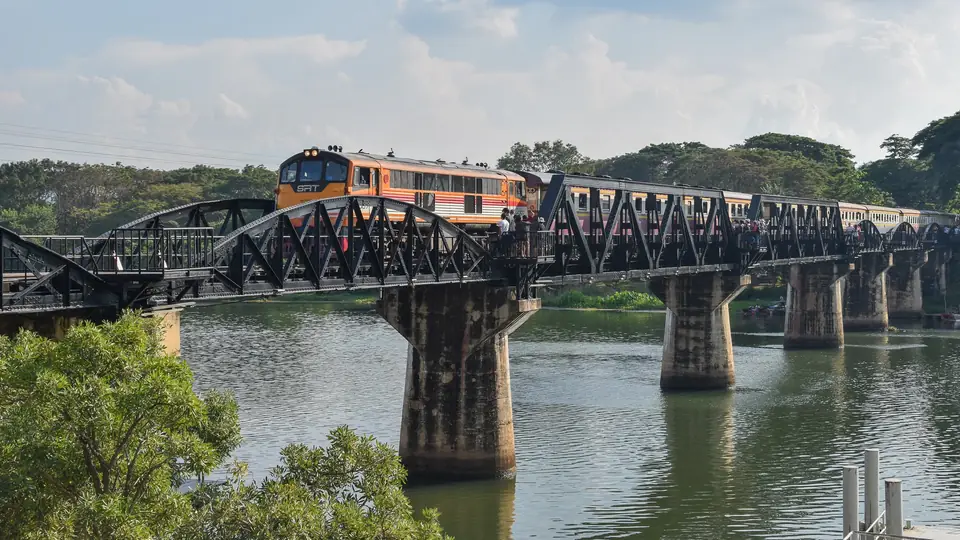
Death Railway
Bridge on the River Kwai Audio Guide (Saphan Khwae Yai)
A railway bridge of 1943 built by Allied prisoners and Asian labourers, patched after the bombings and still crossed daily by the train. The real story of Tamarkan is more human and more wounded than the film's.
- 45 min of audio
- Thailand-Burma Railway
The Bridge on the River Kwai, in Kanchanaburi, is part of the 415 km Thailand-Burma railway. Its steel and concrete were assembled in 1943 with eleven curved truss spans from a bridge dismantled in Java. More than 90,000 Asian civilians subjected to forced labour and about 12,000 Allied soldiers died building the line. Anyone looking for what to see at the Bridge on the River Kwai finds an engineering monument still in service, with pedestrians on the track and side platforms to step aside on when the train passes.
The silhouette tells the story of the war: between the original arches are two angular spans that replaced those brought down by the bombings of 1945. Add to that the contrast with the myth. Pierre Boulle's novel and the 1957 film angered the former prisoners, because the real officer at Tamarkan, Philip Toosey, never collaborated with the Japanese. And the river was not even called Kwai in 1942.
Highlights
- Curved steel spans — brought from a bridge dismantled in Java
- Two angular spans — the postwar repair after the 1945 bombings
- Side platforms — where pedestrians step aside when the train passes
- Black granite wall — the history of the bridge in Thai and English
- Philip Toosey — the real colonel of Tamarkan, far from the film
The history of the Bridge on the River Kwai begins on 26 October 1942, when the British prisoners of war assigned to build it arrived at Tamarkan, at kilometre 56 of the line. Since then the place has accumulated layers: a temporary wooden bridge, another of steel and concrete finished between May and June 1943, Allied bombings, a postwar repair and a cinematic fame that has little to do with what happened. The sources disagree on some completion dates and on casualty figures, and the tour treats them with that caution.
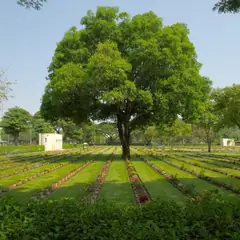
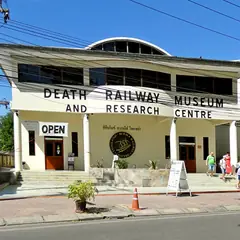
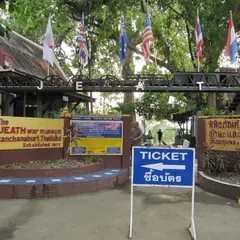
The audio guide itinerary, of about 45 minutes, goes from the locomotives on the city bank to the spans patched after the bombings and ends looking at the river from the opposite end. The full experience comes from following the narration on the deck itself. Those following the story of the Death Railway usually complete it with the Kanchanaburi War Cemetery, where those who built the line rest, with the Thailand-Burma Railway Centre, which explains the bridge’s route, and with the JEATH War Museum, the first museum dedicated to the prisoners.
Two locomotives and a plaque from 1942
River Kwai Bridge Station
Summary of this stop
The first stop is beside the Saphan Khwae Yai halt, at the foot of the bridge, where trains of the Thonburi–Nam Tok line and the weekend specials stop. On the south bank wait a plaque of the Thailand-Burma railway, a diesel rail-road trolley used in the works and a steam locomotive of the military line. A black granite wall, erected by the Municipality of Kanchanaburi, sums up the history of the bridge in Thai on the left and English on the right.
Here the first key to reading appears. The railway crosses the river at Tha Makham and not at Kanchanaburi itself because the ground there was more stable and the flood risk lower, although that forced an apparent detour of the line. Added to this is the human cost of the whole undertaking: more than 90,000 Asian civilians and about 12,000 Allied soldiers, according to the most quoted figure.
Casualty figures vary by source, and the detail of how that count is sustained is kept for the narration on the spot.
Arches from Java and sabotage with termites
Curved steel spans
Summary of this stop
From the first side platform of the deck one can see the curved steel spans: truss girders with an arched upper chord, resting on concrete piers. They are the eleven spans from a bridge dismantled in Java in 1942, although one Thai source speaks of iron brought from Malaya. It is the bridge that still stands today.
Beneath those arches a silent war was fought. Under the command of Lieutenant Colonel Philip Toosey, the prisoners secretly sabotaged the work: they collected termites in great numbers so that they would devour the wooden structures, and mixed the concrete badly.
This stop also brings in the figure of Boonpong Sirivejjabhandu, a Thai merchant from Kanchanaburi with a contract to supply the railway camps. According to documented tradition, he used that contract as a cover to smuggle in medicine, money and food, in collaboration with Toosey, at the risk of his own life and his family’s. He is credited with a drop in mortality among the prisoners from five deaths a day in May 1943 to one a week in November.
Two straight spans where the bombs fell
Angular spans in the centre
Summary of this stop
The scar of the war can be read in the silhouette itself. Opposite the central angular spans, two truss girders of rectangular profile break the sequence of arches. A plaque on the new spans records the postwar repair, and one source attributes those spans to Japan’s war reparations, while others cite the State Railway of Thailand.
Allied bombings brought down one of the eleven steel spans in mid-February 1945 and two others between April and June; the June raids left the line out of service until the end of the war. Earlier, on 29 November 1943, bombs had already fallen on the Tamarkan camp, then a convalescent camp and hospital, killing 18 prisoners and wounding 68.
This stop also dismantles the myth of the exploding bridge. According to documented tradition, on 10 March 1957 the filming of the movie at Kitulgala, in what was then Ceylon, had to repeat the demolition: the train went straight on until it crashed into a generator and the bridge blew up the following morning. The one in Kanchanaburi was never brought down by commandos.
The river without its wooden bridge
Steel spans at the far end
Summary of this stop
The last stretch of the tour leads to the opposite end of the bridge, where the six steel spans replaced the original wooden ones after the war. The surface of the Khwae Yai stretches about 100 metres from the current bridge, where the temporary wooden bridge built in early 1943 stood, later dismantled because it obstructed navigation. No visible remains are left; the exact position appears in the sources both upstream and downstream. To the east, the statue and shrine of the goddess Kuan Yin form the backdrop, raised despite local protests.
The name itself is another layer of the story. In 1942 that stretch was the upper Mae Klong and, in 1960, it was renamed Khwae Yai, “big tributary”; the name Kwai was born from the British pronunciation of khwae, which in Thai sounds like “buffalo”. As for the fiction, Pierre Boulle’s novel and the 1957 film with Alec Guinness as Colonel Nicholson angered the former prisoners, because Toosey never collaborated with the Japanese.
A human episode remains that the film did not tell. According to documented tradition, Sergeant Major Saito, the camp’s second in command, was considered less brutal than many guards. When the war ended, Toosey spoke in his favour and Saito was never tried; the two wrote to each other for years and, when Toosey died in 1975, Saito travelled from Japan to visit his grave. Meanwhile, the train still crosses the bridge daily, and the River Kwai Bridge Week stages every year, between late November and early December, a light and sound show in tribute to the prisoners and Asian workers.