War museum
Thailand-Burma Railway Centre Audio Guide
A two-storey museum across from Kanchanaburi's war cemetery turns 415 kilometres of Death Railway into a scale model, a rail wagon and a wall of rusty spikes.
- 75 min of audio
- Death Railway
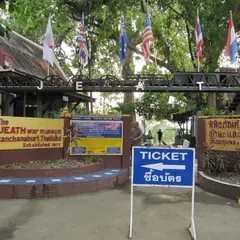
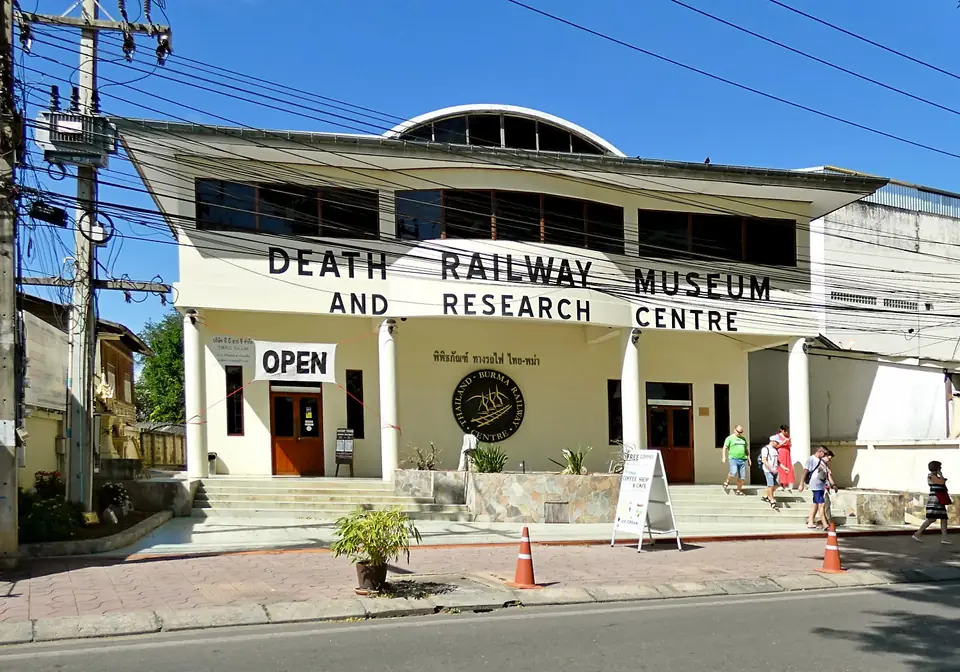
The Thailand-Burma Railway Centre was built between March 2001 and January 2003 on a plot beside the war cemetery and opened on 20 January 2003. It was founded by Rod Beattie, a civil engineer from Queensland who came to Thailand in 1990 as a consultant in the gem industry and ended up spending years mapping the route of the railway. More than 300,000 Australian dollars in donations from veterans, families and private individuals paid for a building with no sponsorship from governments or large companies.
The tour brings together a rice wagon that visitors walk through, a 9-metre topographic model with LED lights over each work camp and a histogram made of sleepers where each spike represents five hundred people dead. The museum also keeps a database with which families of more than 15,000 dead Allied men search for where their loved ones died, and a café overlooking the headstones of 6,982 Allied graves.
Highlights
- Rice wagon — replica of the freight cars that carried prisoners from Singapore and Malaya
- 9-metre topographic model at 1:50,000 scale with LEDs on every work camp
- Wall of sleepers — each spike represents five hundred people dead
- Nearly complete AZON bomb, the world's first guided weapon
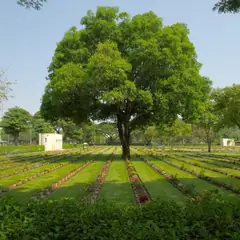
- Café with a panoramic view of the Kanchanaburi war cemetery
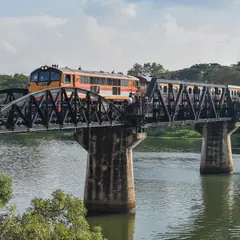
What to see at the Thailand-Burma Railway Centre and why its story matters: the cream-coloured building on Jaokannun Road, on the west side of Kanchanaburi’s war cemetery, explains how, why and at what price the railway between Thailand and Burma was built. Work began in June 1942 and the two halves of the line met in October 1943, after only sixteen months. More than 60,000 Allied prisoners of war and about 240,000 Asian workers were brought to it. The full experience comes from walking the museum with the EarGuide audio guide, which links each room to the stories of those who passed along the line. Its account of the line has its setting at the Bridge on the River Kwai, and across the road stretches the Kanchanaburi War Cemetery, with the graves of the prisoners the museum talks about.
A private museum facing the graves
Thailand-Burma Railway Centre
Summary of this stop
The museum occupies a two-storey building raised from scratch, with no connection to any earlier barracks. Some encyclopaedias in English and Thai describe it as the former headquarters of the Imperial Japanese Army built by prisoners, but the project’s founding record documents a new build between March 2001 and January 2003. That discrepancy is part of the place’s story.
Behind the building stands a man and a way of paying for it. Rod Beattie, a civil engineer from Queensland, came in 1990 for the gem business, settled in Kanchanaburi and from 1994 devoted his free time to mapping the line and gathering records, while supervising the city’s Commonwealth war cemeteries. The cost, above 300,000 Australian dollars, came from veterans, families, private individuals, a Thai benefactor and the promoters themselves.
The most personal detail of who this engineer was and why he stayed is left for the narration on the spot.
The rice wagon where men travelled
Wooden bridge and rice wagon
Summary of this stop
The visit starts under a replica wooden bridge built with the same techniques as the bridges of the railway. Then visitors walk through a replica of the freight wagons called rice wagons, the cars in which prisoners were moved from Singapore and Malaya to Thailand. Inside, an electronic fibre-optic map marks the routes of those transfers.
The context is given by the line itself: 415 kilometres begun simultaneously from Thanbyuzayat, in Burma, and from Nong Pladuk, in Thailand, under the direction of the 5th and 9th Railway Regiments of the Imperial Japanese Army. The cramped space of the wagon serves as an antechamber to that scale.
Nine metres for 415 kilometres of jungle
Topographic model of the Kwae valley
Summary of this stop
In the geography gallery, a topographic model 9 metres long at a scale of 1:50,000 traces with fibre optics the route of the line through the River Kwae valley. Buttons light LEDs that mark the confirmed location of all the work camps. Beside it are displayed a model of a trestle bridge and track relics.
The model also shows the later fate of the line. Around 1946-1947 the track and its rolling stock were sold to the Thai government, and in the late 1950s Thailand reopened the stretch between Nong Pladuk and Nam Tok, which remains in service. The rest of the route was swallowed by the jungle.
In the mid-1990s, Rod Beattie and his wife Thuy, eight months pregnant, cleared with machetes and chainsaws 4.5 km of railway bed in the Hellfire Pass cutting. The curator checked against his database of 105,000 prisoner records the claim, repeated even in some books, that Japanese guards killed 68 Australian prisoners there, and concluded that it does not hold up against the records. It is an episode of disputed history: the museum corrects its own myths file by file.
One spike for every five hundred dead
Wall of sleepers and spikes
Summary of this stop
In the death toll gallery, the figures by origin are shown in a histogram made of old railway sleepers studded with track spikes. Each spike represents five hundred people dead. More than 13,000 prisoners died between late 1942 and late 1945, and the deaths of Asian workers are around 100,000, although the figures vary by source: the Australian War Memorial and other profiles give somewhat different totals.
The period known as the speedo, in 1943, is the harshest point. Pressure from Tokyo to finish on time forced almost uninterrupted days of manual labour, with a record of 62 hours of work in 72, and its coincidence with the first cholera outbreak pushed mortality to its peak. Even the exact dates are not settled: the Centre’s website places it from July to October 1943 on one page and from March to September on another.
A story from the collection speaks of the Tonchan South camp, today without a single sign. There, according to the documented account, a quartermaster and three other men were beaten by a guard nicknamed the Tiger for having given up part of their rations to men of F and H Forces. The punishment says as much about the guard as about the men who, starving, still shared food.
The bomb, the coffee and the headstones
Thailand-Burma Railway Centre café
Summary of this stop
On the first floor, the end-of-the-railway gallery displays a nearly complete AZON bomb, the world’s first guided weapon, used to destroy bridges on the line. With it are a stretch of bomb-damaged rail, recovered from the route, and a 3-metre-deep model of a cutting dug at night.
The Centre also maintains a database of servicemen of all nationalities who died as prisoners on the project, compiled with the help of Dutch, Australian and British organisations. It serves to give answers to relatives of more than 15,000 dead Allied men: the daughter of Private Jack McCarthy learned this way for the first time where her father died, on 21 July 1943.
The café, with more than 50 seats, has picture windows with a panoramic view of the gardens of the war cemetery and its 6,982 Allied graves. Former prisoners and their families use it as a refuge on their pilgrimages. According to documented tradition, in November 2007 a prisoner’s daughter, Heather, travelled with the autograph book of her father, Donald William Ford, and the museum located in that cemetery the grave of Ford’s best friend, author of one of the poems in the book. The family left a copy there.