Old town
Pak Phraek Street Audio Guide (Thanon Pak Phraek)
Two kilometres of Sino-Western shophouses beside the city wall and the meeting point of the two Khwae rivers. The trading Kanchanaburi was born here in 1831, and a shopkeeper secretly helped the prisoners of the Death Railway.
- 40 min of audio
- Sino-Western architecture
Pak Phraek is the oldest urban community in Kanchanaburi. Around 1831, under Rama III, the city moved to this fork of the rivers, and Chinese and Vietnamese merchants settled to trade. What remains of that origin is the city's first concrete street, only two lanes wide, and a row of houses of one to three storeys built with imported Portland cement over bamboo frames.
Behind the neighbourhood-shop facades lies a larger story. This stretch was home to the shop of Boonpong Sirivejjabhandu, who used his supply contract with the Imperial Japanese Army as a cover to get medicine, money and food to the prisoner camps. At the end of the street, the temple of Wat Thewa Sangkharam keeps the legend of a monk who came back from Burma as a captive.
Highlights
- Kanchanaburi's first concrete street, about 2 km long, running parallel to the city wall and the Khwae Yai river
- Ban Sitthisang, a Sino-Portuguese house of 1920 painted with paddy-field soil and glutinous rice water
- Ban Boonpong & Brother, the 1917 shop from which the prisoners were secretly helped
- Sumitrakhan, Kanchanaburi's first hotel, and the Kanchanaburi Hotel with its coloured glass
- Wat Thewa Sangkharam and the legend of the monk who returned from Burma
What to see on Pak Phraek Street, the old town of Kanchanaburi, is above all a matter of facades and stories. The street runs about 2 km parallel to the city wall and the Khwae Yai river, and gathers shophouses of one to three storeys with balconies, stained glass, folding doors and openwork lattices. Its history begins around 1831, when the city moved to the meeting point of the two rivers, and runs down to the Second World War, with a merchant who saved lives under the watch of the Japanese army. Every Saturday, from 16:00 to 21:00, the neighbourhood project “177 Years of Pak Phraek” turns the street into a pedestrian market with food and crafts. The full experience comes from walking it with the audio guide, from the city gate to the temple at the northern end. As part of the old town, it connects with the Kanchanaburi City Gate, a remnant of the same wall, and with the JEATH War Museum, also by the river.
Two rivers and a change of name
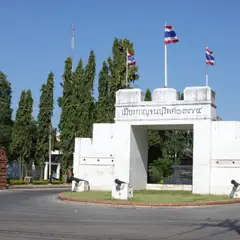
Kanchanaburi City Gate
Summary of this stop
The walk starts in front of the gate in the wall, from Lak Mueang Road, where the houses line up along the wall parallel to the Khwae Yai. The name Pak Phraek comes from the Chinese “Pak Phek”, meaning “fork”: in this tambon the Khwae Noi and the Khwae Yai join to form the Mae Klong. Burmese documents call the place “Mie Song”, “rivers that meet”.
Around 1831 (2374 of the Buddhist Era), under Rama III, Kanchanaburi moved from Tha Sao, at the foot of Khao Chon Kai, to this spot. Chinese and Vietnamese merchants settled to trade and gave rise to the oldest urban community in the city, also called Ban Nuea. The sources do not fully agree on the year of the move: some give 1831 and others add 1833.
The street was the first concrete one in Kanchanaburi. It has only two lanes and is about 2 km long. Why that move changed the city is best told on the spot, with the audio guide.
The house painted with rice water
Sitthisang Coffee
Summary of this stop
From the reign of Rama IV, shophouses of one or two storeys were built with imported Portland cement over frames of mai ruak bamboo, almost always by Chinese master builders. The detached houses of the wealthy merchants, of brick and mortar, served as both home and business, and have eaves of around 1 m.
The facade of Ban Sitthisang, today Sitthisang Coffee, is the best example. It was built in 1920 (2463 of the Buddhist Era) as a two-storey Sino-Portuguese building with three bays, an arched balcony, stucco capitals, folding doors and openwork lattices with plant motifs. Its paint was made from the soil of the Thung Na Khrat paddy fields, strained and mixed with glutinous rice water. Today the house works as a café.
The shophouses here are no mere scenery: they are still open for business, and on Saturday afternoons the whole street does the same with its pedestrian market.
The shop that supplied both sides
Ban Boonpong & Brother
Summary of this stop
Ban Boonpong & Brother is a building of three storeys and three bays, put up in 1917 (2460 of the Buddhist Era) by Khun Siriwetchaphan, Boonpong’s father. At the time it was the only one of its kind on the street. Its facade keeps balconies, drip mouldings, coloured-glass fanlights, panelled doors and a rooftop terrace. During the Second World War it was the shop that sold provisions and goods to the Japanese soldiers.
Behind that counter worked Boonpong Sirivejjabhandu (1906-1982), a member of the clandestine “V” organisation. He used his supply contract with the Imperial Japanese Army as a cover to bring medicine, money and food into the prisoner camps of the Burma Railway. With that medicine, mortality fell from five deaths a day in May 1943 to one a week in November. He received the British King’s Medal for Courage and the rank of officer of the Order of Orange-Nassau. The sources differ on the details of his decorations and even on the spelling of his surname.
The postwar years left a dark episode. According to documented tradition, Boonpong was assaulted by the Thai police in a mistaken reprisal. The Australian surgeon Weary Dunlop had a report drawn up on the “injured Thai civilian” who had done so much for the prisoners. In 1947, in financial difficulty, an association of former prisoners organised a collection on his behalf. Soon afterwards he founded the Boonpong bus company, and later an Australian medical scholarship carried his name alongside Dunlop’s. The end of the story is kept for the narration on the spot.
Timber merchants’ hotels, guests in uniform
Hotel Sumitrakhan
Summary of this stop
The street also served as a gateway to the frontier. The Sumitrakhan Hotel, Kanchanaburi’s first hotel, is a row of five bays and two storeys, half brick and half timber, built in 1937 (2480 of the Buddhist Era) by Luang Kraison. It began as rental houses; the upper floor was partitioned into rooms above a restaurant and put up timber merchants from Thong Pha Phum and Sangkhla Buri. During the war it received Japanese soldiers. Today its ground floor sells food and pet supplies.
The Kanchanaburi Hotel, which predates the Second World War, had 14 rooms at 2-4 baht a night. It was used mostly by timber merchants, officials and people from the border minorities. Its China-born owner copied it from buildings in his homeland, and the third-floor windows have coloured glass in their frames, between two balconies.
The war took over other houses too. Japanese officers rented Ban Sahakul Phanit as lodgings and mounted a machine gun on its roof, and the house keeps an air-raid shelter in the basement intact.
The monk who came back from Burma
Wat Thewa Sangkharam
Summary of this stop
The walk ends in the courtyard of Wat Thewa Sangkharam, known as Wat Nuea, at the northern end of the street. It was founded by Abbot Siang, a resident of old Kanchanaburi who was deported to Burma with his mother as a novice after the fall of Ayutthaya in 1767. Its official founding dates from 1825 (2368 of the Buddhist Era), a date earlier than the city’s move, which the account of his return itself cannot quite square.
According to documented tradition, once ordained a monk in Burma, Siang longed to return, and his mother told him where she had buried their belongings in the old city. On coming back with five or six Thais he found the city moved to Pak Phraek and the old one about to be abandoned. Instead of building his monastery there, he decided to build it next to the new city, first as a residence for monks and later with its ordination hall.
The temple keeps an old ubosot with stacked Ayutthaya-style roofs and a mondop with two statues of men in high-collared jackets on either side of the entrance. The pediment of the new ubosot bears the emblem of Khana Ratsadon, the People’s Party, because it was paid for with the kathin offering organised by Phraya Phahon Phonphayuhasena, the second prime minister, who was married to two women from Kanchanaburi. In the old ubosot, a mural shows a figure pulling by hand at the two painted bands that the painter could not make meet.
The neighbourhood also gave Thai Buddhism its supreme authority: Somdet Phra Ñanasamvara (Charoen Suvaddhano), the 19th Supreme Patriarch of the Rattanakosin era, was born and studied in Pak Phraek before his ordination. His birthplace was demolished and the new house of his descendants now stands on the same plot. As a child, according to documented tradition, his favourite game was dressing as a monk and giving “sermons” to friends and family.