Frontier history
Kanchanaburi City Gate Audio Guide (Pratu Mueang Kanchanaburi)
A white crenellated gate, with cannons in front and a stretch of brick beside it, is all that remains standing of Rama III's wall. It is the birth certificate of today's Kanchanaburi.
- 25 min of audio
- Rama III's wall
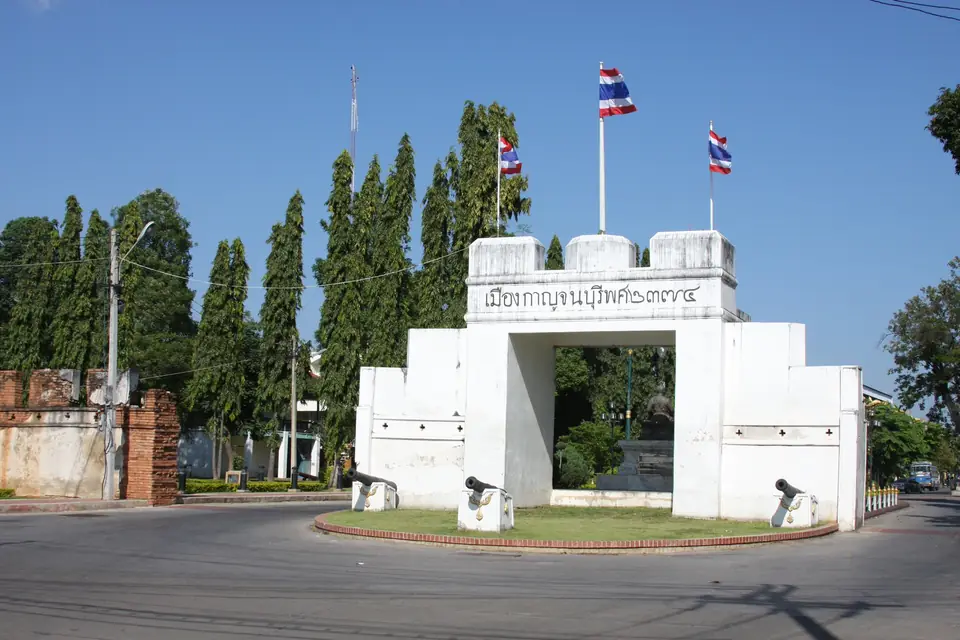
The gate is the last remnant of the enclosure that Rama III ordered built around 1831, when the border city came down from the hill to the meeting of the rivers. A single opening in a whitewashed block, crowned with square battlements and flanked by stepped walls, holds a sign with the city's name in Thai letters. The cannons on white pedestals and the tricolour flags complete an image that evokes the military past of the place.
The contrast is strong: what now looks like roundabout decoration presided over an enclosure of about 200 by 436 metres with forts at all four corners. Beyond the gate there is no longer a continuous wall, only streets, houses and public buildings on the old perimeter. Above the arch, moreover, the city's name points to Khun Phaen, the hero of a great Thai popular poem that Kanchanaburi claims as its own.
Highlights
- Whitewashed, crenellated gate — the only standing remnant of Rama III's enclosure
- Old cannons before the arch, with a frontier air
- Enclosure of about 200 × 436 metres with forts at the corners
- Stretch of red-brick wall beside the gate
- Khun Phaen, the poem hero the city claims as its own
What to see at the Kanchanaburi City Gate can be summed up in one image: a white block with battlements, several old cannons in front and a piece of brick wall at one side. It is what survives of the wall ordered by Rama III, whose construction began on 8 March 2374 and ended on 17 May 2375 of the Buddhist Era, around 1831-1832. The exact date of the move and of the wall is disputed depending on the source, and the conversion to the current calendar is approximate.
The history of the gate is that of a frontier that changed place. In the late 18th century, Rama I established Kanchanaburi as a defensive outpost against Burma at Lat Ya, at the foot of Khao Chon Kai. After the war of 1785, the military base came down to Pak Phraek, at the meeting of the Khwae Yai and the Khwae Noi. The full experience of the gate’s history comes from walking the site with the audio guide. The gate is part of the old town, with Pak Phraek Street running along the wall and the JEATH War Museum about 470 m away. Somewhat farther, about 3.6 km away, Wat Tham Khao Pun adds the religious and wartime side of the same region.
Cannons before the last gate
Kanchanaburi City Gate
Summary of this stop
In front of the white gate, the scene at first glance looks like a roundabout ornament. A single passage opens in a whitewashed block crowned with square battlements, with stepped side walls, and several cannons on white pedestals point toward the street. Flagpoles with the Thai tricolour rise above the gate and beside it.
What looks like decoration is the only thing standing of an enclosure of about 200 by 436 metres, with a fort at each of the four corners, a large fort on a mound on the southwest front and a small one opposite. The wall of 1831 vanished through natural decay and through demolitions by the administration itself for other uses, and beyond the gate streets, houses and public buildings now occupy its perimeter. The measurements vary slightly depending on the transcription of Rama V’s account.
Above the arch, a sign in Thai letters bears the city’s name. Kanchanaburi presents itself as “Mueang Khun Phaen”, the city of Khun Phaen, and so the province’s official motto begins. According to documented tradition, Khun Phaen is the hero of the poem Khun Chang Khun Phaen: a soldier, seducer and master of spells, who in the end comes to govern the city with the title of Phraya Kanchanaburi. On Khao Chon Kai, the hill above the old city, there is a shrine with images of Khun Phaen and his father, Khun Krai. The most surprising detail is kept for the narration heard on the spot.
Why the frontier came down to the river
Brick wall beside the gate
Summary of this stop
Beside the gate, the stretch of red-brick wall, partly plastered, introduces the twist in the story. The old Kanchanaburi of Lat Ya, rectangular in plan at about 170 by 355 metres and with corner forts of earth and stone, was wedged into a pass between hills on the Khwae Yai, about 15 km northwest of the current gate. The distance is given as 14, 15 or 16 km depending on the source.
The war of 1785-1786 taught the lesson. In the battle of Thung Lat Ya, Prince Maha Sura Singhanat took his troops out of camp at night and brought them back in by day to feign reinforcements; on 18 February 1786 he launched the final assault and Bodawpaya’s army withdrew. That same prince also set up a camp at Pak Phraek, where the centre of Kanchanaburi stands today.
The reason for the move was strategic: a Burmese attack on the new capital had to come by fleet downriver from Sangkhla Buri along the Khwae Noi, right to the meeting point where the Mae Klong begins. Trade was added to this. In his account of the journey to Sai Yok, Rama V explained that the old city lay upriver behind two rapids that made things hard for merchants, while Pak Phraek opened an easy road to Ratchaburi. Pak Phraek remains today an alternative name for Kanchanaburi and that of the subdistrict where the provincial government seat is.
From palisade to Rama III’s brick
Southern stretch of the wall
Summary of this stop
On the southern stretch of the wall, the story passes from wood to brick. The first Kanchanaburi at Pak Phraek had no masonry wall: it was enclosed with a palisade of wooden posts and an earth embankment. According to documented tradition, in the time of Rama II Prince Chetsadabodin came out here at the head of troops to block the way of the Burmese armies.
That same prince rose to the throne as Rama III and, as king, ordered the palisade replaced with a permanent wall and bastions. A stone inscription records the order: Kanchanaburi was a passing place for the English, Burmese and Mon, and was to become a bulwark of the kingdom. The commission fell to Phraya Ratchawarin, chief of the royal police, appointed governor.
Between 2368 and 2375 of the Buddhist Era, the years of the move and of the wall, the city was governed by Phraya Prasit Songkhram, nicknamed “the red-eyed governor” (Chao Mueang Ta Daeng). The gate thus has a personal history: the king who ordered it built knew the frontier from the inside, having guarded it in his youth behind a simple wooden fence.