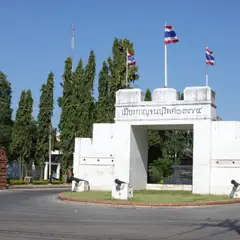
Cave temple
Wat Tham Khao Pun Audio Guide
A cave temple on a limestone hill above the Khwae Noi river, with grottoes full of Buddhas and Hindu gods. The same hill gave its name to the Chungkai prisoner camp.
- 40 min of audio
- Cave above the Khwae Noi river
Four kilometres from Kanchanaburi, beside Highway 3228, Wat Tham Khao Pun occupies a hillside overlooking the Khwae Noi river. It is a community temple of the Maha Nikaya order, in the subdistrict of Nong Ya, and inside it opens a large system of limestone caves in which each grotto shows a statue of the Buddha at a different stage of his life.
The name of the hill has a second path. The prisoners of war of the neighbouring Chungkai camp, at the foot of this stretch of the Death Railway, wrote it Kao Poon or Kaopon. From the terrace of the golden chedi and from the viewpoint, local devotion and the memory of the war fit into a single glance.
Highlights
- Cave of chambers and narrow passages — entry by donation and exit at another point of the hill
- Grottoes with a Buddha statue at each stage of his life, beside Hindu deities
- Great reclining Buddha — deeply venerated by the people of Kanchanaburi
- Golden chedi above the valley of the former Chungkai camp, which treated 19,975 patients
- Giant Chinese-style Buddha facing the Khwae Noi river and the railway line
What to see at Wat Tham Khao Pun: a limestone cave turned into a temple, a hill with two overlapping histories and a balcony over the Khwae Noi river. The compound, 4 km from Kanchanaburi, is a community temple (wat ratsadon) of the Maha Nikaya order. Its labyrinth of grottoes gathers statues of the Buddha and of Hindu deities, and a great reclining Buddha receives special veneration from the local population.
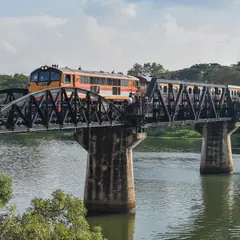
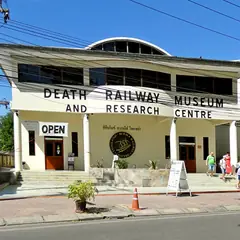
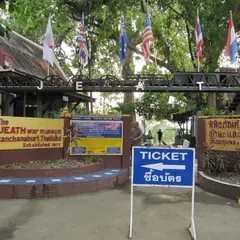
The history of Wat Tham Khao Pun is not exhausted by the religious. The Chungkai prisoner camp, at the foot of this stretch of the Death Railway, was also recorded as “Kao Poon” or “Kaopon”, and the hill has an Allied cemetery that carries its name in Thai. The full experience, with the stories of the camp and the valley, comes from walking it with the audio guide. Its memory of the war is completed by the JEATH War Museum, and by the Bridge on the River Kwai, a key work of the same railway line that linked the camps of the valley.
The hill that gave a camp its name
Wat Tham Khao Pun
Summary of this stop
The temple esplanade lies on a hillside overlooking the Khwae Noi, beside Highway 3228 and about 4 km from Kanchanaburi. It is a neighbourhood temple of the Maha Nikaya order, located in the subdistrict of Nong Ya, Mueang Kanchanaburi district.
The name of the hill, Khao Pun, is the key to reading the rest. The records of the Chungkai prisoner camp also give it as “Kao Poon” and “Kaopon”. Chungkai was 57 km from Non Pladuk, at the meeting of the Mae Khlong and the Khwae Noi, and was the headquarters of prisoner group 2.
At this point one begins to understand why a temple and a war camp share a name. The detail that joins both stories is left for the narration on the spot.
A donation and the rock brushing your shoulders
Khao Pun Cave
Summary of this stop
The mouth of the cave marks the passage from light to half-light. Entry is in exchange for a donation, and the Khao Pun system is not a single grotto, but several chambers joined by a web of narrow passages.
The route is not out and back: one enters at one point of the hill and leaves by another. The narrow corridors, with the rock close on both sides, are part of the character of the visit.
A life of the Buddha told in stone
Grottoes with scenes from the life of the Buddha
Summary of this stop
The inner chambers have a plot. Each grotto shows a statue of the Buddha at a different stage of his life, so that the underground route works as a biography of the Buddha in stone, followed in order.
Among those Buddhist images, statues of Hindu deities also coexist, arranged in the same chambers. The whole reflects a devotional atmosphere in which both traditions share space.
A great reclining Buddha, surrounded by offerings, is an object of special veneration by the people of Kanchanaburi. It is one of the points where it is most noticeable that this temple is, above all, a living place for the community.
Golden chedi above the Chungkai camp
Chedi Thong Wat Tham Khao Pun
Summary of this stop
From the terrace of the golden chedi (Chedi Thong), visible from the whole esplanade, the gaze drops to the valley where the Chungkai camp stood. The Japanese 9th Railway Regiment had it in its charge between October 1942 and September 1944. It was first a work camp and, from March 1943, one of the main prisoner hospitals in Thailand.
The camp and hospital closed in June 1945, after having treated 19,975 patients. According to documented tradition, the prisoners of group II set up clandestine radios there to follow the news of the war behind their guards’ backs: one hidden in a water bottle, another in a cylindrical cigarette tin and another in a flat biscuit tin. One of those bottle radios was carried by Captain Reginald W. J. Newton, nicknamed “Roaring Reggie”, from 1942 until August 1945.
The full episode of the radios, and what those who kept them going risked, is kept for the audio guide.
The Chinese Buddha watching over the railway
River and Mountain Viewpoint
Summary of this stop
From the river and mountain viewpoint, south of the temple, one sees the Khwae Noi, the valley and the route of the Death Railway. A giant Chinese-style Buddha statue dominates from Khao Pun the river and the railway line, which at this point leaves Kanchanaburi heading south.
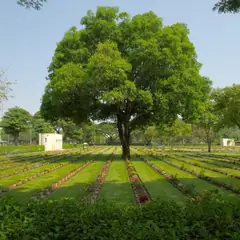
At the foot of the hill, the Chungkai Allied cemetery bears in Thai the name Suksan Thahan Samphanthamit Khao Pun. It covers about 7 rai on the banks of the Khwae Noi, holds the graves of prisoners, mostly British, and was designed by the British architect Colin St Clair Oakes. North of the temple, the Khao Pun halt (code 4059, KPU, km 124.55) is still in service on the line. The old Khao Pun station, at km 121.55, was downgraded to a halt on 13 June 1968 and moved to its current site on 1 January 1977.
According to documented tradition, the Chungkai camp flooded every year with the monsoon, and in 1944 it did so twice. The prisoners who could swim guided to the camp the great logs the flood carried down, to feed the cooking fires, and the hollow of the theatre, turned into a pool, served as a swimming pool. That story, which closes the circle between devotion and survival, has its place in the narration at the viewpoint itself.