History of Phuket
Heroines Monument Audio Guide (Thao Thep Kasattri and Thao Si Sunthon Monument)
On a roundabout in Thalang, two sisters with a sword recall how an island with no governor resisted a Burmese fleet in 1786. Their silhouette is today the official seal of Phuket province.
- 20 min of audio
- Defence of Thalang, 1786
The monument stands at the Tha Rua junction, in Thalang district, the old heart of the island. It was built in 1966 and inaugurated by King Bhumibol Adulyadej on 23 May 1967. It remembers Chan and Muk, daughters of a local chief and a Malay woman who had come from Kedah, who organised the defence of Thalang against the Burmese general Wungyi.
The story the pedestal celebrates has a less bright side. A generation later, in 1810, Thalang was razed in a new invasion, and the family's letters to a British merchant speak of hardship. Between the two extremes, the island also keeps a legend: that of the women disguised as soldiers on the ramparts.
Highlights
- White pedestal with the two sisters, Thao Thep Kasattri and Thao Si Sunthon
- North-face inscription dating the defence to the Buddhist year 2328
- Cannons with names of their own and a siege of about a month in 1786
- Image of the monument turned into Phuket's official seal since 1985
- Offering altar with garlands, candles and yellow flowers
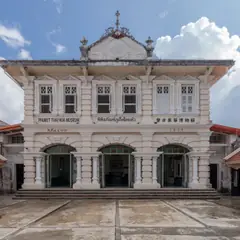
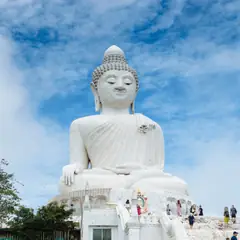
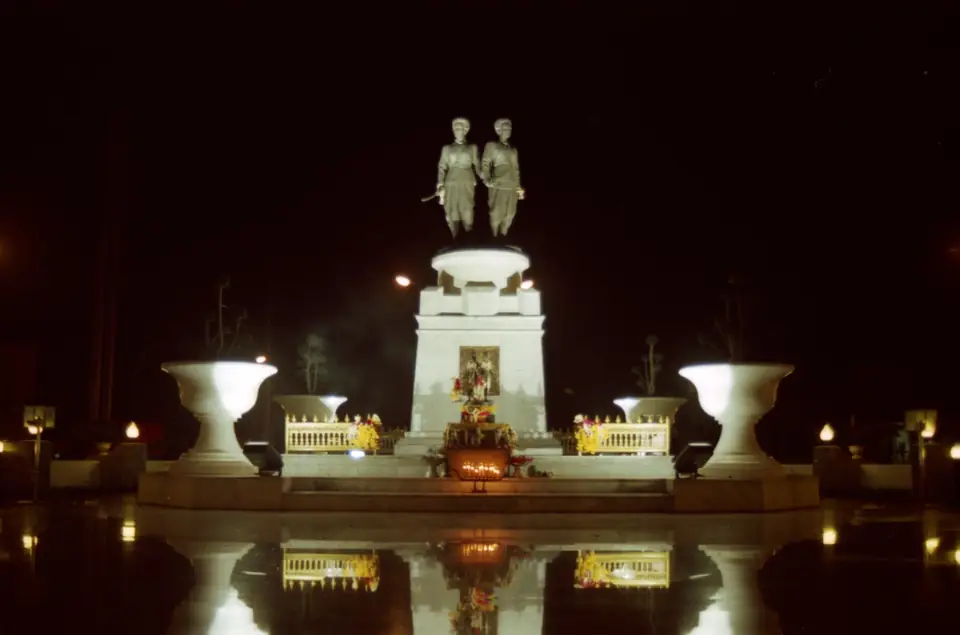
What to see at the Heroines Monument: a white pedestal in the middle of the Tha Rua roundabout, with the traffic of the airport road circling around it, Thai and royal yellow flags, and two female figures at the top, at least one of them with a sword. The history of the Heroines Monument begins in 1786, when Chan and Muk, together with Chan’s son Thien and their cousin Thongpun, organised the defence of Thalang against a Burmese fleet of 3,000 men. The monument was built in 1966 and inaugurated in 1967. Thalang was then the largest settlement on the island; the present city of Phuket was not founded until 1827. The full experience, with what the pedestal does not tell, is best enjoyed on site with the audio guide. Its story connects with the history of Phuket told in the Phuket Thai Hua Museum, and among the island’s great monuments it shares the stage with the Phuket Big Buddha.
Phuket’s seal on a roundabout
Heroines Monument
Summary of this stop
The monument was raised in 1966 (year 2509 of the Buddhist era) at the Tha Rua junction, in the tambon of Si Sunthon, Thalang district. In 1985 the image of the group, inside a circle with kanok ornament, became the official seal of Phuket province, so the silhouette of the two sisters appears on official signs all over the island. Phuket’s emblem is thus born in the old heart of the island and not in Phuket city.
The north face of the pedestal, the front one, carries an inscription in Thai that dates the defence of Thalang to the year of the snake 2328 and the building of the monument to 2509. The group also includes a poem by Prince Krom Phra Narathip Praphanphong. The date of the victory is a matter of debate: the inscription places it in 1785, while the historiography based on the Thalang letters dates it to 13 March 1786. The difference fits the old Siamese reckoning, in which the year changed in April.
At the foot of the pedestal, an altar receives garlands, candles, yellow flowers and elephant figures left by devotees. Huge white cups frame the circular plaza and a gilded balustrade surrounds the base. Before they were statues, Chan and Muk were characters in film, television and illustration, according to documented tradition: Suek Thalang (1956), the series Songkhram Kao Thap (1988), Ying Kraeng Mueang Thalang (2006) and the drawings of Hem Vejakorn around 1969. The original model of the sculptural group is kept in the Sculpture Prototype Hall. How that earlier fame shaped the image seen today at the top is explained by listening to the narration on the spot.
A widow arrested before three thousand Burmese
Statues of Thao Thep Kasattri and Thao Si Sunthon
Summary of this stop
On the west side, the two figures are at the height of an upward gaze. Chan, born around 1735, and Muk, around 1737, were daughters of Chom Rang, local chief of Thalang Ban Takhian, and of Masia, a Malay woman who had come from Kedah. The titles they now bear on the monument they received later, from the king’s hand.
The context of the invasion explains the weight of the moment. In December 1785 Phra Phimol, governor of Thalang and Chan’s husband, died, and the city was left without a governor as the threat approached. Shortly before, Chan had been arrested by Phraya Thammatrailok to be tried at Pak Phra, and she returned to Thalang when the Burmese took that town. General Wungyi set sail with a fleet of 3,000 men and launched the assault on Thalang in February 1786, as part of King Bodawpaya’s War of the Nine Armies. A newly freed widow thus found herself at the head of a city with no governor.
Two named cannons and a month of siege
Sword of the statues
Summary of this stop
The south side of the pedestal condenses the military scene. According to the sources, Chan and Muk fortified Wat Phra Nang Sang with a cannon called Mae Nang Klang Mueang, while their cousin Thongpun defended Thung Nang Dak with another, Phra Phirun Sanghan. The Burmese landed at Tha Taphao. The British merchant Francis Light, a friend of Chan’s family, supplied the defenders with matchlocks; in 1786 he left Thalang for the island of Penang and kept corresponding with the family.
After about a month of continuous fighting, the Burmese withdrew from Thalang on 13 March 1786. Against this chronicle of camps and cannon fire, the island keeps a brighter legend. The legend says that, with the governor newly dead, Chan and Muk ordered the women to dress as soldiers and take position on the ramparts, and that the Burmese, believing they saw a larger garrison, gave up the assault. The chronicle of the fighting mentions no disguises, but every 13 March the island celebrates the two sisters at the Thao Thep Krasattri and Thao Si Sunthon fair.
The king’s titles on the map, hardship in the letters
View towards Route 402
Summary of this stop
From the east side, looking towards Route 402, the titles that King Rama I granted after the war remain in the territory. Chan received that of Thao Thep Kasattri and Muk that of Thao Si Sunthon, the names the monument bears. In 1940 the tambon of Liphon, where it stands, was renamed Si Sunthon, and another tambon of Thalang is called Thep Krasattri. According to tradition, the old name Liphon derives from “Ban Lik Phon”, “the place where they escaped”, after the neighbours who took refuge there without the Burmese soldiers finding them.
The glory had a less festive end. Thalang fell in 1810 in a new Burmese invasion and was razed completely; Thien, Chan’s son and governor of the city, was taken captive to Burma. Earlier, from Penang, Francis Light had kept receiving letters from the family written in old Thai. In 1788 Prang, Chan’s eldest daughter, confessed to him that she lived every day in great difficulty, and in 1792 Thien asked him for compassion for his mother, by then old, sick and in straitened circumstances. Those intimate letters, which the audio guide narration takes up on the spot, show what came after the victory celebrated by the roundabout.