Monumental Buddha
Phuket Big Buddha Audio Guide (Phra Phutta Ming Mongkol Eknakiri)
A 45-metre seated Buddha, clad in white Burmese marble, crowns Nakkerd Hill. Thousands of donations and signed plaques raised it, and the mountain that carries it ended up taking its toll.
- 60 min of audio
- Burmese marble and naga legend
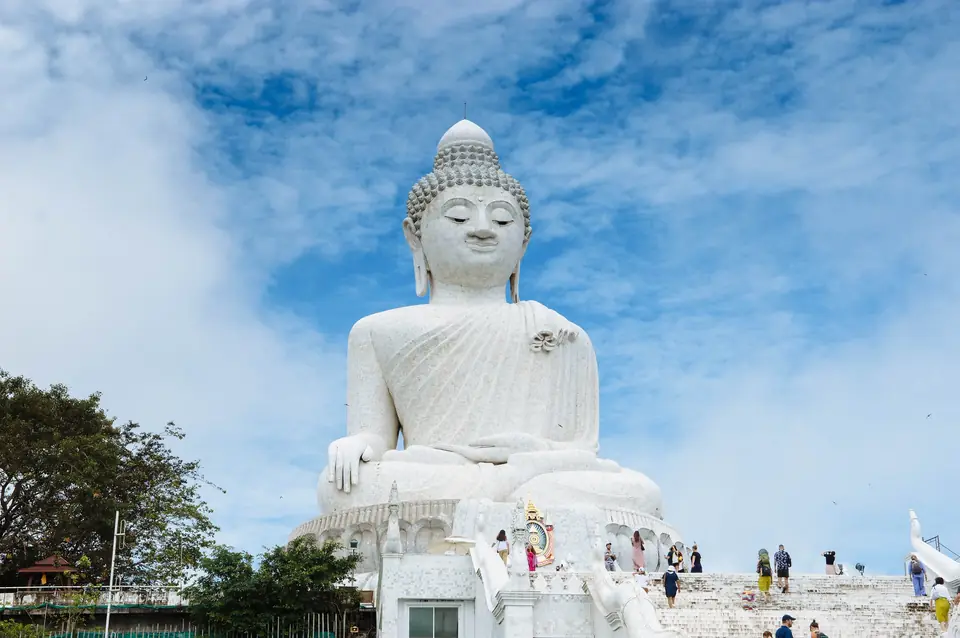
The foundation stone was laid on 26 May 2002, and the budget of 30 million baht was gathered from donations by the public. The result is a concrete core 45 metres high and 25.45 wide, clad in white Suriyakanta jade-type marble, with about 135 tonnes imported from Myanmar. It is the principal image of Wat Kitti Sangkharam, known as Wat Kata.
The monument has two faces. According to legend, this summit is where some nagas were reborn in light after hearing the Buddha. In August 2024, after torrential rain, a mudslide broke loose just below the statue and killed 13 people. The site stayed closed for 18 months and reopened on a stable basis on 3 March 2026.
Highlights
- A 94-step staircase guarded by two naga serpents
- 45 metres of white Burmese marble, plaque by plaque
- Circular viewpoint over Kata, Kata Noi and Chalong Bay
- The 2024 landslide and the 2026 reopening
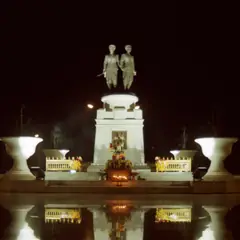
What to see at the Phuket Big Buddha begins with the figures: 45 metres high, a concrete core clad in white Burmese marble and a foundation anchored to the mountain with 50 reinforced-concrete piles that go down 12 metres. General Phijit Kulawanich, a member of the King’s Privy Council, laid the foundation stone on 26 May 2002, and the work was paid for with donations. Anyone looking into the history of the Phuket Big Buddha also finds a hill of legend, a royal dedication, the title of Buddhist treasure and an 18-month closure. The full experience is best enjoyed on site with the audio guide. Together with Wat Chalong it forms the two great Buddhist sites of the island’s south, and among Phuket’s great monuments it is joined by the Heroines Monument.
Two serpents on Naga Hill
Staircase of the two nagas
Summary of this stop
The route starts at the foot of the naga staircase, where two serpents guard the 94 steps that climb from the terrace to the base of the Buddha. Some visitors count 97, a minor difference that is part of local conversation. From there the statue is seen head-on: 45 metres high and 25.45 wide, with its face turned 19 degrees to the northeast, towards Chalong Bay.
The official name, Phra Phutta Ming Mongkol Eknakakiri, mixes Thai, Sanskrit and Pali and means “the beloved and auspicious Lord Buddha on Naga Hill”. Local legend explains the name of the mountain, Nak Kerd, “where the nagas are born”. It tells that the Buddha came to the coast of Phuket, climbed to this summit at the invitation of the gods and the nagas, and preached to them. The nagas who grasped the teaching were reborn in heaven with a luminous body, and the villagers who saw the glow gave the mountain its name.
The statue is the principal image of Wat Kitti Sangkharam, known as Wat Kata. Why two serpents guard this particular climb is a detail that makes sense when the narration is heard on the spot.
Thousands of names beneath the white marble
Big Buddha Phuket
Summary of this stop
At the base, facing the Buddha’s face, the giant breaks down into thousands of white marble plaques whose joints can be made out up close. The cladding is a jade-type marble called Suriyakanta, of which about 135 tonnes were imported from Myanmar. The budget was 30 million baht, and the work began in the Buddhist year 2545 (2002), financed by donations from the public.
The fundraising formula has a feature of its own: visitors sponsor marble plaques and write their names on them before they are built into the work. On a pedestal of stylised lotuses, the Buddhist symbol of the purity of the mind, the statue is thus made in part of anonymous names.
The complex was not born on this summit either. According to the version found in the disputed history of the monument, work began next to Kata beach, and the size of the project forced it to be moved to Nak Kerd Hill, onto land that a devotee had donated to the temple. In March 2007 it was announced as the largest seated Buddha in the world in its posture, a record ambition that time has toned down. A minor dating issue accompanies the monument: some sources place the start in 2004, while the foundation stone and other editions point to 2002.
The mountain that gave way beneath the Buddha
Rear terrace with views of Kata
Summary of this stop
The rear terrace offers a quieter atmosphere, with the wooded slope in view. The statue was built inside the Khao Nak Kerd national forest reserve, with the authorisation of Thailand’s Royal Forest Department. That slope is also the setting of the site’s most recent wound.
On 23 August 2024, after torrential rain, a mudslide broke away just below the Big Buddha. Thirteen people died, a Russian couple, nine Burmese workers and two Thais, and 209 households were affected. That same month the Forest Department filed a complaint with the Phuket police against the chairman of the Big Buddha Foundation for alleged encroachment on Khao Nak Kerd land; the authorised buildable area was 2.4 hectares.
Responsibility for the landslide is a disputed matter. The clearing of the mountain was pointed to as an aggravating factor and the foundation was accused of exceeding what was authorised, but the debate remains open and the narration on site presents it with that nuance.
Phra Yai, a Buddhist treasure reopened on Makha Bucha
Small temple and construction hall
Summary of this stop
The way down passes a small temple with monks and amulets and a hall with information on the construction. Beneath the platform unfinished works remain, more than twenty years after the foundation stone. Two prestigious milestones fit here: the Big Buddha was dedicated at the royal ceremony for King Bhumibol Adulyadej’s 80th birthday, on 5 December 2007, and in 2008 the Supreme Patriarch of Thailand, Somdet Phra Yanasangwon, declared the statue a “Buddhist Treasure of Phuket”.
The site closed on 23 August 2024. It reopened for just three days on 1 January 2026 and reopened on a stable basis on 3 March 2026, the day of Makha Bucha, after 18 months closed and 25 conditions from the Forest Department.
Nobody in Phuket uses the long official name: the statue is Phra Yai, “the Big Buddha”, or Luang Pho To Phuket. According to an old Thai saying, whoever is in Phuket and has not yet climbed up to see the Big Buddha has not truly arrived on the island. The close of the route plays on that idea.