Sino-Portuguese old town
Thalang Road Audio Guide
Phuket's old “head of the market”: a street of 151 shophouses with very long plots and five-foot covered walkways, raised with tin money and brought back to life since 2010.
- 45 min of audio
- Sino-Portuguese shophouses
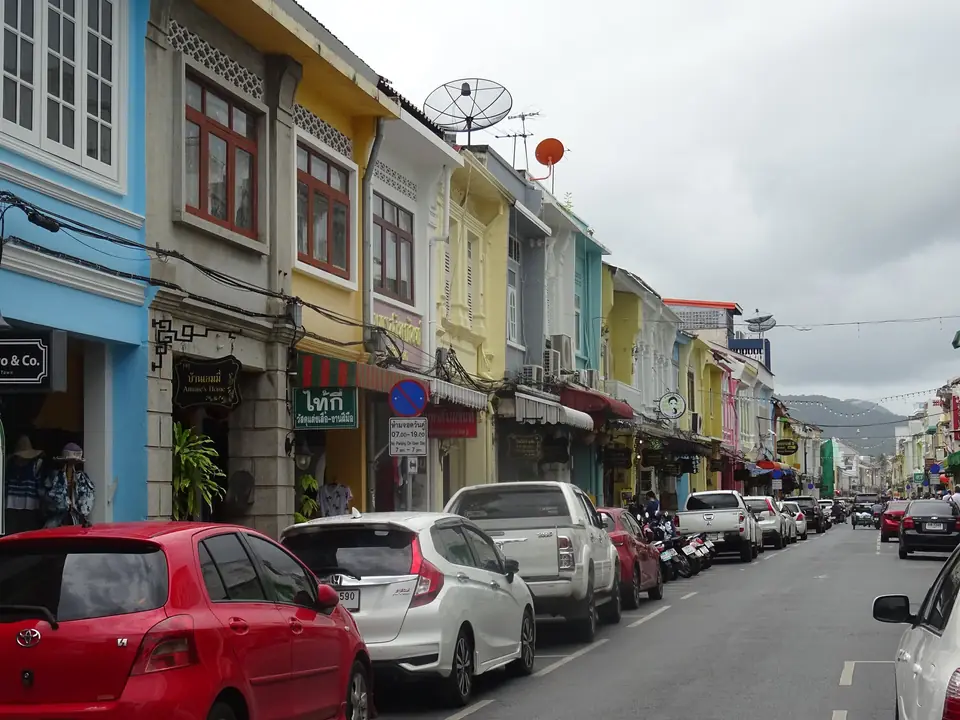
Thalang Road has existed since at least 1850 and is the head of the grid of blocks that Phuket adopted in the manner of Penang under Khaw Sim Bee na Ranong, commissioner of the monthon in the time of Rama V. It joins Yaowarat Road with Montri Road, in the Talat Yai subdistrict, and of its roughly 151 shophouses about half keep Sino-Portuguese architecture. Anyone looking for what to see on Thalang Road finds an old town that can be walked under cover, along a continuous five-foot-wide passage.
The facades read like dragon faces: the door is the mouth, the windows are the eyes and the upper vent is the eyebrows. Behind, each shophouse can reach 50 metres or more in depth. Since 2010 the street has had its cables underground, and every Sunday afternoon it is closed to traffic for the Lard Yai walking market, after being quiet until the 1990s.
Highlights
- Hng-o-kha-khi walkway: a 5-foot covered passage linking the whole street
- 151 shophouses: half of them in Sino-Portuguese architecture
- Dragon-face facades: up to 50 metres deep
- Soi Romanee: from tin-era gambling quarter to cafe alley
- Lard Yai market: every Sunday afternoon, with the street closed to traffic
The history of Thalang Road is that of a city that tin drew, abandonment put out and a new generation lit up again without erasing its former owners. Documented since 1850, when Phraya Phuket Lohakasetrarak (Tat) governed Phuket, the street was afterwards the starting point of an urban re-plan in blocks: Thalang as Tua Pho, the “head of the market”, and Krabi Road as Sia Boi, the “tail”, with Yaowarat cutting across them at right angles.
The route, of some 450 metres on foot, runs from the dragon statue at the east end to the crossing with Yaowarat. Between the two points come narrow-fronted shophouses, an alley that was a gambling district, a miners’ money exchange, a family herbalist and shrines of Chinese immigrants. The architecture and history of Thalang Road are best understood on the ground, and the full experience is best enjoyed with the EarGuide audio guide. This street is part of the Sino-Portuguese old town that continues at Jui Tui Shrine, and its Chinese-Peranakan heritage is completed at the Phuket Thai Hua Museum and at Chinpracha House, home of the tin barons.
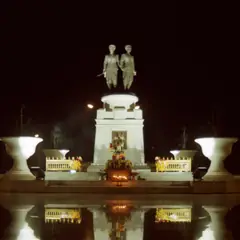
At the feet of the dragon Hai Leng Ong
Hai Leng Ong Statue
Summary of this stop
The walk starts at the east end of the street, before the crossing with Thep Kasattri, beside the south side of Queen Sirikit Park. There stands the statue of Hai Leng Ong, the sea dragon. An old Chinese legend says that the whole island of Phuket is that dragon, risen from the waters of the sea; a popular belief, not a proven fact, but one that offers a key to reading everything that follows.
From that point it is clear that the street is the head of the city. Thalang has existed since at least 1850, year 2393 of the Buddhist era, and joins Yaowarat Road with Montri Road, in Talat Yai. Later, under Phraya Ratsadanupradit Mahitsaraphakdi (Khaw Sim Bee na Ranong), commissioner of the monthon of Phuket in the time of Rama V, the city was re-planned in blocks in the manner of Penang, starting with Thalang and reaching as far as Krabi Road.
A few steps to the west, the street crosses the Bang Yai canal, which in the early days of the city was an important waterway. How the dragon of the legend peeks out again on the facades of the street is something the narration keeps to be heard right there.
Five feet of shade and rolls of cloth
Walkway of the fabric shops
Summary of this stop
On the main stretch, some 400 metres west of the crossing with Thep Kasattri, the shophouses leave a continuous covered passage five feet wide beneath the upper floor. It is called hng-o-kha-khi and was built in the time of Khaw Sim Bee to shelter from the sun and the heavy rains of Phuket. It makes it possible to go the whole length of the street without stepping onto the roadway.
The name mixes two languages: hng-o is “five” in Hokkien and kha-khi is “foot” in Malay. The five-foot measure also comes from the British standard for public pavements in Singapore, a trace of the trade routes that connected Phuket with the rest of the region.
Under that shade old family businesses remain open: Muslim fabric shops with rolls of cloth in view and shutters on the first floor, print shops, hardware stores and noodle shops. They are a reminder that Thalang was always a street of trade.
Facades with a dragon face
Dragon-face facades
Summary of this stop
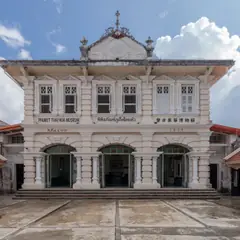
In front of the south-side facades, the row of houses seems to repeat itself, but each one reads as a dragon face: the door is the mouth, the two windows are the eyes and the upper vent is the eyebrows. On the upper floors, stucco reliefs show creatures ranging from turtles to phoenixes, visible when looking up from the roadway.
Behind each narrow facade the body can be guessed. Phuket shophouses can reach 50 metres or more in depth: the business took the front rooms, and family life, the kitchen and the well took the back ones. The roofless courtyard of the well, called Chim-Jae, is the body of the dragon, and the toilet at the back, the tail.
The street adds up to 151 shophouses, and roughly half keep Sino-Portuguese architecture. Their exact age is debated: the street is documented since 1850, the Thai Wikipedia attributes buildings of this style to the time of Khaw Sim Bee, and the English one states that it is not known exactly when the first was built, although it was already established in photographs from the reign of Rama V.
Soi Romanee, from gambling den to postcard
Soi Romanee
Summary of this stop
Halfway along the street, towards the north, opens the mouth of Soi Romanee, a colourful alley 125 metres long that joins Thalang with Dibuk Road. Today its restored shophouses are cafes and guesthouses. During the tin boom it was the gambling and prostitution district of Phuket Town, and when the mines closed it was abandoned and most of its houses fell into ruin. There are different versions of the character of that red-light quarter: one tourism source extends it to the whole street, another places it only in this alley, and some accounts record it as something that is told.
The turn comes with recent memory. In the mid-1990s Thalang was a quiet street of fabric shops and hardware stores, and Soi Romanee a row of abandoned shophouses that nobody photographed. According to documented tradition, the first change came around 2001, when The Loft opened, a venue run by foreigners in a converted shophouse: the first stylish place on a street that was dead at night.
In 2010 Thalang was the first street in Phuket to bury its electric cables. It left the Sino-Portuguese facades in view, and today not a single wire crosses the street, something rare in Thailand. It was the trigger for the conversion of shophouses into cafes, shops and guesthouses.
China Inn, the miners’ money exchange
China Inn
Summary of this stop
China Inn occupies a century-old Sino-Portuguese shophouse that was a currency exchange office for the Chinese labourers of the tin mines. After years of abandonment, it was restored over two years around 2008, keeping its original character, with a back garden courtyard, and received a conservation architecture award.
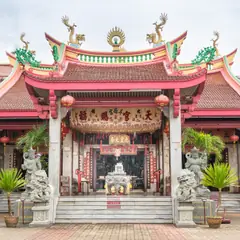
The same street keeps the memory of another migration story. The Hainan shrine, with a red door the width of a single shophouse that goes in very deep, dates from 1910: more than 180 first-generation Hainanese immigrants pooled their money to buy the building as a refuge for new arrivals from China. Inside, a carved altar and the image of the goddess of the sea.
Among the facades there is also one that looks like an ordinary shop. According to documented local custom, it is the entrance to a covered passage 150 metres long that crosses the block to Dibuk Road, with stalls of clothes, batik and Thai silk and food tables in the middle. Today it is called The Oasis Thalang and serves as a shortcut and as a refuge when the rain starts.
Herbs from 1917 and a passage to the shrine
Kopitiam by Wilai
Summary of this stop
Beside the restaurant Kopitiam by Wilai is the herbalist Nguan Choon Tong, the oldest Chinese remedies shop in Phuket, run by the same family since 1917. The counter and the herb jars keep the atmosphere of an apothecary from another era.
From Kopitiam by Wilai, a narrow passage beside the kitchens leads to the Shrine of Serene Light, built in 1889 and with its main entrance on Phang Nga Road. It is a route that closes the walk on what is still alive in the street.
The final image is that of Sunday. Since the end of 2013, every Sunday afternoon Thalang is closed to traffic and becomes the Lard Yai walking market, the “Big Market”, with the stalls in the middle of the roadway among the shophouses. Behind one of those facades, according to documented tradition, there is also a bar hidden behind a fake vending machine, Shhh., the most recent secret of a street that keeps on guarding them.