Vegetarian Festival
Jui Tui Shrine Audio Guide
A Hokkien shrine with jade-green roofs that was born from a fire and a straw shed, and that every autumn launches the longest procession of the Phuket Vegetarian Festival.
- 30 min of audio
- Hokkien Taoist shrine
The name Jui Tui (水碓) joins “jui”, water, and “tui”, rice mortar, and alludes to the water wheel that the neighbours installed in the wide canal that ran in front of the shrine to husk rice. The canal can no longer be seen, but the name preserves it. After the fire of 1907 and three years of rites under a straw shed, the first shrine was built here in 1911, next to Put Jaw, the oldest Chinese shrine in Phuket Town.
The contrast is that of a quiet courtyard which, during the ninth lunar month, becomes the heart of the festival: the Go Teng pole with its nine lamps is raised, gunpowder erupts in the red tower and, before dawn, thousands of entranced mediums set out for the old town with rods through their cheeks. In 2018 the governor of Phuket described Jui Tui as the “am”, the shrine, of the province.
Highlights
- A name that recalls a water wheel in a vanished canal
- From the fire of 1907 to the first shrine of 1911, next to Put Jaw
- Go Teng pole with nine lamps, the sign that the fast begins
- The 2025 procession with over 2,500 mediums, the longest of the festival
- Main altar with three statues and a temple rebuilt in 1982
Jui Tui Shrine, in Phuket Town, is a Hokkien Taoist shrine with jade-green roofs and columns that set it apart from the others on the island. Its history begins, according to tradition, with a travelling Chinese opera company, and continues with a fire in 1907, a straw shed and a first building in 1911. Today it is one of the central stops of the Vegetarian Festival, in which about 30 Phuket shrines take part. Anyone wondering what to see at Jui Tui Shrine or looking up its history finds here a route of four stops, whose full experience is best enjoyed with the audio guide on the grounds. The shrine belongs to the Sino-Portuguese old town walked along Thalang Road and, among the island’s temples, is complemented by Wat Chalong.
Red lanterns over a rice mill
Jui Tui Shrine
Summary of this stop
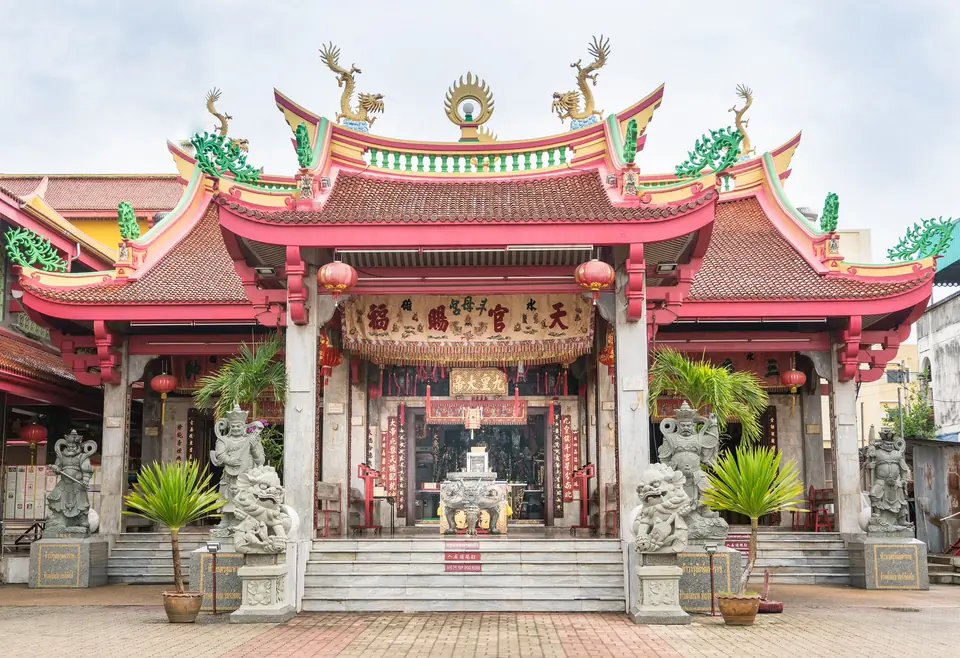
The entrance to the compound is made under hanging red lanterns, with gold-lettered plaques and ornaments on the upper beams; the shrine faces east. Behind that gate hides the memory of a water wheel: the name Jui Tui joins “water” and “rice mortar” and refers to the mill that the neighbours set up in the canal that ran in front to husk the harvest.
It is also the gate through which the procession that carries the gods through the old town sets out each year. According to documented local custom, families set up offering tables in front of their houses and kneel in silence as the procession passes: it is the god who visits and blesses the neighbours. In 2026 the Jui Tui procession went through the city on Friday 16 October, with the tables set from 06:00 to 12:00.
In 2018 the governor of Phuket described Jui Tui as the province’s shrine, an obligatory stop of the festival. What the narration says about this threshold is left to be heard right there.
The neighbour who saved the sacred objects
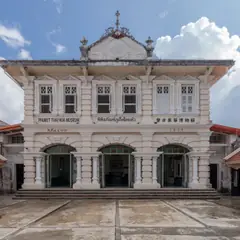
Put Jaw facade
Summary of this stop
Next to the shrine stands Put Jaw, or Kuan Im Teng, smaller and more secluded, dedicated to Guan Yin and considered the oldest Chinese shrine in Phuket Town. It was restored in August 2026, just before the festival. According to tradition, the rite was born when the opera company that venerated Kiu Ong held a vegetarian fast of 9 days and 9 nights in Soi Romanee, with the participants dressed in white, and on leaving left the neighbours the sacred Hiao Hoi fire and the implements of the rite, with which they founded a first shrine on that street.
In 1907 a fire destroyed that shrine, and the sacred objects that were saved were taken to Put Jaw. For three years, the rites of the ninth lunar month were held in a straw shed put up each year in the neighbouring orchard and dismantled afterwards.
The owner of that orchard donated the land to Kiu Ong Tai Te and in 1911 the first Jui Tui shrine was built there, with a thatched roof. The exact origin of the rite is a matter of debate: one version places the arrival of the opera company in 1825, in the midst of a cholera epidemic, while the account gathered by the foundation speaks only of seventy-odd years ago, with no specific year.
Nine lamps, gunpowder and pierced cheeks
Go Teng pole courtyard
Summary of this stop
The Go Teng pole courtyard is the stage of the festival. Each year the pole with its nine lamps is raised there to invoke the Nine Emperor Gods, and before the festival the faithful stick gold leaf on it. On 8 October 2018, at 17:09, Jui Tui raised the Go Teng under the chairmanship of the governor of Phuket, Phakphong Thawiphat: the sign that the vegetarian fast begins.
To one side, the red and gold firecracker tower, a later addition to the old core, was built to contain the din and the remains of the ritual firecrackers; next to it is a round burner full of red wax and gunpowder remains. Before dawn, in this compound, assistants pierce both cheeks of each medium with rods one foot long, about 30 cm, without anaesthetic. “Ma song” means “entranced horse”, the mount of the gods. On 27 October 2025, the eighth day of the festival, the Jui Tui procession set out for Saphan Hin with more than 2,500 mediums, the longest of the festival, and some 1,900 pierced mediums walked through the old town.
According to documented tradition, the courtyard also lives through nine days of little-seen rituals: after the “lang am” washing, the master of ceremonies performs the “Pang Ia” and releases an army of invisible soldiers which, according to the faithful, stands guard around the compound and receives ritual banquets. In the “Cha Tek Kiam”, wooden swords are driven into 9 points to close the perimeter, and Lam Tao and Pak Tao, the deities who keep the register of births and deaths, are invited to settle in. A permanent open-air Chinese opera stage recalls the operatic origin that tradition attributes to the rite.
Three statues and a temple of 1982
Main altar with three statues
Summary of this stop
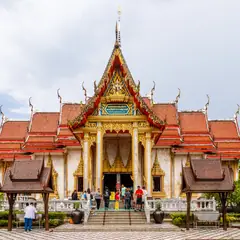
The main hall rises on steps, with red pillars, gilded carvings on the roof, curved ridges, deity figures on the crest and jade-green details. In 1982, when the original building could no longer be repaired, the shrine was rebuilt with donations from the faithful and came to be run by the Jui Tui Tao Bo Keng Foundation.
At the main altar three large statues gather with minor guardian figures and pink and yellow hangings. Among incense sticks and the rattle of bamboo fortune cylinders, the faithful ask for health and protection from Tean Hu Huan Soy, to whom the shrine is dedicated. Not all sources agree: some present Kiu Ong Tai Te, the Nine Emperor Gods, as the main deity.
The festival ends where it began. According to documented tradition, on the last night Jui Tui bids farewell to the Jade Emperor and Kiu Ong Tai Te: the shrines turn off their lights and close the main door when the procession departs, and then the Go Teng is lowered, the sign that the fast is over. In 2026 that farewell fell on Sunday 18 October. The noisiest shrine on the island then falls silent.