Buddhist temple
Wat Chalong Audio Guide (Wat Chaiyathararam)
Phuket's largest and most visited temple keeps a history of revolt, an abbot covered in gold leaf and a Buddha relic that came from Sri Lanka.
- 60 min of audio
- Buddha relic
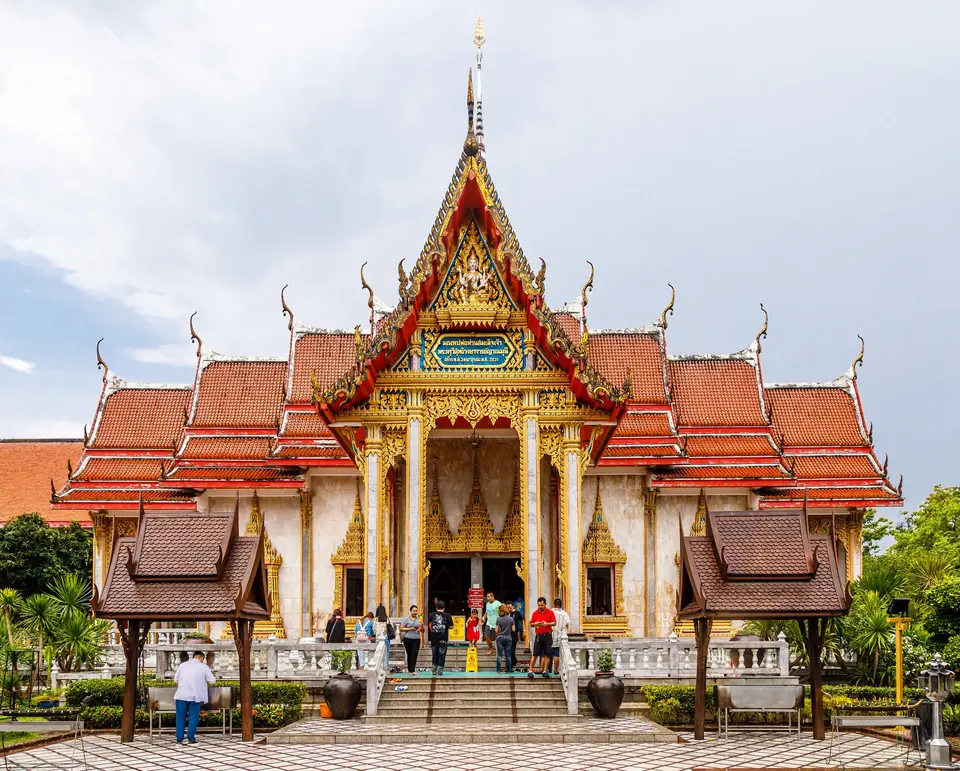
Wat Chalong, officially Wat Chaiyathararam, was built in the early 19th century and is today Phuket's largest and most visited temple. Its fame was born in 1876, when the fall in the price of tin left tens of thousands of Chinese mine labourers unpaid and a revolt broke out: Ban Chalong was the only place on the island where the residents, led by the temple's abbot, defeated the rebels. King Chulalongkorn later rewarded that abbot, Chaem, with a title and the post of head of the Buddhist clergy of Phuket.
The compound gathers, a few steps from one another, the ubosot with its defensive low wall, the wax figures of the three Luang Pho, the brick kiln where the thank-you firecrackers go off and the 60-metre chedi, the most recent building. Among the episodes told is that of an abbot whom devotees gilded in his lifetime through their vows, to the point that his portrait ended up covered in gold leaf.
Highlights
- A temple that won its official name after the revolt of 1876
- Abbot Chaem and the gold leaf of the devotees
- The ubosot and the low wall behind which the defenders took cover
- Brick kiln with strings of thank-you firecrackers
- A 60-metre chedi with a fragment of Buddha bone from Sri Lanka
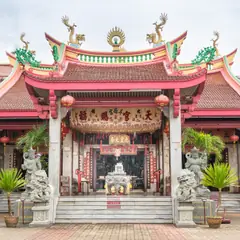
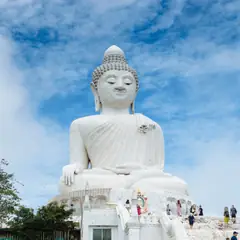
What to see at Wat Chalong goes well beyond a compound of golden pavilions. Phuket’s largest and most visited Buddhist temple, built in the early 19th century, is also a discreet monument to the revolt of the Chinese tin miners of 1876, and the history of Wat Chalong is best understood by following a single man: Abbot Chaem, venerated across the province, rewarded by King Chulalongkorn and still remembered at the annual Chinese New Year fair. The route of this audio guide links five points of the compound: the temple’s official name, the figures of the Luang Pho, the wall of the ubosot, the firecracker kiln and the great chedi with its relic. The most surprising detail of each is revealed by listening to the narration on the ground. Among the Buddhist sites of the island’s south, the temple is a kin of the Phuket Big Buddha, and among Phuket’s temples of the Taoist-tradition Jui Tui Shrine.
A name won in a battle
Wat Chalong
Summary of this stop
Wat Chaiyathararam is the temple’s official name, although almost nobody uses it. According to a documented tradition, King Chulalongkorn granted it as a reward for the defence of 1876, when he also promoted Abbot Chaem to Phra Khru Wisutthiwongsachan and head of the Buddhist clergy of Phuket.
The context of that reward is the fall in the price of tin, which left tens of thousands of Chinese mine labourers unpaid, organised in the secret societies Ngi Hin and Pun Thao Kong. In the revolt that followed, Ban Chalong was the only place on the island where the residents, led by the temple’s abbot, defeated the rebels.
In front of the main hall, the visitor thus finds a busy temple that keeps the memory of the island’s only victory in that conflict. The narration on site keeps the detail that explains why the name of a royal decoration was almost forgotten.
The monk they gilded in his lifetime
Figures of the three Luang Pho
Summary of this stop
Before the wax figures of Luang Pho Chaem, Luang Pho Chuang and Luang Pho Kliam, objects of offerings, one sees to what extent devotion turned a living man into a sacred image. In 1898 Prince Damrong Rajanubhab, Siam’s Minister of the Interior, received Abbot Chaem in Phuket, by then elderly, with his shins speckled with small sheets of gold leaf stuck on by devotees who had made vows to him, as to a sacred image.
A legend of documented tradition says it all began with fishermen caught in a storm on the high seas, who swore to gild the venerable father of Wat Chalong if they came out alive. The abbot, according to the account, refused at first, but ended up accepting a single tiny sheet, which he washed off as soon as the fishermen had left. Afterwards, the custom of promising him gold is said to have spread across the whole island.
The gold left a mark beyond his person. In 1928 his enlarged photographic portrait, on an altar in his kuti, had all the glass covered in gold leaf except the gap for the face, and his staff placed in front was also gilded. Thai Buddhists and Thai-descended Chinese of Penang, then British territory, adopted him as their mahathera, and in 1934 his gilded portrait presided over an altar at Wat Sri Sawang Arom in Penang.
The white heads behind the low wall
Ubosot and perimeter wall
Summary of this stop
The ubosot, the ordination hall, is surrounded by the kamphaeng kaeo, a low wall behind which the defenders of 1876 took cover. The sources record that Abbot Chaem forbade altering the surroundings of the ubosot and the wall, which in 1928 were still intact while his old kuti had become a two-storey building.
According to documented facts, the abbot refused to leave the temple and handed out to more than a hundred residents white cloths with protective diagrams, which they tied around their heads; the Chinese rebels nicknamed them “the white heads”. In the second assault, the rebels arrived in the morning in formation, with flags and signal drums, and at midday stopped to eat boiled rice. The defenders, who used the temple as a command post, surrounded and scattered them. After the defeat, the ringleaders put a price on the abbot’s head: 1,000 dollars for whoever cut it off.
A disputed matter is the abbot’s exact role. The widespread image presents him leading the fight, but the testimony gathered by Prince Damrong indicates that he limited himself to handing out the cloths and lending the temple as a command post, and that it was the residents who organised the fighting. On the island the triumph was attributed to his supernatural powers; he, according to tradition, explained it by the rebels’ boiled rice.
Firecrackers to say thank you
Brick firecracker kiln
Summary of this stop
The brick kiln reserved for firecrackers is one of the noisiest corners of the compound. There the faithful whose prayers have been answered give thanks by setting off strings of firecrackers, a form of gratitude that is part of the temple’s daily life.
That tradition links with the figure of Abbot Luang Pho Chaem, famous in the time of Rama V for preparing herbal remedies, curing the sick and splinting broken bones. Offerings are still made to him during the annual Wat Chalong fair, which lasts about ten days around Chinese New Year and mixes firecrackers, markets and luk thung concerts; the 2026 edition was held from 16 to 22 February.
Inside the compound, the stalls of amulets, flowers and souvenirs grow denser on those dates. The audio guide places each piece of the complex in its setting and leaves for listening at the kiln itself what links the din with the memory of the abbot.
A relic from Sri Lanka up high
Phra Mahathat Chedi Phra Chom Thai Barami Prakat
Summary of this stop
The Phra Mahathat Chedi Phra Chom Thai Barami Prakat is the most recent building of the compound and measures 60 metres. It has three floors with murals of the life of the Buddha, including the birth, the enlightenment and the entry into parinirvana, and numerous gilded statues donated by devotees fill its halls.
At the top, a few steps above the terrace, a glass case holds a fragment of Buddha bone. The relic comes from a chedi in Anuradhapura, the ancient capital of Sri Lanka; it was collected at the Sri Lankan temple of Sambodhi Vihara on 20 March 1999 and the Supreme Patriarch of Thailand handed it over to Phuket in 2000 to be installed at Wat Chalong.
The upper terrace works as a viewpoint from which the whole temple compound can be taken in, the same one that a village abbot defended in 1876. The narration at this point closes the route by joining the relic, the view and the history that precedes them.