Seminyak's Eat Street
Jalan Kayu Aya Audio Guide
Some two kilometres of restaurants, boutiques and cafés running down to the sand, where the beach club culture of Bali is said to have begun; and, on the threshold of every shop, an offering of flowers laid that same morning.
- 45 min of audio
- Street of restaurants and boutiques
Jalan Kayu Aya, known as Eat Street and also as Oberoi Street, is Seminyak's most famous road: a stretch of some two kilometres with more than fifty restaurants, bars and cafés, mixed with boutiques and fine dining. Seminyak, north of Kuta and Legian, in the Kuta district of Badung regency, was once an independent village; today it is a tourist and residential area much appreciated by foreigners living on the island, with land and accommodation prices among the highest in Bali.
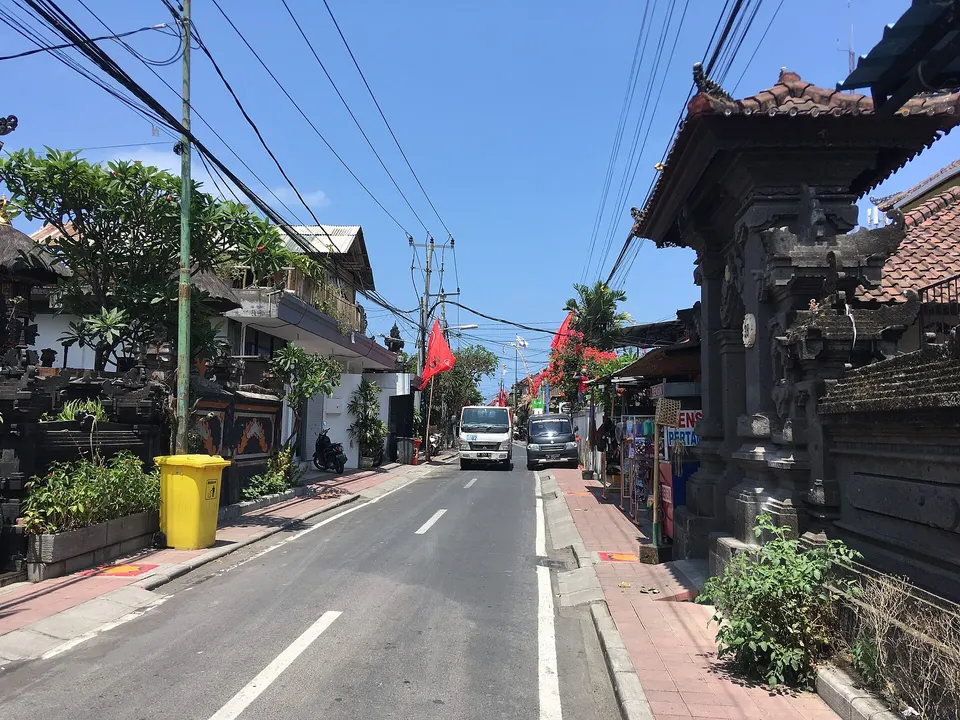
Among the international brands, Balinese life goes on: every morning small palm-leaf trays with flowers and incense appear at the doors of shops and restaurants, and between two shop windows a walled Hindu shrine opens, with chequered cloths and parasols. At the end of the street waits Ku De Ta, the seafront club opened in 2000 to which the start of Bali's beach club culture is attributed.
Highlights
- Eat Street — Some two kilometres with more than fifty restaurants, bars and cafés
- Seminyak Square — The open-air shopping centre where the street begins
- Canang sari — Offerings of flowers and incense on the threshold of every shop
- Street shrine — A walled Hindu temple among boutiques, beside Kayu Aya Square
- Ku De Ta — Since 2000, the club to which the start of Bali's beach clubs is attributed
In Seminyak, one of the most expensive corners of Bali, there is a street that sums up in two kilometres what the island has learned about tourism. Jalan Kayu Aya, Seminyak’s Eat Street, also called Oberoi Street, runs down from Seminyak Square to the sand between more than fifty restaurants, bars and cafés, fashion boutiques and fine-dining tables. And yet, on the threshold of every door, a small offering of flowers still appears each morning.
The history of Jalan Kayu Aya is that of Seminyak. Located just north of Kuta and Legian, in the Kuta district of Badung regency, Seminyak was an independent village before becoming today’s mix of tourist area and residential neighbourhood, much appreciated by foreigners who have settled in Bali and with land and accommodation prices among the highest on the island. The district’s main artery is Jalan Raya Seminyak, which almost everyone calls Jalan Legian and which runs parallel to the beach; Jalan Kayu Aya is the street that descends from it toward the sea.
Its second name has a probable explanation: everything suggests that “Oberoi Street” comes from the Oberoi hotel, near the seaward end of the street. At that same end, facing the ocean, Ku De Ta has occupied its plot since 2000, the club to which the birth of Bali’s beach club culture is attributed. To learn what to see on Jalan Kayu Aya, the audio guide walks the street in three stops and 45 minutes, from Seminyak Square to the shrine at Kayu Aya Square and the sand of Ku De Ta, following a clear thread: how everyday Balinese life and global tourism have learned to share the same pavement.
From Legian beach to Seminyak’s beach-club street, the route links with Double Six and Legian Beach; Oberoi Street ends in Petitenget, between clubs and temple, at Pura Petitenget.
Where the street of fifty restaurants begins
Seminyak Square
Summary of this stop
The street starts, by all indications, beside Seminyak Square, an open-air shopping centre at the junction with Jalan Raya Seminyak. From that point, Jalan Kayu Aya presents itself as visitors know it: a succession of cafés, bars, restaurants and boutiques stretching for some two kilometres, which has earned it the nickname Eat Street.
In this first stretch one understands what Seminyak is: a former independent village turned fashionable area, where many foreigners live and where the price of accommodation is among the highest in Bali. But what has not changed is visible too. At ground level, before the doors of shops and restaurants, rest the canang sari, palm-leaf trays with flowers and incense offered daily to Sang Hyang Widhi Wasa in thanks for peace, and placed on thresholds as well as altars.
The narration, at this junction, explains how a street of fifty restaurants still begins each day with a gesture that has nothing to do with the menu.
A shrine among the shop windows
Street shrine
Summary of this stop
Further down, beside Kayu Aya Square, everything suggests the street holds its most unexpected surprise: a walled Hindu shrine, with chequered cloths and parasols, wedged between the shops. Among brands and shop windows, the people keep their gods in place.
That balance has a name in Bali: Tri Hita Karana, the three causes of well-being, the principle of harmony with the divine, with other people and with nature. The offerings at every doorway are its most everyday expression, and so are the rules of Balinese courtesy: the left hand is considered impure, so things are given and received with the right, and offerings placed on the ground are not stepped on.
At this stop, the audio guide tells how those three harmonies are sustained on one of the island’s most commercial streets.
Where the beach club was born
Ku De Ta
Summary of this stop
The street ends on the sand, beside Ku De Ta, the seafront club that has occupied this plot of Jalan Kayu Aya since 2000 and to which the start of beach club culture in Bali is attributed.
Not far away, on Jalan Petitenget, Potato Head Beach Club opened in 2010, with a facade made of thousands of reclaimed wooden shutters, another chapter of the same story. And everything suggests that the street’s other name, Oberoi Street, comes from the Oberoi hotel, near this end by the sea.
On the sand, the narration closes the route with the birth of the Balinese beach club and with the way of taking leave of the street with respect.