Sea temple
Pura Petitenget Audio Guide
A 16th-century sea temple, a haunted chest guarded by a green giant and, a few steps away, Bali's trendiest sand. At Petitenget, the legend of a priest and a magazine-worthy beach club share the shore without either feeling ashamed of the other.
- 45 min of audio
- Balinese Hindu temple
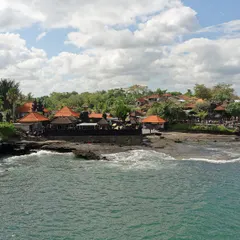
Pura Petitenget stands facing Seminyak beach, on Jalan Petitenget, already in Kerobokan. Tradition counts it among the coastal temples attributed to the priest Dang Hyang Nirartha, raised to guard the island's perimeter against the sea: a chain of pura segara founded along the coast in the 16th century.
Its name hides a story of spirits: peti means chest and tenget, charged with magic or haunted. According to legend, the place's evil spirits were locked inside that chest, and a repentant green giant still stands guard beside the same sand where the sunset is watched every evening.
Highlights
- Candi bentar — split gate in red brick and carved grey stone
- Three tiered courtyards, the innermost reserved for worshippers
- The legend of Buto Ijo, the green giant who guards the haunted chest
- Canang sari — daily offerings of flowers and incense on the sand
- Potato Head facade — an amphitheatre of thousands of reclaimed shutters
What to see at Pura Petitenget is really a double question: a living temple on the Balinese coast and the most elegant strip of sand in Seminyak, separated by a few steps. The temple belongs to the chain of pura segara, the sea temples founded along the coast in the 16th century, and tradition attributes it to Dang Hyang Nirartha, a Shaivite Hindu priest born in Java at the end of the Majapahit period. Balinese chronicles place his arrival in Bali around 1492, and in 1537 he was still writing. To him is owed the padmasana, the empty-throne shrine dedicated to the supreme god.
The history of Pura Petitenget starts with a legend of ogres and chests, continues with the offerings that appear on the sand each day and ends with the shared ritual of modern Bali: the sunset facing Potato Head. The audio guide covers that path on foot, stop by stop, in the very place where it happens.
Its chain of sea temples continues at Tanah Lot and at Pura Batu Bolong and Echo Beach, and Oberoi Street ends in Petitenget, between clubs and temple, at Jalan Kayu Aya.
The split gate of the sea temple
Temple gate
Summary of this stop
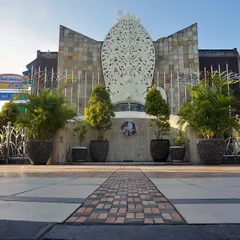
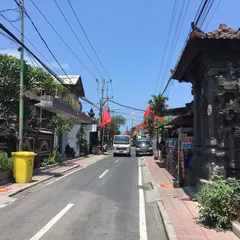
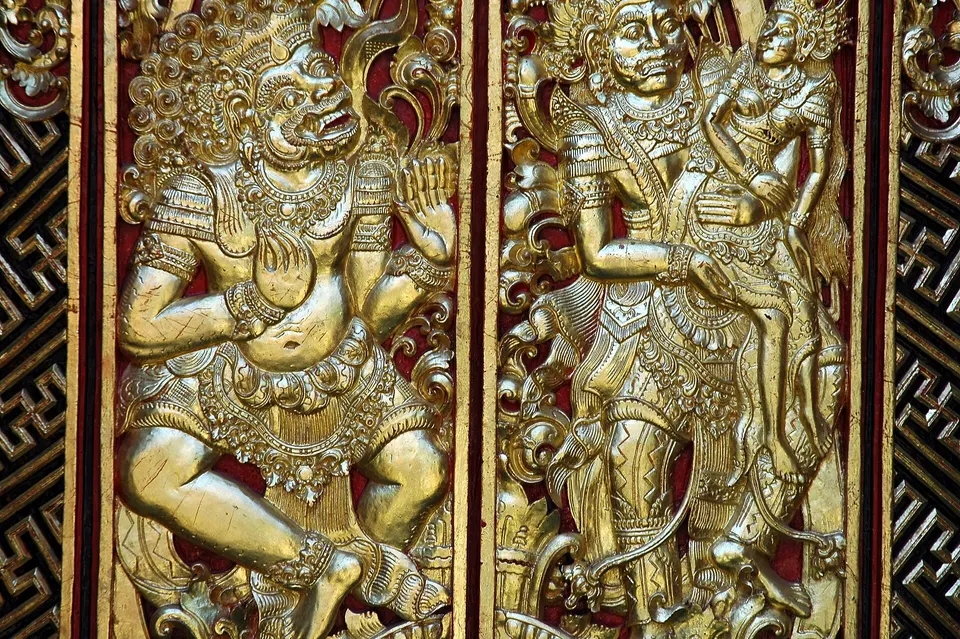
On Jalan Petitenget, facing the temple, the first thing to appear is the candi bentar: the two symmetrical halves of the outer gate, in red brick and carved grey stone. Beyond it, the architecture of Pura Petitenget is organised in three courtyards rising in steps, outer, middle and inner, and the last is reserved for worshippers. In front, with nothing in between, stretches Petitenget beach.
It is no dead monument. The temple celebrates its odalan, the anniversary festival, every 210 days of the Balinese Pawukon calendar, on a Wednesday of the week called Merakih. Whoever crosses the gate does so in sarong and sash; women who are menstruating do not enter the compound and no one climbs the shrines. And Pura Petitenget does not stand alone: it is a link in the chain of coastal temples that, according to tradition, Nirartha raised to protect the island’s perimeter from the sea. The meaning of that chain, and of the name, is revealed in the narration beside the gate.
The green giant and his haunted chest
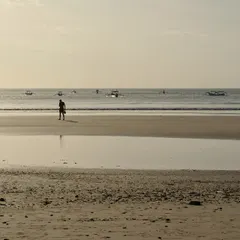
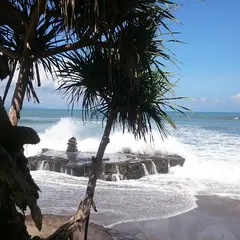
Petitenget Beach
Summary of this stop
Now on the sand, facing the temple, the name makes sense. Peti means chest; tenget, charged with magic or haunted. Legend says Nirartha was resting in the undergrowth of Kerobokan when Buto Ijo came upon him, a green giant who had spent years terrorising the villagers. The priest immobilised him with a spell; the giant repented and asked to serve him. Nirartha then locked the place’s evil spirits in wooden chests and entrusted them to the reformed ogre.
According to locals, the giant still stands guard, and a figure of him goes out in procession during the Petitenget festival. The history of Pura Petitenget is also read on the ground: the canang sari, small square palm-leaf trays with coloured flowers and incense, appear each day on the sand, the steps and the walls. They are offered to Sang Hyang Widhi Wasa in thanks for peace in the world, and each flower is placed by its colour and direction for a different deity. Behind it lies the Tri Hita Karana, the three causes of well-being: harmony with the divine, with other people and with nature. What the chest really holds is told by the audio guide on the spot.
The silence of sunset
Sunset strip
Summary of this stop
A little north of the temple’s beach curves the facade of Potato Head Beach Club, opened in 2010 by Ronald Akili: an amphitheatre-shaped wall built from thousands of recycled, reclaimed wooden shutters. Between that designer wall and the 16th-century temple stretches the same sand, that of Petitenget.
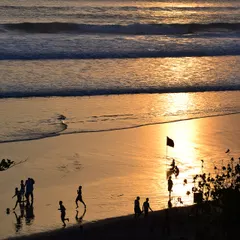
When evening falls, the strip lowers its voice. The sacred and the glamorous coexist here without getting in each other’s way: the offerings remain on the sand while the sun sinks into the sea, a few steps from the Potato Head beanbags. Why that shared silence is the ritual of modern Bali is left for the end of the narration, with feet in the sand.