Sea temple
Tanah Lot Audio Guide (Pura Luhur Tanah Lot)
A temple on a wave-ringed rock on the Tabanan coast, attributed to the priest Dang Hyang Nirartha and guarded, according to tradition, by sea snakes that were once his sash.
- 90 min of audio
- Temple on the sea
Tanah Lot rises in the village of Beraban, in the Kediri district of Tabanan regency, some twenty kilometres north-west of Denpasar. It is one of the seven great sea temples of Bali, dedicated to Dewa Baruna, also called Bhatara Segara, the god of the sea, and its foundation is attributed to the priest Dang Hyang Nirartha, who came from Majapahit Java in the 16th century.
Bali's most famous image hides a secret: in the 1980s the rock was crumbling, and a restoration funded by a loan from the Japanese government rebuilt it. More than a third of what now looks like natural rock is disguised artificial stone.
Highlights
- Temple rock — An islet crowned with meru shrines of tiered black roofs, reached on foot only at low tide
- Sacred spring — Tirta Pabersihan, fresh water welling up at the foot of the rock a few metres from the sea, with which priests bless visitors
- Snake cave — The sea snakes in the rock's crevices, considered guardians of the temple
- Pura Batu Bolong — A small temple on a natural rock arch, some three hundred metres to the north
- Sunset terraces — The classic view of the rock silhouetted against the sunset from the southern headland
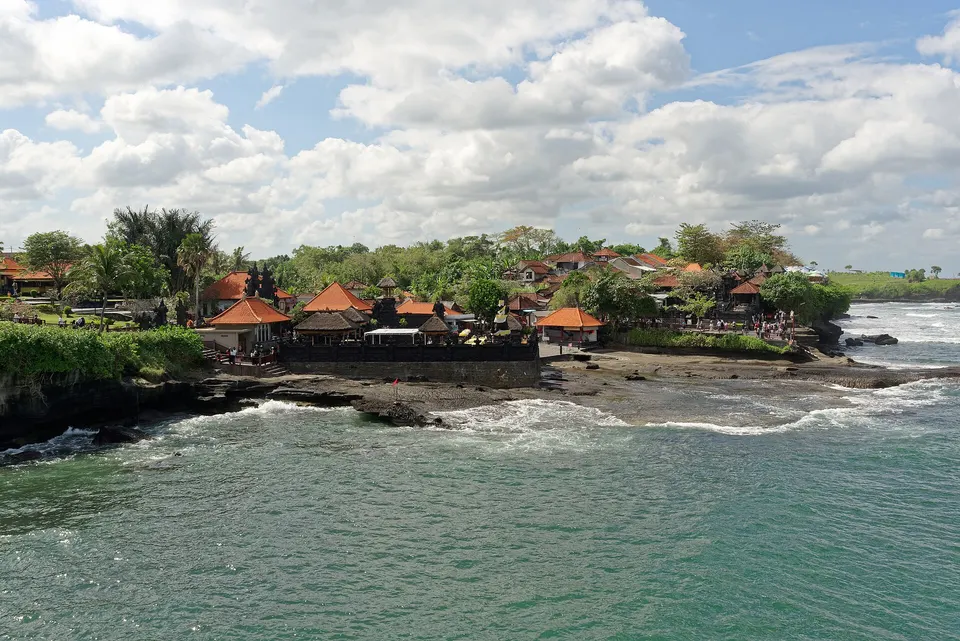
On the Tabanan coast, in the village of Beraban, some twenty kilometres north-west of Denpasar, a black rock rises among the waves with a temple on top. It is Tanah Lot (Pura Luhur Tanah Lot), one of the seven great sea temples of Bali and, for many, the very image of the island. A study published in 2019 estimated that around half a million people a year visit it. Its foundation is attributed to Dang Hyang Nirartha, the priest who in the 16th century travelled the south coast and, the story goes, spent a night on this rock.
What to see at Tanah Lot goes far beyond the postcard: a freshwater spring beside the sea, sacred snakes, minor temples scattered along the coast and a restoration that changed the rock itself. The history of Tanah Lot is that of a 16th-century idea, that the sea can become sacred, and of an island that has never stopped rebuilding it. Walking it with the audio guide lets these pieces be joined on foot, from the entrance to the sunset.
The sea temples tied to Nirartha on the same coast include Pura Petitenget, and from Tanah Lot to Batu Bolong the rock temples of the west coast continue at Pura Batu Bolong and Echo Beach.
The road to the sea: the priest who came from Java
Entrance path
Summary of this stop
The path down from the entrance toward the coast serves to meet the protagonist of this story. Dang Hyang Nirartha was a Shaivite priest from Majapahit Java. Balinese chronicles place his arrival around 1492; in 1537 he was still writing, he introduced the padmasana, the empty-throne shrine, to Bali, and he died at Uluwatu. The sea temples he founded in the 16th century are described as a chain around the island’s coast, and Tanah Lot is one of its links.
Legend says the village chief, Bendesa Beraban Sakti, looked warily on the newcomer’s teachings and led his followers to drive him out. Nirartha is said to have answered by moving the rock out to the sea and raising his shrine there; afterwards the chief gave in and became his disciple. The full outcome of that confrontation is left to the narration, which tells it as the sea appears at the end of the path.
The rock among the waves: gods, snakes and tides
Temple rock
Summary of this stop
Facing the shore rises the rock crowned with meru shrines of black roofs, cut off from land when the tide comes in. Here Dewa Baruna, also called Bhatara Segara, the god of the sea, is venerated, and the rock can be reached on foot only at low tide. The temple’s upper courtyards are reserved for Balinese Hindu worshippers: tourists reach only the base. There, a few metres from the sea, a freshwater spring wells up, Tirta Pabersihan, whose water priests use to bless visitors.
In the caves at the foot of the rock live sea snakes considered guardians of the temple. According to a documented tradition, when Nirartha finished his work he took off his sash and turned it into a sea snake to protect the rock; today’s snakes would be its descendants, a form of the serpent Naga Basuki. And there is another, lesser-known truth: in the 1980s the rock wall was crumbling, and a restoration funded by a loan from the Japanese government rebuilt it. More than a third of what looks like rock is now disguised artificial stone, a detail the audio guide helps to see with new eyes from the shore.
The pierced rock: Batu Bolong and the minor temples
Batu Bolong arch
Summary of this stop
Some three hundred metres north of Tanah Lot, on a rock headland pierced by a natural arch, stands Pura Batu Bolong. It is one of several temples in the complex, which besides the main one includes Pakendungan, Jro Kandang, Enjung Galuh, Batu Bolong, Batu Mejan and Penataran Madya, together with the sacred spring, the snake cave, a sunset terrace and Kecak dance performances.
This point helps in understanding the form of a Balinese sanctuary, which is not a single building but a constellation of temples spread across the landscape, part of that chain of sea temples around the island. Every 210 days the temple’s anniversary, the piodalan, is celebrated. What that cycle reveals about the life of the sanctuary is one of the keys the narration keeps for this stretch.
Sunset over the rock: the postcard and its history
Sunset terrace
Summary of this stop
On the terraces of the southern headland waits the view that draws half a million visitors a year: the temple rock silhouetted against the setting sun. From here one takes in the complex surrounding the main temple, with its minor shrines, its spring and its Kecak dance performances.
It is also the moment to go back over everything before: the temple of the sea god that, as attributed, Nirartha founded after spending a night on the rock, and the stone remade by hand centuries later so that the idea would remain standing. The audio guide closes the route here, when the postcard already has a history.