Hindu monument and myth
Garuda Wisnu Kencana Cultural Park Audio Guide (Taman Budaya Garuda Wisnu Kencana)
A god riding an eagle, 121 metres of copper and brass on the Bukit plateau, and twenty-eight years of stubbornness between the first sketch and the last piece. Behind the giant lies a myth about a son who pays his mother's ransom.
- 90 min of audio
- 121 m statue
The Garuda Wisnu Kencana Cultural Park covers about sixty hectares in Ungasan, on the Bukit plateau, some 263 metres above sea level and ten to fifteen minutes by car from the airport. Everything revolves around a statue of Vishnu mounted on his bird Garuda, designed in 1990 by the Balinese sculptor Nyoman Nuarta. Work began in 1997, the Asian financial crisis halted it for sixteen years, and it only resumed in 2013, when the developer Alam Sutera agreed to fund it. President Joko Widodo inaugurated the monument on 22 September 2018.
Before the complete statue existed, the park displayed its fragments: Vishnu's torso in one plaza, Garuda's head in another and, between them, a corridor of carved limestone pillars that has hosted an Iron Maiden concert and the welcome dinner of the G20 summit. The idea was never peaceful, either: Bali's religious authorities feared that so large a figure would upset the island's spiritual balance.
Highlights
- GWK Statue — 121 metres with its pedestal, almost thirty more than the Statue of Liberty
- 754 modules — Made in Bandung and assembled with copper and brass sheet over stainless steel
- Wisnu Plaza — Vishnu's torso, which waited alone with raised hands for two decades
- Lotus Pond — A limestone pillar corridor of about 4,000 m² where the G20 leaders dined in 2022
- Garuda's Head — 18 metres of mythical eagle over Garuda Plaza
On the Bukit plateau, in the south of Bali and a few minutes from the airport, stands one of the island’s most ambitious and most debated works. The Garuda Wisnu Kencana Cultural Park, known as GWK and officially called Taman Budaya Garuda Wisnu Kencana, gathers on some sixty hectares in Ungasan a monument 121 metres tall: the god Vishnu riding Garuda, the mythical bird that agreed to serve as his mount forever. The history of Garuda Wisnu Kencana is that of an idea that took twenty-eight years to complete: designed in 1990 by Nyoman Nuarta, begun in 1997, halted by the Asian financial crisis, resumed in 2013 and finished in 2018, at a cost of around one hundred million dollars.
What to see at the Garuda Wisnu Kencana Cultural Park unfolds in three beats: the torso of a god that waited alone for two decades, an old quarry turned into an international stage and, at the end, the complete giant of copper and brass. The audio guide weaves the three together with the myth, the engineering and the controversy that surround them.
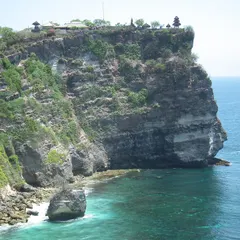
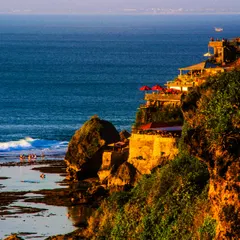
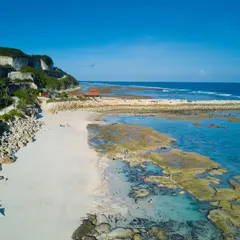
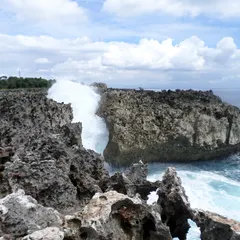
From the park’s hill, Melasti Beach also lies in Ungasan, beneath the cliff, and Jimbaran Bay stretches out on the other side of the plateau; some 7.9 km away, on the east coast, is the Nusa Dua Water Blow.
The god who waited twenty years
Wisnu Plaza
Summary of this stop
On Wisnu Plaza, the park’s upper terrace, rises Vishnu’s bronze-coloured torso, with its hands raised. For two decades it was almost all there was of the project: a half-finished god on a hill about 263 metres high, on a plateau that the project’s defenders saw as barren land ready for a new attraction.
The author, Nyoman Nuarta, was born in Tabanan in 1951, trained at the Bandung Institute of Technology and made his name with the Proclamation Monument in Jakarta. GWK is his most ambitious work. He conceived it in 1990, the first stone was laid in 1997 and, soon after, the Asian financial crisis stopped the cranes for sixteen years, until the developer Alam Sutera agreed to fund the rest in 2013.
The wait was not only financial. Bali’s religious authorities objected that a statue of that size could upset the island’s spiritual balance and that its commercial character was not appropriate. How that debate lives alongside the torso that started it is one of the keys the narration reveals at this point.
The eagle’s head and the quarry
Garuda Plaza and Lotus Pond
Summary of this stop
On Garuda Plaza an eighteen-metre head of Garuda looms, and at its feet opens the Lotus Pond, a corridor of carved limestone pillars covering about 4,000 square metres that can hold seven thousand people. Before the complete statue existed, the park showed its loose pieces this way: the god in one plaza, the eagle in another and the quarry between them.
That stone corridor has welcomed very different audiences, from an Iron Maiden concert in 2011 to the welcome dinner of the G20 summit that President Joko Widodo hosted on 14 November 2022.
The whole monument springs from a Hindu myth, the quest for amrita, the elixir of life. According to tradition, Winata, Garuda’s mother, had been enslaved by Kadru, the mother of serpents; to free her, Garuda stole the elixir from the gods, and Vishnu granted it to him in exchange for the eagle serving as his mount forever. The country’s largest statue tells, at heart, the story of a son who pays his mother’s ransom.
The last piece
GWK Statue
Summary of this stop
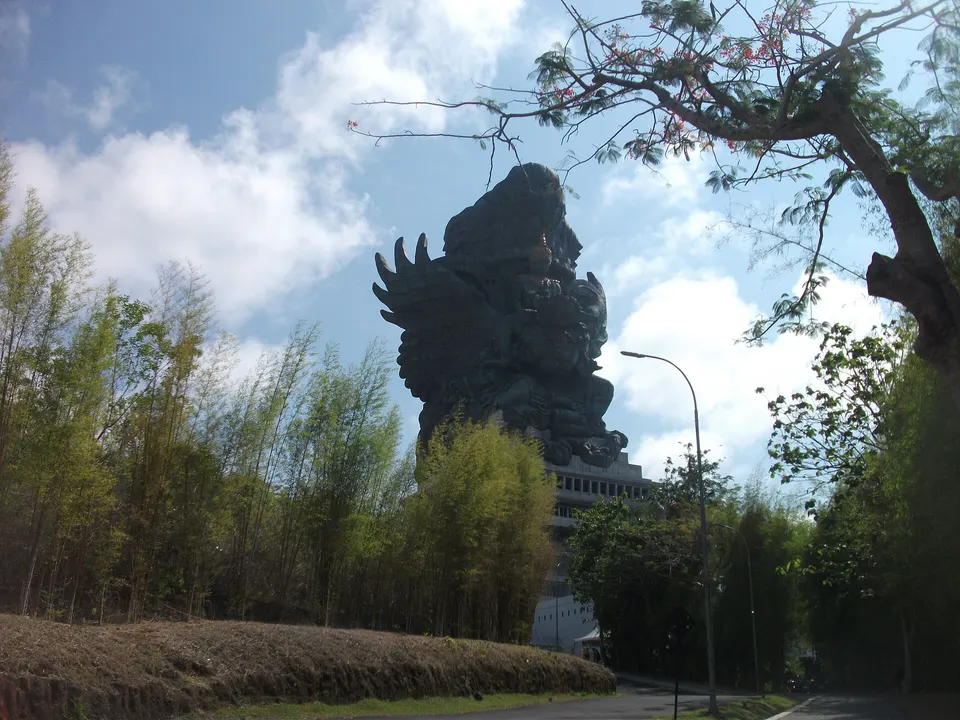
At the foot of the GWK statue, the scale becomes hard to take in: the figure stands 75 metres tall and 65 wide and rests on a 46-metre pedestal, which adds up to 121 metres, almost thirty more than the Statue of Liberty. It can be seen from the airport and from much of southern Bali. The architecture of Garuda Wisnu Kencana combines copper and brass sheet over a stainless steel structure with a steel and concrete core, around 4,000 tonnes in all, and Vishnu’s crown is covered in gold mosaic.
The statue was assembled from 754 modules made in Bandung, in West Java, cut into about 1,500 pieces so that cranes could lift them. Garuda’s form is so complex that the engineers designed special joints where up to eleven steel beams meet at a single point, and the whole is meant to withstand storms and earthquakes for a hundred years. The work was completed on 31 July 2018 and inaugurated on 22 September of that year.
Next to the monument, the open-air amphitheatre hosts the daily cultural shows and the Kecak, in one of the stages built expressly for this dance in Bali. Which piece finally completed the giant, and how that moment was lived, is left for the audio guide.