Natural phenomenon
Nusa Dua Water Blow Audio Guide
At the edge of Peninsula Island, a crack in the limestone turns the swell of the Indian Ocean into columns of spray several metres high. It is the one corner of the Nusa Dua tourist enclave that could never be tamed.
- 40 min of audio
- Cliff and swell
Nusa Dua is a tourist enclave built in the 1970s in southeastern Bali, about 22 kilometres from Denpasar: 350 gated hectares that gather more than twenty resorts and that administratively belong to the village of Benoa, in the South Kuta district. Its name means two islands, nusa island and dua two, after the two islets of its bay: Peninsula Island to the south and small, shaded Nusa Dharma to the north, with the temple of the same name.
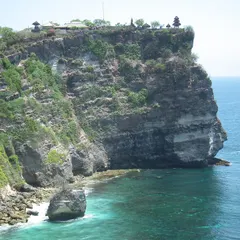
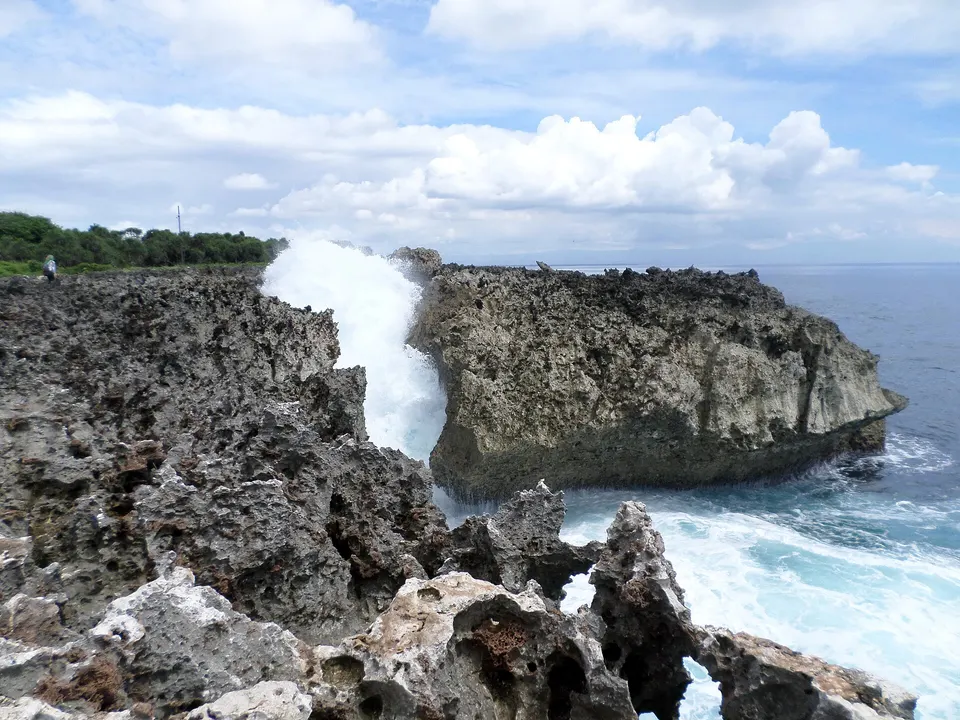
On the eastern edge of the enclave, the resorts' lawns end abruptly against sharp limestone pitted by salt. There, a cleft that narrows beneath the cliff channels each charge of the Indian Ocean upwards, in bursts several metres high that sometimes reach tens. It only happens at high tide, and the enclave's own developer warns that at Water Blow there is no sand and no swimming: only the cliff and the sea far below.
Highlights
- The cleft — A narrowing crack that throws the swell up in columns several metres high
- Railed platform — The viewpoint where the spray comes closest
- Jagged limestone — Ledges of sharp, pitted rock eaten by salt and waves
- Two islands, one name — Peninsula Island and Nusa Dharma, which give Nusa Dua its name
- Reborn reef — One of the five sites of Indonesia's Coral Garden
On the east coast of the Bukit peninsula, in the south of Bali, the Nusa Dua tourist enclave is a world of trimmed lawns, paths and hotels. And on its eastern edge, on Peninsula Island (officially Pulau Peninsula), the Indian Ocean has found a crack in the rock. This is Water Blow, a natural sea geyser where waves slip into a narrowing cleft and shoot out in columns of white spray. The province’s tourism portal speaks of waves rising up to eight metres as they hit the rocks.
The history of the Nusa Dua Water Blow is tied to that of a planned enclave. Nusa Dua was built in the 1970s on 350 hectares of the island’s southeast, about 22 kilometres from Denpasar, and its developer, the state-owned Indonesia Tourism Development Corporation, opened the first hotel, the Nusa Dua Beach Hotel, in 1983. In 1991 came the Grand Hyatt, with 636 rooms, then the largest hotel in Bali; today eight of the island’s ten largest hotels are here.
Against that resort architecture, the architecture of Water Blow is pure geology: Tertiary limestone, raised, jagged and pitted by salt. What to see at the Nusa Dua Water Blow is arranged in three stops, from the path between lawn and rock to the platform over the crack and to the ledge looking down the coast, and the full meaning of the place is revealed on the walk with the audio guide.
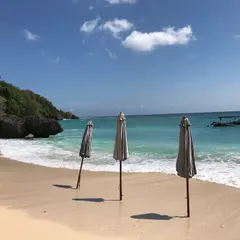
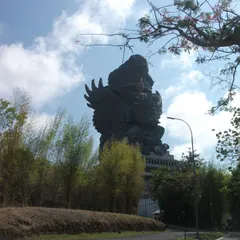
On the same east coast of the Bukit, among reefs, swell and beaches, lies Melasti Beach; some 7.9 km away is the Garuda Wisnu Kencana Cultural Park.
An enclave of two islands
Path to Water Blow
Summary of this stop
The path to Water Blow starts where the enclave’s lawns run right up to the rock. The contrast explains everything: Nusa Dua is a gated compound, with security checks and a paid entrance for visitors, that gathers more than twenty resorts and depends administratively on the village of Benoa, in the South Kuta district. It was launched in the 1970s by the state-owned Indonesia Tourism Development Corporation, which opened its first hotel, the Nusa Dua Beach Hotel, in 1983. The Grand Hyatt, with 636 rooms, was Bali’s largest hotel when it opened in 1991.
The name of the place speaks of geography, not hotels. Nusa means island and dua, two: they are the two islets of the bay, Peninsula Island to the south and the smaller, shaded Nusa Dharma to the north, which houses the Nusa Dharma temple. Around them, the Bukit peninsula, of which Nusa Dua forms the eastern shore, is dry, arid and stony, very different from Bali’s green interior, and is made of raised Tertiary limestone.
A resort designed on paper, a name that means two islands and a corner nobody managed to tame. What joins those three pieces is discovered by listening to the narration at the start of the path.
The crack that throws the sea
Viewpoint
Summary of this stop
At the end of the path, a railed platform leans out over the cleft. There the waves of the Indian Ocean crash against the jagged edge of the limestone, and a crack that narrows beneath the cliff compresses them and hurls them upwards in bursts several metres high, which occasionally reach tens. The province’s tourism portal describes waves of up to eight metres dissolving into white spray. The phenomenon only occurs at high tide.
The viewpoint offers a wide view over a seascape of tormented rock. A small entrance fee is charged, and the enclave’s own developer warns that at Water Blow there is no sand and no swimming: only the cliff and the sea far below. This same promontory has hosted the Nusa Dua Festival and other international events.
The spectacle depends on the rhythm of the wave sets. How a simple crack turns a wave into a tower of spray is understood by listening to the narration over the cleft itself.
Rock, reef and a temple down the coast
Rocky ledge
Summary of this stop
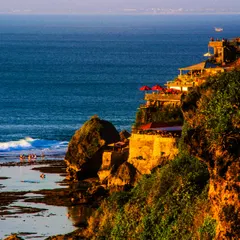
West of the platform, a ledge of rock extends over a second blowhole and lets the coast be seen in the distance. The stone is the same raised Tertiary limestone that forms the Bukit peninsula, dry and stony, eaten by salt and waves.
Beneath the water there is another story. Nusa Dua is one of the five sites of Indonesia’s Coral Garden, one of the largest coral restoration projects in the world. In 2021, nearly a thousand locals who had lost their tourism jobs during the pandemic were hired to make and place eight thousand steel-tube structures for new coral.
About three kilometres to the south, in Sawangan, Geger Beach has a sea so calm that seaweed can be farmed, and on its promontory stands a small temple, Pura Geger. The rebuilt reef and the quieter coast beyond the resorts close the route, and what joins them is revealed by listening to the narration from the ledge.