Atapuerca
Museum of Human Evolution Audio Guide (Museo de la Evolución Humana)
A great glass container on the banks of the Arlanzón holds the story of humanity's origins, written in the fossils of the Sierra de Atapuerca.
- 90 min of audio
- Human evolution
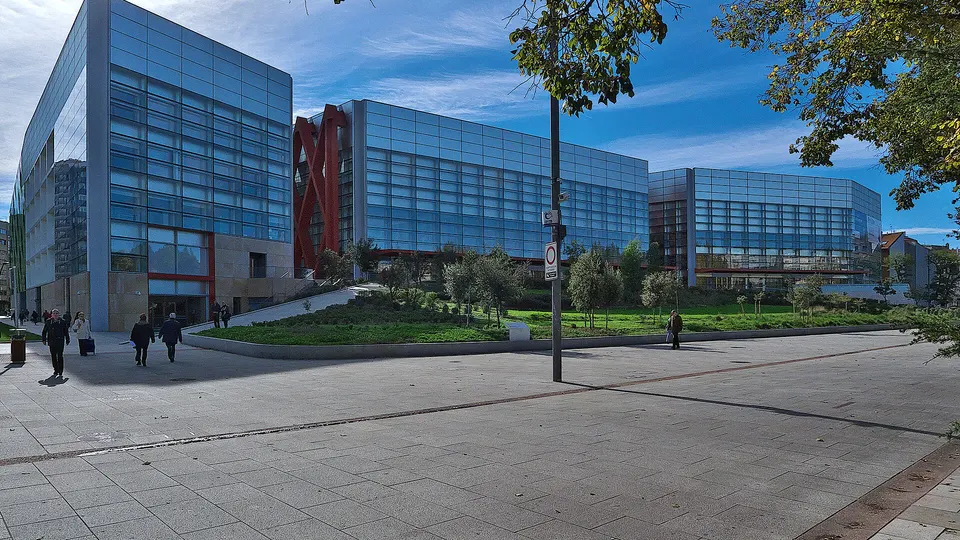
Opened in 2010 in a building by Juan Navarro Baldeweg, the museum stands on the site of the former convent of San Pablo and is part of the Human Evolution Complex, together with the Atapuerca sites and the National Research Centre on Human Evolution. Its exhibition brings together replicas and originals of finds from sites located about 15 kilometres from Burgos.
Among the standout pieces are the skull nicknamed Miguelón, one of the most complete of its age, and a reddish quartzite hand axe known as Excalibur, interpreted by some as a possible funerary offering. A reconstruction of HMS Beagle, Darwin's ship, closes the tour with the underlying question: who are we.
Highlights
- Glass and white concrete building by Juan Navarro Baldeweg, opened in 2010
- Atapuerca fossils, a World Heritage Site since 2000
- The Miguelón skull, one of the most complete of its age
- The Excalibur hand axe, a possible funerary offering from the Sima de los Huesos
- Reconstruction of HMS Beagle, Darwin's ship
What to see at the Museum of Human Evolution in Burgos is, to a large extent, a question about time. The history of this museum begins in 2010, when the building designed by Juan Navarro Baldeweg opened, but its raw material is far older: the finds of the Sierra de Atapuerca, whose sites were declared a UNESCO World Heritage Site in 2000. In a city of golden stone and medieval memory, the museum looks much further back, to the first Europeans. The full experience is lived by walking it with the audio guide, which arranges the rooms into a story of about 90 minutes. Across the Arlanzón lies the Paseo del Espolón, and together with the Burgos Cathedral it forms one of the city’s two great draws.
The glass building by the river
Museum of Human Evolution
Summary of this stop
On the bank of the Arlanzón rises a great container of glass and white concrete. The contrast with the historic centre of Burgos is deliberate: the contemporary against the medieval, in a single urban landscape.
The building occupies the site of the former convent of San Pablo, the so-called solar de Caballería, and is part of the Human Evolution Complex, which also brings together the Atapuerca sites and the National Research Centre on Human Evolution. Navarro Baldeweg’s architecture thus works as a gateway to a wider scientific ensemble.
The museum is devoted to human evolution through the finds of Atapuerca, about 15 kilometres from the city. Before crossing the door, the façade already poses what kind of journey awaits inside, and the most surprising detail is kept for the narration on the spot.
The time of Atapuerca
Atapuerca exhibition
Summary of this stop
The room devoted to the sites presents the deep time of the sierra. At Atapuerca the species Homo antecessor was defined from remains some 800,000 years old, one of the oldest human populations in western Europe. They are, in practice, the first Europeans the museum speaks of.
That time scale coexists with a more recent story, that of the research. The excavations have been directed by the team of Eudald Carbonell, Juan Luis Arsuaga and José María Bermúdez de Castro, awarded the Prince of Asturias Award in 1997. UNESCO’s recognition in 2000 completed the picture of a place that changed the view of European origins.
The Sima de los Huesos
Miguelón skull
Summary of this stop
The Sima de los Huesos site has yielded thousands of human fossils attributed to the lineage leading to the Neanderthals, several hundred thousand years old. The museum displays replicas and originals of these fossils, among them the skull nicknamed Miguelón, one of the most complete of its age.
Next to the skulls appears the reddish quartzite hand axe known as Excalibur, found in the Sima de los Huesos itself. Its name, as the story goes, comes from the colour and rarity of the piece, which reminded the researchers of King Arthur’s legendary sword. Some specialists interpret it as a possible funerary offering, which would make it one of humanity’s first symbolic gestures, although the interpretation remains debated.
Death, symbol and origin meet at this stop: a red stone that perhaps was a first farewell to the dead. What its discovery suggests is better explained before the display cases, with the audio guide.
Darwin’s ship and us
HMS Beagle reconstruction
Summary of this stop
The exhibition includes a reconstruction of HMS Beagle, Charles Darwin’s ship, which serves to explain the theory of evolution. After the Atapuerca fossils, the model shifts the gaze from the remote past to a question about the present: evolution as a matter that concerns whoever walks through the rooms.
At this point there is also a very Spanish anecdote. According to a documented tradition, the most famous skull of Atapuerca was christened Miguelón in tribute to the cyclist Miguel Indurain, at the height of his Tour victories. A popular nod to a fossil hundreds of thousands of years old, which the tour picks up with humour before its close.