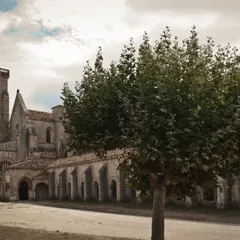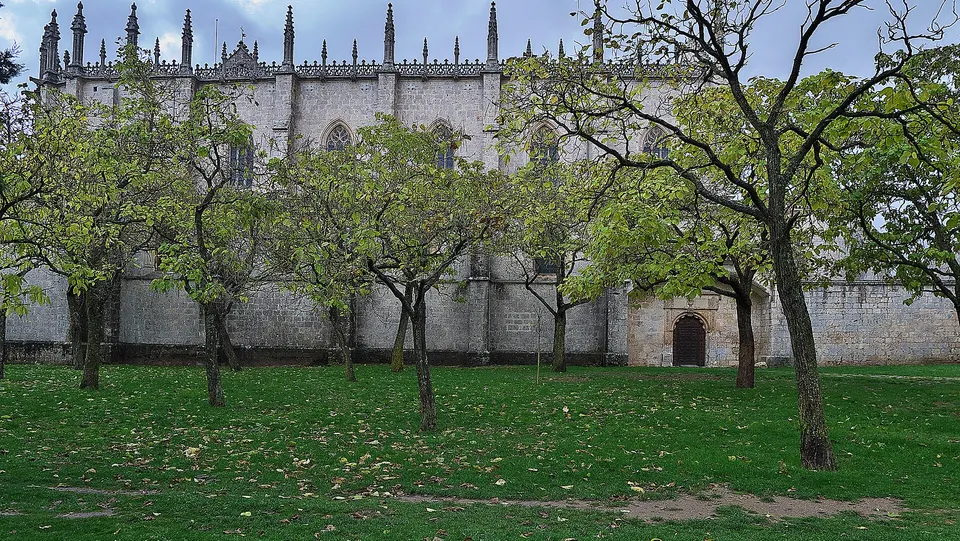
Carthusian monastery
Miraflores Charterhouse Audio Guide (Cartuja de Santa María de Miraflores)
A Carthusian monastery where a community of monks still lives in silence, with a gilded altarpiece and star-shaped royal tombs by Gil de Siloé.
- 45 min of audio
- Isabelline Gothic
The Miraflores Charterhouse was founded in 1442 by King John II of Castile on a former royal palace handed over to the Carthusian order. Its church, promoted by Isabella the Catholic as a pantheon for her parents, is an outstanding example of late Gothic, or Isabelline, in Castile.
Contrast defines the place: the voluntary poverty and silence of the monks coexist with the carved marble and gold with which the kings wished to secure their memory. The Carthusian community still lives in the monastery and keeps the rule of silence and enclosure.
Highlights
- Founded in 1442 by John II of Castile on a former royal palace
- Star-shaped tomb of John II and Isabella of Portugal, by Gil de Siloé
- Polychrome and gilded high altarpiece, around 1496-1499
- Single-nave church divided into three spaces
- A community of Carthusian monks who keep silence
The story of the Miraflores Charterhouse begins in 1442, when King John II of Castile founded the monastery on a former royal palace handed over to the Carthusian order. Half a century later, his daughter Isabella the Catholic promoted the church as a pantheon for her parents and commissioned Gil de Siloé to make the royal tomb and the great altarpiece. The result is one of the most outstanding ensembles of Isabelline Gothic in Castile, set about three kilometres east of the centre of Burgos, in a wooded spot. Anyone looking for what to see at the Miraflores Charterhouse finds history, architecture and a silence that is still alive. The full experience is best enjoyed by walking the monastery with the audio guide. The two great royal monasteries on the outskirts of Burgos are this one and the Las Huelgas Monastery, while the Gothic of the Colonia family and Gil de Siloé has its great urban stage in the Burgos Cathedral.
Before the charterhouse in the woods
Miraflores Charterhouse
Summary of this stop
The charterhouse rises about three kilometres east of the centre of Burgos, in a wooded spot that already announces its purpose: withdrawal from the world. The history of the Miraflores Charterhouse begins here with John II of Castile, who in 1442 founded the monastery on a former royal palace handed over to the Carthusian order.
The monastery is no museum piece. It is still inhabited by a community of Carthusian monks who keep the rule of silence and enclosure, and that presence shapes the whole visit.
The most surprising part of this first stop is kept for the narration, heard right there, before the woods.
The nave of silence
Charterhouse church
Summary of this stop
The church has a single nave divided into three spaces: one for the faithful, another for the lay brothers and another for the monks of the choir. That arrangement reflects Carthusian life and makes the architecture of the Miraflores Charterhouse an architecture of recollection, an outstanding example of late Gothic, or Isabelline, in Castile.
The church grew out of the impulse of Isabella the Catholic, who wanted it as a pantheon for her parents. Among the visible elements, the carved wooden choir stalls of the monks stand out.
The monks still live here in almost total silence, given to prayer and solitude, according to a documented tradition of a way of life barely changed since the Middle Ages.
The royal tombs
Tomb of John II
Summary of this stop
In the presbytery lies the tomb of John II and his wife Isabella of Portugal, a carved marble tomb with an eight-pointed star plan. It is the work of the sculptor Gil de Siloé, who carved it between 1489 and 1493.
Beside it stands the tomb of Prince Alfonso of Castile, brother of Isabella the Catholic, also carved by Gil de Siloé. This wall-set tomb in an arched recess completes a space given over to marble, death and the memory of kings.
The gilded altarpiece
Charterhouse altarpiece
Summary of this stop
The high altarpiece, polychrome and gilded, was designed by Gil de Siloé and Diego de la Cruz around 1496-1499. It is one of the great pieces of the church and concentrates the gold of the whole, understood as prayer made matter.
According to tradition, part of the gold covering the altarpiece comes from the first gold brought from America. Legend has it that the Catholic Monarchs offered it, which would make this charterhouse one of the first places in Europe where the gold of the New World shone. It is a popular belief that the narration presents as such, without taking it as proven fact.