UNESCO heritage
Burgos Cathedral Audio Guide (Catedral de Santa María de Burgos)
Gothic turned to stone lace and the eternal shadow of El Cid, beneath a crossing tower that crowns one of Europe's most admired churches.
- 60 min of audio
- Gothic architecture
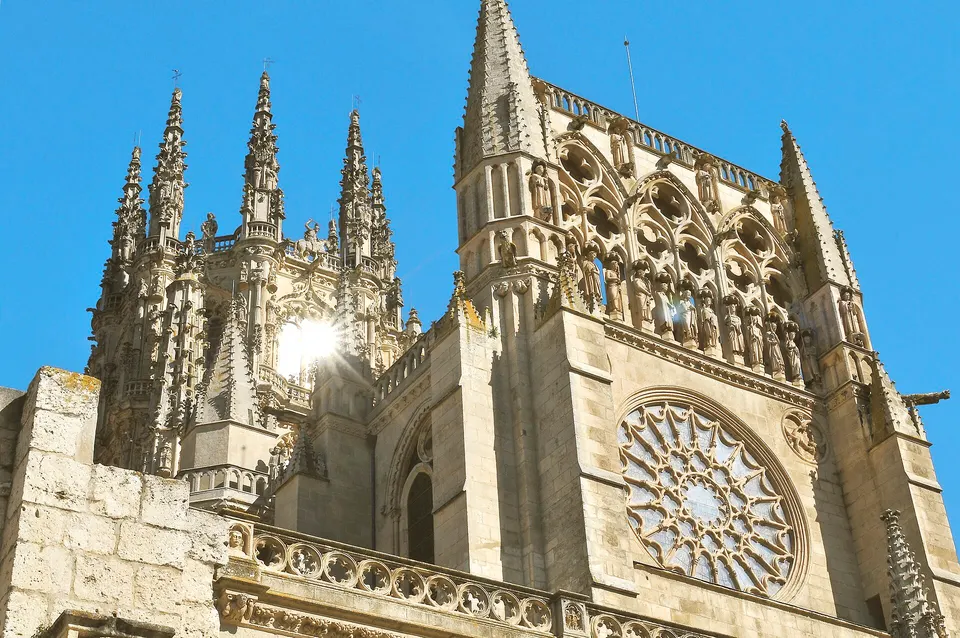
The first stone of the Gothic cathedral was laid in 1221, at the urging of King Ferdinand III and Bishop Maurice. Dedicated to Saint Mary, it rises in the historic centre of Burgos, a few metres from the Arlanzón river. Its construction stretched over centuries, which is why the whole combines Gothic, Renaissance and Baroque elements. UNESCO declared it a World Heritage Site in 1984, and it is the only Spanish cathedral with that distinction on its own rather than as part of an urban ensemble.
Among its most singular features are the openwork spires of the façade, the Plateresque crossing tower beneath which El Cid and Doña Jimena rest, the Papamoscas automaton clock and Diego de Siloé's Golden Staircase. A tour of about 60 minutes links these points with the legends that go with them.
Highlights
- Openwork spires of the façade — by Juan de Colonia, 15th century
- Tomb of El Cid and Doña Jimena beneath the crossing tower
- The Papamoscas — an automaton clock that opens its mouth on the hour
- Golden Staircase — Diego de Siloé's Renaissance stairway
- Chapel of the Constables — an openwork star vault
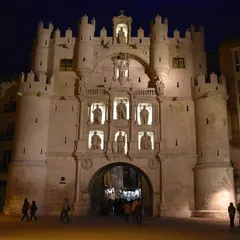
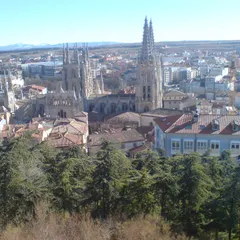
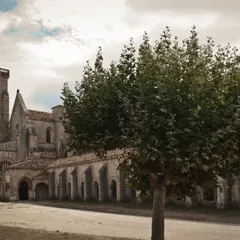
What to see at Burgos Cathedral begins with a date: 1221, the year the first stone of the Gothic church was laid, at the urging of King Ferdinand III and Bishop Maurice. The history of Burgos Cathedral is that of a work that took several centuries to complete and that is now regarded as one of the summits of European Gothic. Its architecture gathers Gothic, Renaissance and Baroque layers, and in 1984 UNESCO granted it World Heritage status, something no other cathedral in Spain holds on its own. The full experience is lived by walking it with the audio guide, which keeps the most surprising detail for each point. Its square is reached through the Arch of Santa María, the old gate of the wall, and the best view of the church from above is found at the Castle Viewpoint. The Gothic of the Colonia family and Gil de Siloé, present in the cathedral, reappears in the Miraflores Charterhouse.
The stone lace of the façade
Burgos Cathedral
Summary of this stop
The tour begins in Santa María square, facing the main façade. Here the cathedral dedicated to Saint Mary is introduced, in the heart of the historic centre and very close to the Arlanzón river, medieval faith turned into stone lace.
The two towers end in openwork spires, raised in the 15th century by the master Juan de Colonia. The perforated stone recalls a lace fabric, and that fineness explains a good part of the fame of the whole.
A legend circulates about these spires: it is said that they were so admired that a belief spread that misfortune would befall anyone who dared damage them, as if the cathedral itself protected its stone work. The narration offers the rest of the story on site.
Beneath the crossing tower, El Cid
Crossing and tomb of El Cid
Summary of this stop
The second point lies at the centre of the crossing, beneath the crossing tower. The present lantern tower, Plateresque in style and decorated with figures and stars, was rebuilt after the earlier one collapsed in 1539.
On the floor, a slab marks the place where Rodrigo Díaz de Vivar, El Cid Campeador, and his wife Doña Jimena rest, their remains having been moved there in 1921. It is the heart of the church and, at the same time, the place where the hero sleeps beneath a stone star. The whole also shows how centuries of different styles coexist in a single building.
Linked to this stop is the episode from the Cantar de Mio Cid in which the hero, exiled and penniless, is said to have filled two chests with sand and pawned them as if they held a treasure. According to tradition, one of those chests is the one kept in the cathedral. The details of that story are reserved for the audio guide.
The Papamoscas and the passing of time
The Papamoscas
Summary of this stop
In the central nave, the gaze turns upward, where the Papamoscas is found. This automaton clock opens its mouth on the hour, and its presence adds a note of popular humour amid the Gothic solemnity.
Burgos tradition describes it as having a life of its own: a figure that mocks those who look at it and opens its mouth as if laughing every time another hour goes by. It is a popular belief, not a documented fact, but it is part of the character with which Burgos looks at its cathedral.
At this point the chest of El Cid is also mentioned, a wooden chest kept in the church and linked to a famous episode of the Cantar de Mio Cid. The audio guide ties both curiosities into the tour.
The Golden Staircase and the layered centuries
Golden Staircase
Summary of this stop
The last stop arrives at the Golden Staircase, in the north arm of the crossing. It is a Renaissance stairway with two flights and rich decoration, the work of Diego de Siloé, inspired by Italian models and built around 1519 to bridge the difference in level of the Coronería Door.
Here the Renaissance converses with the Gothic, and the church shows clearly its layered centuries. Very close lies the Chapel of the Constables, Gothic, with an openwork star vault, ordered built in the late 15th century by the Constables of Castile.
The close of the tour shows how a cathedral raised over centuries gathers art from different eras, an impression the narration completes on the ground.