Cistercian royal pantheon
Las Huelgas Monastery Audio Guide (Monasterio de Santa María la Real de las Huelgas)
A convent of nuns where an abbess ruled with almost episcopal power and where the kings of Castile chose to rest. Medieval power, dressed in a habit.
- 60 min of audio
- Royal pantheon and Cistercian art
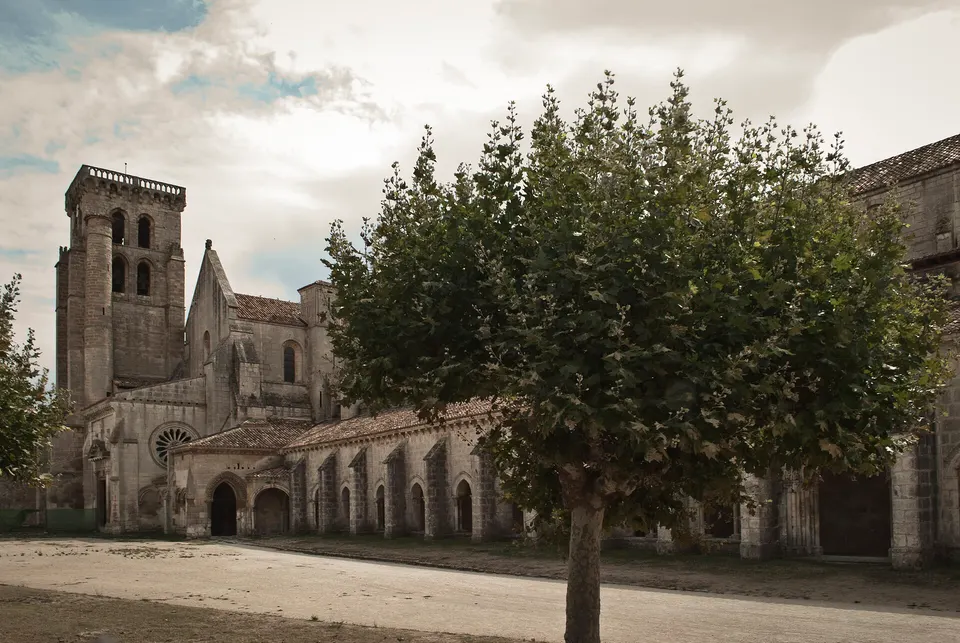
Founded in 1187 by Alfonso VIII and Eleanor Plantagenet as a Cistercian abbey for women, the monastery stands west of the centre of Burgos, in the old area of huelgas, or royal pleasure grounds, beside the Arlanzón, from which it takes its name. Today it belongs to Patrimonio Nacional and is still home to a community of Cistercian nuns.
Amid the Gothic sobriety of the church, the plasterwork of Almohad tradition in the Cloister of San Fernando and some thirty royal tombs, the complex also holds the Museum of Medieval Fabrics, with textiles taken from the tombs that form a first-rate textile collection in Europe.
Highlights
- Royal pantheon — some thirty tombs of kings, infantes and nobles
- An abbess with quasi-episcopal jurisdiction over towns and monasteries
- Museum of Medieval Fabrics — textiles and clothing taken from the tombs
- Cloister of San Fernando — plasterwork of Almohad tradition
- Revolving iron pulpit in the nuns' choir
What to see at the Las Huelgas Monastery, one of the most singular ensembles in Burgos, is above all a glimpse into a small kingdom governed by women. The history of the monastery begins in 1187, when King Alfonso VIII of Castile and his wife Eleanor Plantagenet founded it as a Cistercian abbey for women. Over the centuries the abbess exercised quasi-episcopal jurisdiction over numerous towns and monasteries, an exceptional lordly power for a woman, and the complex came to serve as the royal pantheon of Castile.
The architecture of the monastery combines the sobriety of the Gothic Cistercian church with the plasterwork of Almohad tradition in the Cloister of San Fernando, and the visit brings together royal tombs, a museum of medieval textiles and a community of nuns who still live on the site. The full experience is best enjoyed by walking it with the audio guide, which keeps the most surprising detail for each point. Among the royal monasteries on the outskirts of Burgos, Las Huelgas finds its pair in the Miraflores Charterhouse, and medieval, royal Burgos can be completed at the Castle Viewpoint, the hill where the city was born.
Before the monastery gate
Las Huelgas Monastery
Summary of this stop
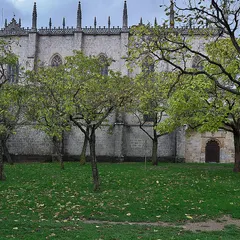
The tour begins at the walled entrance, the threshold of a women’s lordship. The monastery of Santa María la Real de las Huelgas was founded in 1187 by Alfonso VIII and Eleanor Plantagenet as a Cistercian abbey of nuns, and from the first moment it was born with the vocation of a great house of the Castilian monarchy.
The name comes from the surroundings: the complex lies west of the centre of Burgos, in the old area of huelgas, or royal pleasure grounds, beside the Arlanzón. Today the monastery belongs to Patrimonio Nacional and is still home to a community of Cistercian nuns, so visitors enter a living place and not an empty museum. The most striking detail of this point is kept for the narration that accompanies the visit.
In the Cistercian church
Las Huelgas church
Summary of this stop
In the nave, before the nuns’ choir, Cistercian sobriety unfolds. The church, in the Cistercian Gothic style, keeps in the choir a revolving iron pulpit that allowed the nuns to be read to without breaking enclosure, an ingenious solution for a community that lived apart from the world.
Here the power of the abbess also makes sense: for centuries she exercised quasi-episcopal jurisdiction over numerous towns and monasteries. It is said that she came to hold such authority that she could appoint priests, hear confessions and judge in her domains, until Rome gradually limited those powers as unfitting for a woman. A documented tradition, which the account presents for what it is: the story of a woman who commanded like a bishop in the heart of the Middle Ages.
Part of the same complex is the Cloister of San Fernando, with plasterwork of Almohad tradition, with geometric and plant motifs of Andalusi influence, a counterpoint of delicate decoration against the austerity of the church.
The royal pantheon
Royal Pantheon of Las Huelgas
Summary of this stop
Beside the tombs of the kings, it becomes clear why Las Huelgas was the royal pantheon of Castile. The monastery keeps some thirty tombs of kings, infantes and nobles, and in the choir of the church lies that of its founders, Alfonso VIII and Eleanor Plantagenet.
Dead kings under the authority of a nun: that is the paradox that defines this point. Tradition also places here the knighting of several kings of Castile, who, it is said, girded on the sword before the altar of the monastery founded by their ancestors. The audio guide reveals on the spot what those rites and those tombs say about power in Castile.
The Museum of Medieval Fabrics
Museum of Medieval Fabrics
Summary of this stop
In the textile room, the recovered colour of the Middle Ages appears. The Museum of Medieval Fabrics keeps textiles and clothing taken from the tombs, a first-rate medieval textile collection in Europe that shows how the kings and infantes of Castile dressed.
Among the monastery’s pieces is also the Pendón de las Navas, an Andalusi fabric associated with the battle of Las Navas de Tolosa in 1212, traditionally kept here. It is the close of a tour in which the power of Castile is dressed in a nun’s habit, and whose final wonder is reserved for the narration on site.