Art and architecture
Munch Museum Audio Guide
A leaning thirteen-storey tower in Bjørvika guards the legacy Edvard Munch left to Oslo: nearly 28,000 works, with The Scream in a darkened room.
- 60 min of audio
- Art and architecture
The MUNCH museum opened on 22 October 2021 on Oslo's waterfront, in a ceremony presided over by King Harald V. It is the work of the Spanish firm Estudio Herreros, of Juan Herreros and Jens Richter, winner of the international competition in 2009. It gathers vertically what Munch left to the city when he died in 1944.
Behind the glass and aluminium lies a story of political disputes, an armed robbery and canvases so large that the building had to be opened up to receive them. From The Scream to The Sun, the visit moves from anguish to light, with the fjord always in the background.
Highlights
- 13-storey tower of about 60 metres, its top cantilevered over the fjord
- Nearly 28,000 works, one of the largest collections devoted to a single artist
- Eight versions of The Scream, shown in rotation in a darkened room
- The Sun, a canvas of about 4.5 by 8 metres hoisted through an opening in the facade
- Self-Portrait between the Clock and the Bed, one of his last great paintings
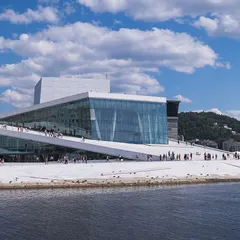
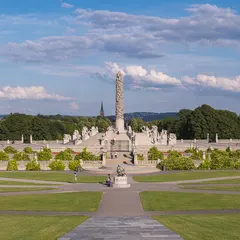
Anyone wondering what to see at the Munch Museum finds more than a picture gallery: a thirteen-storey building in the Bjørvika district that holds the gift a childless painter made to his city. Edvard Munch died on 23 January 1944 and bequeathed to Oslo everything he kept on his Ekely estate. That legacy is today one of the largest collections in the world devoted to a single artist. The history of the Munch Museum mixes architecture, politics, theft and mourning, and the full experience is best enjoyed by walking it with the audio guide. The museum is part of Bjørvika’s new waterfront, where the Oslo Opera House also stands. And like Munch, the sculptor Gustav Vigeland is one of Norway’s two great artists, with his work gathered in the Vigeland Park.
The tower that leans over the fjord
MUNCH
Summary of this stop
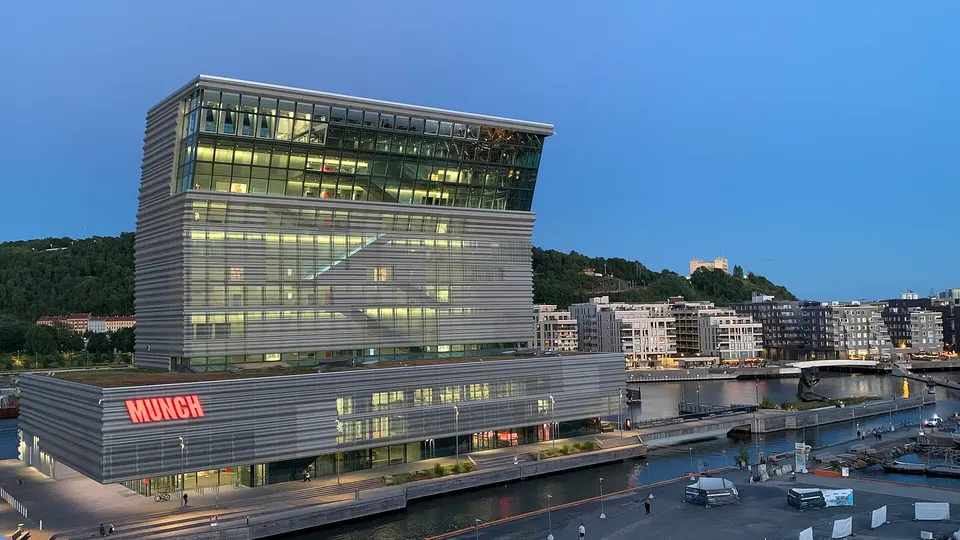
The visit starts on the esplanade in front of the museum, from where the whole tower can be seen. The vertical body, 13 storeys and about 60 metres high, is clad in panels of recycled, perforated aluminium that filter the light to protect the art inside. At the top, the crown juts out and tilts towards the city and the fjord, the feature that gives the building its recognisable silhouette.
The architecture of the Munch Museum is the work of the Spanish firm Estudio Herreros, which won the international competition called by the city in 2009. The museum opened on 22 October 2021, but the road was long: in December 2011 Oslo City Council even voted to halt the project, the plan was revived in May 2013 and construction did not start until September 2015.
The debate centred on the cost, about 2.25 billion kroner, and on whether the collection should stay at Tøyen. The tilted form went on dividing critics even after the opening. The details that explain such ambition for a single painter are revealed by listening to the narration on the esplanade itself.
The legacy Munch left to the city
MUNCH
Summary of this stop
In the lobby and the lower galleries one grasps the turn that explains everything. Munch died without descendants and bequeathed to Oslo about 1,200 paintings, some 7,050 drawings, 18,322 prints and 14 sculptures, as well as some 10,000 personal objects. At Ekely, the works were spread across studios and sheds, and some were even left outdoors.
Before this building there was another: the first Munch Museum opened in 1963 at Tøyen to mark the centenary of the painter’s birth, in 1863. In the summer of 2021 nearly 28,000 works were moved from there to the Bjørvika tower.
The gesture of the bequest weighs more given its context. The Nazis branded his art “degenerate” and in 1937 removed 82 of his works from German museums. Even so, the painter entrusted his entire output to Oslo. Today the museum holds 26,724 works by Munch himself and more than 42,000 museum objects.
The Scream in the darkened room
The Scream
Summary of this stop
On the 4th floor waits a small, dimly lit space devoted to The Scream. The museum holds eight versions: a painting on cardboard in tempera and oil, a wax crayon drawing and six lithographs. They are shown in rotation, with only one on view at a time, because cardboard and paper degrade with light.
The painting also has a history of theft. On 22 August 2004 two armed men took The Scream and Madonna from the old Tøyen museum. Both works were recovered on 31 August 2006. The raid exposed the security shortcomings of the old building and strengthened the decision to build a new home.
According to documented tradition, the episode happened in broad daylight and in full view of visitors, and The Scream came back with a damp stain in the lower left corner that could no longer be removed. Where to look and what that mark tells is revealed by listening to the audio guide in front of the room.
The Sun that came in through the wall
Edvard Munch Monumental
Summary of this stop
The 6th floor houses the double-height hall “Edvard Munch Monumental”. Here “The Sun” is displayed, a canvas of about 4.5 by 8 metres that Munch painted around 1910-1911 as a full-size study for the decoration of the Aula of the University of Oslo, a commission he worked on between 1909 and 1916. It is a sunrise that bursts into rays over the sea.
Its arrival at the museum has an anecdote of its own. According to documented tradition, “The Sun” and “The Researchers”, almost 5 by 11 metres, were so large that they fitted through no door or lift. A slot about 60 centimetres wide and 7.1 metres high was opened in the wall facing the sea, more than 26 metres above the ground. The canvases arrived by barge, a crane hoisted them and the opening was closed afterwards.
Alongside the light of The Sun, the collection holds “Self-Portrait between the Clock and the Bed”, painted between 1940 and 1943. Munch portrays himself already old, standing between a faceless grandfather clock and a bed, two symbols of time running out. All of it connects with the “Frieze of Life”, the cycle on love, anxiety and death that he began in the 1890s and from which The Scream was born, in 1893.
From here, from Oslo to the world
MUNCH
Summary of this stop
The visit ends on the top floor, where a viewing platform opens the view over the fjord. From there one can make out the roof of the Opera House, the towers of the Barcode, the ferries and the islands and hills of the Oslofjord.
Up here the meaning of everything before ties together. The almost 28,000 works the city inherited, 26,724 of them by Munch himself, are no longer a private matter: they are a public place that Oslo shows to the world. One man’s intimate anguish ends up turned into a luminous gift facing the water.
How the tower, the legacy and the final view connect is what the narration leaves for the last stretch of the visit.