Nordic skiing
Holmenkollen Ski Jump Audio Guide (Holmenkollbakken)
The great ski jump crowning a hill above Oslo: a national stage since 1892, rebuilt in steel in 2010, with the world's oldest ski museum at its base.
- 75 min of audio
- Nordic skiing
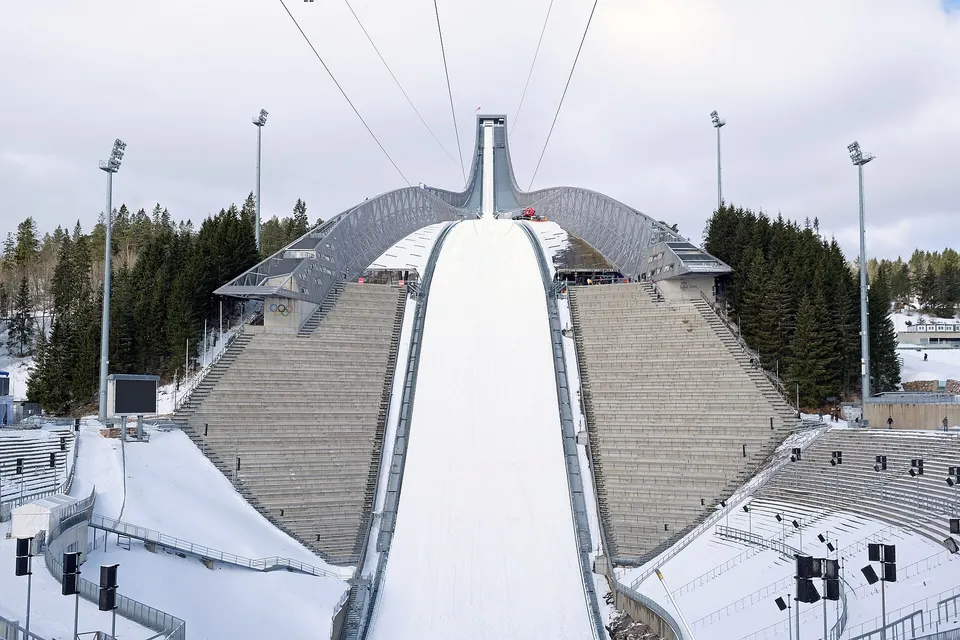
Holmenkollen has hosted ski competitions since 1892, and today's jump is the latest chapter in a long series of reconstructions. Designed by Julien De Smedt with Florian Kosche and opened on 3 March 2010, it uses around 1,000 tonnes of steel and cuts its white silhouette against the city.
Beneath the slope lies the Skimuseet, which covers some 5,000 years of skiing history, and at the top of the tower a viewing platform opens the view over Oslo and the fjord. Between the two extremes there is room for a king who rode the train with his skis on his shoulder and for some years when nobody wanted to jump.
Highlights
- 2010 steel ski jump — around 1,000 tonnes of steel, designed by Julien De Smedt
- Ski Museum — the world's oldest, founded in 1923
- Viewing platform at the top of the tower — views of Oslo and the fjord, reached by lift
- Holmenkollen Ski Festival — every March since 1892
- Kollensvevet zip line — 361 metres along the structure
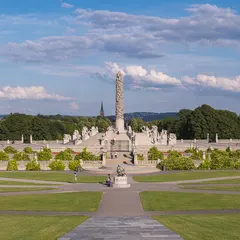
The history of the Holmenkollen Ski Jump (Holmenkollbakken in Norwegian) begins on 30 and 31 January 1892, when the first competition was held here: an 18-kilometre cross-country race on the Saturday and jumping the next day, with a winning jump of 21.5 metres in front of between 15,000 and 20,000 people. Since then the hill has hosted four Nordic World Ski Championships (1930, 1966, 1982 and 2011) and the ski jumping event of the 1952 Oslo Winter Olympics. Anyone wondering what to see at the Holmenkollen Ski Jump will find a site that brings together sport, architecture, a museum and a viewing platform in one compound, reached by metro line 1. The full experience is best enjoyed by walking it with the audio guide. The polar exploration of the Fram Museum and the skiing of Holmenkollen are two faces of Norway’s cold. To the west of the city lies the Vigeland Park.
The hillside a whole country climbs
Holmenkollbakken
Summary of this stop
The walk begins at the foot of the jump, beside the stadium, where the scale of the jump hits all at once. The in-run drops steeply towards a snowy expanse with the stands of the combined cross-country and biathlon stadium, part of the Holmenkollen National Arena, which also includes the Midtstubakken normal hill.
This hillside is the setting of the Holmenkollen Ski Festival, organised by Skiforeningen, the Norwegian ski association. It has been held every year since 1892, always in March, with the only exceptions of 1898 and the years of the Second World War (1941-1945), and is the great date of Nordic skiing in the country. Documented tradition describes tens of thousands of people climbing the hill each spring.
What exactly happens in that collective climb, and why the hillside works almost like a national altar, is part of what the narration keeps for the place itself.
Five thousand years of skiing under the slope
Skimuseet
Summary of this stop
At the foot of the hill, under the jump, is the entrance to the Skimuseet, the Ski Museum. Founded in 1923 on the initiative of the architect Hjalmar Welhaven, it is the world’s oldest ski museum.
Its display covers some 5,000 years of history, from Stone Age rock carvings to modern competition. Among its collections is equipment from the great polar expeditions, donated by Fridtjof Nansen and Roald Amundsen.
The jump itself is part of that history: it has been rebuilt many times, eighteen according to the Ski Museum and nineteen according to other sources, with milestones such as the stone take-off of 1910 and the slope superstructures of 1914 and 1928.
The edge of the take-off and the silence of war
Holmenkollen jump tower
Summary of this stop
At the top of the tower one reaches the lip of the take-off, the steel cantilever that projects from the start house and crowns the jump’s white silhouette. The current all-steel structure was designed by Julien De Smedt (JDS studio) with Florian Kosche, whose proposal won out over 104 entries. After the previous structure was demolished in 2008, it opened on 3 March 2010, in time for the 2011 World Championships.
The technical figures give an idea of its scale: a large hill of size HS134 with a K-120 critical point (raised from the earlier K-105 in 1992), a 96.95-metre in-run and a start house rising about 64 metres above the ground. The Olympic jumping event was held here in 1952, won by the Norwegian Arnfinn Bergmann in front of more than 100,000 spectators, one of the largest crowds ever gathered for a ski jump.
Another episode, of a very different tone, belongs to the German occupation (1940-1945). Documented tradition speaks of a “sports strike” in which Norwegian athletes and spectators refused to compete under the new regime: the contest, which usually drew some 450 jumpers, stood empty, and the edition the collaborators tried to organise had barely twenty entrants. The details of that silence are kept for the audio guide.
The lookout of the people’s king
Holmenkollen viewing platform
Summary of this stop
The tower’s viewing platform is a public deck, reached by lift, with panoramic views over Oslo and the fjord. From it starts the Kollensvevet, the zip line installed in the 2010 rebuild, which descends 361 metres along the structure over a drop of 107.5 metres.
The way up also has its history. The Holmenkollen line (Holmenkollbanen) opened on 31 May 1898 as Oslo’s first suburban railway; extended to Frognerseteren in 1916, it is now metro line 1 and climbs the hill towards the Nordmarka forest. On the same hill stands Kongsseteren, the royal family’s residence, a gift from the Norwegian people to King Haakon VII and Queen Maud on the occasion of the 1906 coronation (completed in 1911), where the royals stay during the Ski Festival.
A much-quoted scene is linked to that train: according to documented tradition, in December 1973, with Sunday driving banned because of the oil crisis, King Olav V rode the Holmenkollbanen with his skis on his shoulder, like any Oslo resident. Gestures like this are why he is known as Folkekongen, the people’s king.