Polar exploration
Fram Museum Audio Guide (Frammuseet)
The original polar ship, preserved whole and open to walk through: the same hull that drifted across the Arctic with Nansen and reached Antarctica with Amundsen.
- 60 min of audio
- Original polar ship
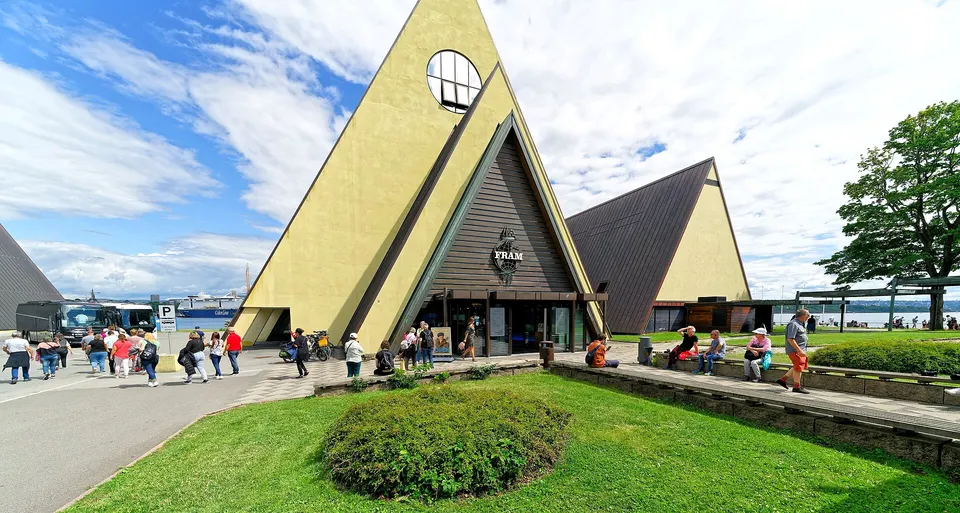
The triangular museum at Bygdøynes, on the Bygdøy peninsula, opened on 20 May 1936 and was built expressly to house the Fram. It is not a replica: it is the original vessel, with its interior intact, and the whole building is organised around it.
This wooden hull holds a unique record: it is the ship that has sailed both farther north and farther south than any other. Alongside, in a second building, waits the little Gjøa, the first vessel to sail the whole Northwest Passage.
Highlights
- The original Fram on board — cabins, saloons, hold and engine room
- Rounded hull designed so the ice would lift it rather than crush it
- Nansen's Arctic drift (1893-1896) and Amundsen's course to the South Pole (1910-1912)
- 270-degree surround film of the polar environment
- The Gjøa and the Northwest Passage in the adjoining building
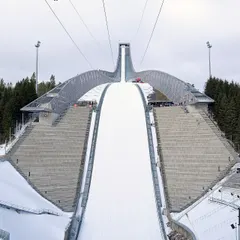
What to see at the Fram Museum (Frammuseet) in Oslo has a clear answer: a real ship. The triangular building at Bygdøynes opened on 20 May 1936 to house the polar ship Fram, and the whole visit revolves around it. The history of the Fram spans three great expeditions: Nansen’s Arctic drift, Sverdrup’s voyage through the Canadian archipelago and Amundsen’s conquest of the South Pole. The full experience is best enjoyed by walking the ship with the audio guide, which ties each corner to its episode. Polar exploration has its continuation in skiing, the other face of Norway’s cold, at the Holmenkollen Ski Jump. The ferries to Bygdøy leave from the area of Akershus Fortress.
The original ship, not a replica
Fram Museum
Summary of this stop
The main hall raises the dark, rounded hull of the Fram in the middle of a triangular space built precisely to enclose it. What one sees is the original ship, with its interior intact: visitors climb aboard and walk through the cabins, the saloons, the cargo hold and the engine room.
From the deck, a 270-degree surround film of the polar environment plays throughout the day, with storm, wind and ice. The 2018 renovation opened the cabins to the public and added original objects, life-size mannequins and interactive audiovisual experiences.
The record that makes the ship famous is also summed up here: no other wooden ship has sailed both farther north and farther south. The audio guide keeps for this very spot the detail that explains how a single hull came to reach both ends of the world.
The hull the ice could not crush
Fram
Summary of this stop
The Fram was designed and built by the Scottish-Norwegian naval engineer Colin Archer for Fridtjof Nansen. She was launched on 26 October 1892 at Archer’s yard in Larvik and christened by Nansen’s wife, Eva. The name means “Forward” in Norwegian, and she is a three-masted schooner about 39 metres long and 11 wide.
The key lies in the shape of the hull: rounded and smooth, with hardly any points where the ice could take hold. The idea was that the pack ice, as it compressed, would push the ship upwards and make it float on the ice instead of crushing it. The oak frames were mounted in pairs, separated by only about 5 centimetres.
Below deck, trapped in the pack ice
Fram cabins
Summary of this stop
Below deck lies the hardest side of the voyage. On the first expedition (1893-1896), Nansen deliberately froze the Fram into the pack ice near the New Siberian Islands on 5 October 1893, to let the polar current carry her across the Arctic Ocean and so prove his drift theory. The narrow cabins and the shared saloon show where the crew spent those years.
On 14 March 1895 Nansen and Hjalmar Johansen left the ship to try to reach the North Pole on foot, with skis and dog sledges. In April 1895 they reached 86°13.6′N, the northernmost latitude attained by humans up to then, and turned back. The Fram came out of the ice on 13 August 1896, near western Spitsbergen and very close to where Nansen had predicted, without having been crushed: the drift confirmed both the theory and the ship’s design.
According to documented tradition, Nansen and Johansen then spent the winter in a hut of stones and moss in Franz Josef Land. In June 1896, it is said, Nansen stumbled by chance upon the British explorer Frederick Jackson, and their return depended on that chance meeting. The audio guide keeps the rest of the scene for this point of the visit.
The same ship, bound for the South Pole
Fram
Summary of this stop
The aft deck is the place to follow the turn that crowns the record. On the second expedition (1898-1902), Otto Sverdrup took the Fram to the Canadian Arctic archipelago, west of Greenland, and explored and charted many islands and coasts until then unknown.
Then, on his third great expedition, Roald Amundsen took the ship to Antarctica (1910-1912). He had announced an expedition to the North Pole, but when news spread in 1909 that Cook and Peary claimed to have reached the North already, he secretly changed course to the south. He set up his base, Framheim (“home of the Fram”), in the Bay of Whales, on the Ross Ice Shelf, at 78°41′S. He and four companions reached the South Pole on 14 December 1911, about five weeks before the British expedition of Robert Falcon Scott, who died with his men on the return journey.
That secret turn was controversial: Amundsen had raised funds and obtained the Fram from Nansen for an Arctic venture, and many, above all in Britain, read it as a disloyal manoeuvre. Other episodes of the race, such as the Polheim tent and the letter that Amundsen left at the Pole, according to documented tradition addressed to his rival, are revealed in the narration.
The Gjøa and the Northwest Passage
Gjøa
Summary of this stop
The visit closes in a second building of the museum, opened in 2013 and joined to the main hall. There stands the Gjøa, the first ship to sail the whole Northwest Passage, on the expedition that Amundsen carried out between 1903 and 1906.
The contrast with the Fram is total: a far more modest vessel beside the giant that touched everything. That difference in scale widens the story of Norwegian polar exploration and makes the perfect close for the audio guide.