Norwegian monarchy
Royal Palace Audio Guide (Det kongelige slott)
A neoclassical palace raised for a French marshal turned king, who died without ever living in it and who only became fully Norwegian after independence in 1905.
- 40 min of audio
- Classicist architecture
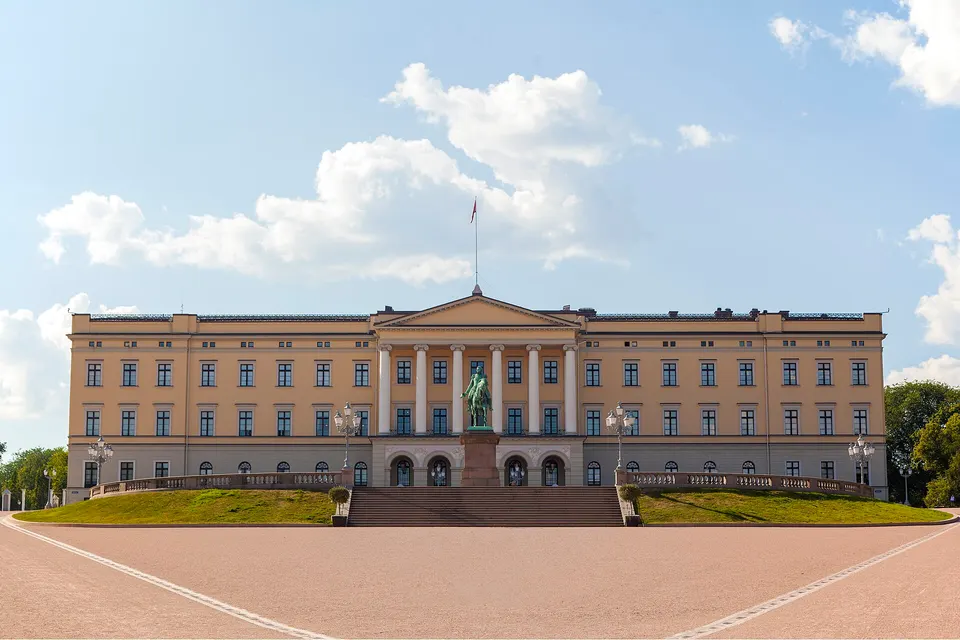
The Royal Palace in Oslo was built between 1824 and 1849 as the Norwegian residence of Carl Johan, born Jean Baptiste Bernadotte, a marshal of Napoleon and founder of the Bernadotte dynasty. The design was by the architect Hans Ditlev Franciscus Linstow, and the building closes the upper end of Karl Johans gate. It remains the official residence of the King of Norway in Oslo.
The contrast lies in the story of its occupants. The king who commissioned it died in 1844 without ever having lived there, and the palace only became a permanent home from 1905. Today a deliberately approachable monarchy shares it with the city: it waves from the balcony to a parade of schoolchildren every 17 May and keeps the surrounding park open.
Highlights
- Equestrian statue of Carl Johan, the largest bronze statue in Norway
- Classicist facade of three wings and 173 rooms
- Changing of the Royal Guard, every day at 13:30
- Main balcony of the children's parade on 17 May
- Slottsparken, a park of about 22 hectares with free access
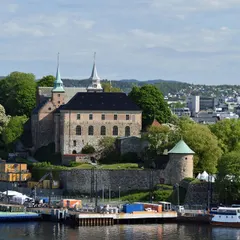
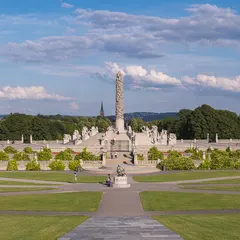
The history of the Royal Palace in Oslo begins with an uncommon decision: around 1821-1822 a foreign king chose this hill to build his Norwegian residence. Carl Johan, Napoleon’s French marshal who ended up on the throne of Sweden and Norway, entrusted the project to Linstow, and the works ran from 1824 to 1849. More than an isolated building, it is the culmination of a ceremonial axis: the great avenue that descends to the city was named Karl Johans gate in 1852 in honour of the late king. Anyone wondering what to see at the Royal Palace in Oslo will find an esplanade, a statue, a guard and a park, and behind it all the story of how an imported crown ended up becoming Norwegian. The full experience is best enjoyed by walking the site with the audio guide. The palace is one of the seats of power in Oslo, along with Akershus Fortress. From the palace one passes to Frogner and the Vigeland Park.
The king on horseback who never lived here
Karl Johan-statuen
Summary of this stop
The palace square, Slottsplassen, is presided over by the equestrian statue of Carl Johan, the work of the Norwegian sculptor Brynjulf Bergslien. It was unveiled by King Oscar II on 7 September 1875 and is the largest bronze statue in Norway. The mounted monarch looks down Karl Johan street, towards the city.
The first contrast is the figure itself: a French marshal, born Jean Baptiste Bernadotte, turned king and cast in bronze on a Norwegian hill. The pedestal bears his personal motto, “Folkets kjærlighed min belönning” (“The people’s love, my reward”), and on the other side the inscription “Det norske folk reiste dette minde” (“The Norwegian people raised this monument”).
At the foot of the statue also begins the story of the axis that bears his name. Linstow proposed in 1838 a great avenue linking the palace with the city, and its western section, the widest, was built in the 1840s. What the king did, and what he never got to do, with his palace is told in more detail in the narration, in front of the statue itself.
The imported crown that became Norwegian
Det kongelige slott
Summary of this stop
In front of the facade one sees a classicist building of three wings and three storeys, in rendered brick, with a pediment held up by columns over the central block. The wings form a U open to the square. That design is the result of cutbacks: Carl Johan laid the foundation stone on 1 October 1825, the cost of the foundations blew the budget and work stopped from 1827 until 1833. For economic reasons the original H-shaped plan was reduced to a simpler U, and the columned pediment was only added at the end.
Carl Johan died in 1844 without ever having lived in his palace. His son, Oscar I, took possession on 15 March 1849 and officially opened it on 26 July of that year with Queen Josephine. The kings of the union, whose main seat was in Stockholm, used it only occasionally. After the dissolution of the union with Sweden in 1905, Haakon VII, the Danish prince Carl elected king of Norway, made it his permanent home. The palace has 173 rooms, and public visits to the interior only began in 2002; it can be toured inside, with a guide, only in summer.
Above the entrance is the main balcony, the palace’s most symbolic spot. Every 17 May, Constitution Day, the royal family waves from there to the barnetog, the schoolchildren’s parade that climbs Karl Johans gate waving small flags. According to documented tradition, the custom was introduced in 1906 by Haakon VII and Queen Maud, and has been kept up except in 1910 and during the years of the occupation. Today it is continued by a fifth generation of the royal family.
The changing of the guard and its penguin general
Slottsplassen
Summary of this stop
Before the sentry boxes on the facade the Royal Guard stands watch, His Majesty the King’s Guard (Hans Majestet Kongens Garde), formed in 1856 under Oscar I. Its main changing takes place at Slottsplassen every day at 13:30, and it is the only moment of movement and ceremony on the visit.
The solemnity of the uniforms has a humorous counterpoint. According to documented tradition, since 1972 the regiment has had an unusual mascot: a king penguin from Edinburgh Zoo called Nils Olav, adopted following its visits to the military Tattoo in the Scottish city. The penguin has risen through the ranks: in 2008 it was knighted with the approval of King Harald V, the first penguin knighted in the Norwegian Army, and in 2023 it was promoted to major general, the highest-ranking penguin in the world.
It is the kind of detail nobody expects from a royal guard and says a great deal about the humour with which this monarchy takes itself. The rest of the story is kept for the audio guide, listened to in front of the sentries.
An open park and a king on the tram
Slottsparken
Summary of this stop
Behind the palace stretches Slottsparken, a park of about 22 hectares with lawns, ponds and statues, open to the public free of charge every day. Its most formal part, the Queen’s Park (Dronningparken), opens seasonally. It is a large, walkable green space that wraps around a royal residence still in use, and sums up the idea of a monarchy that prides itself on needing no distance.
King Harald V has reigned since 17 January 1991, when he succeeded his father Olav V. He, Olav V and his grandfather Haakon VII have shared the same royal motto, “Alt for Norge” (“Everything for Norway”), the only one the independent Norway born in 1905 has had.
An episode of traditional documentation is linked to that closeness. During the 1973 oil crisis, with driving restricted at weekends, Olav V, known as “Folkekongen”, the people’s king, is said to have put on his ski clothes and taken the Holmenkollen suburban train like any other passenger. When asked about the lack of an escort, he replied that he had “four million bodyguards”: the entire population of Norway. The full narration of the scene is heard in the park itself.