Medieval fortress
Akershus Fortress Audio Guide (Akershus festning)
The fortress on the rock above Oslo's harbour that no foreign enemy ever took in battle. Within a single compound sit a Renaissance castle, a royal mausoleum and the memory of the Nazi occupation.
- 60 min of audio
- Medieval history and memory of the occupation
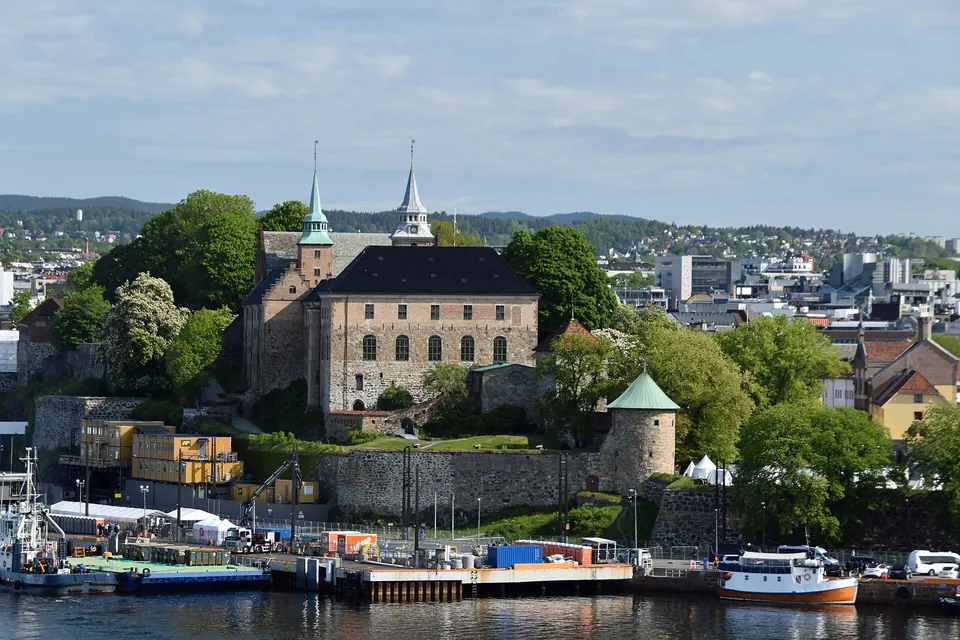
Begun by Håkon V Magnusson in the 1290s and documented by around 1300, Akershus was raised to strengthen Oslo's defences after the attack by Count Alv Erlingsson in 1287. It occupies a rocky headland that commands the harbour and the entrance to the Oslofjord, a position chosen to control access to the city by sea. Between the late 16th century and the mid 17th, Christian IV turned the medieval castle into a Renaissance residence with bastions of Italian design.
The fortress withstood every siege, but surrendered without a fight to Nazi Germany in 1940. The occupiers executed 42 members of the Norwegian resistance here in 1945 and, after liberation, eight people convicted of treason, Vidkun Quisling among them, were shot within the same walls. Today it also holds the Royal Mausoleum and remains the main stage for the Norwegian state's official ceremonies.
Highlights
- Never taken by a foreign enemy in battle
- Christian IV's Renaissance castle with the Blåtårnet and Romerikstårnet towers
- Bastions with historic cannon above the Oslofjord
- Resistance Museum and memorial to the executed
- 1948 Royal Mausoleum with the sarcophagi of Haakon VII and Olav V
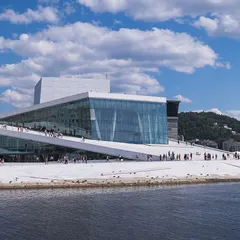
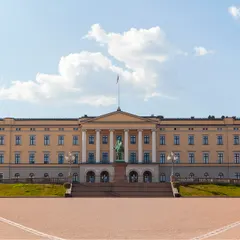
The history of Akershus Fortress (Akershus festning) spans some seven centuries of Norwegian power on a single rock. Founded by Håkon V Magnusson around 1300, it passed from medieval stronghold to Renaissance castle, from prison and place of execution to a venue for the representation of the state. Anyone wondering what to see at Akershus Fortress will find towers, bastions with cannon, a resistance museum and a royal mausoleum, all inside the same compound. The full experience is kept for the audio guide, which ties every corner to its story on the spot. The fortress is part of Oslo’s bay, like the Oslo Opera House, and the seats of power in the city are completed by the Royal Palace. The ferries to Bygdøy link this area with the Fram Museum.
The rock that watches the harbour
Akershus festning
Summary of this stop
The north entrance leads into a compound whose origin is tied to geography. The fortress stands on a rocky headland that commands Oslo’s harbour and the entrance to the Oslofjord, and that position explains why it was built precisely here: from the rock, anyone arriving by water can be watched.
Håkon V Magnusson began the construction in the 1290s, and by around 1300 it already existed, the year of its first documentary mention. It was raised to strengthen Oslo’s defences after the attack that Count Alv Erlingsson launched against the city in 1287. Håkon V also moved his royal seat to Oslo, and the choice of Akershus as the royal castle contributed to the shift of Norway’s capital from Bergen in the early 14th century.
The main gate, the fortified entrance to the inner compound, has a legend of its own. Popular tradition links it to Malcanisen, a guard dog that, according to the belief, was buried alive beside the entrance so that its spirit would keep watch. It is said that anyone who meets the ghostly animal, or is bitten by it, dies within three months. These are oral tales of watchmen and guards, not documented episodes, and the narration places them on the spot, under the arch itself.
The walls no army took
Akershus walls
Summary of this stop
The bastions of Italian design and the sloping walls above the harbour, crowned by historic cannon aimed at the mouth of the fjord, uphold the fortress’s reputation as impregnable. It withstood every siege in its history and was never taken by a foreign enemy in battle.
The dates make up a record of failed attacks: the Swedish duke Erik Magnusson in 1308, the Swedish king Karl Knutsson Bonde in 1449-1450, Swedish troops in 1523, the Northern Seven Years’ War in 1567 and Charles XII of Sweden in 1716, the last military action at Akershus.
One of those episodes came with an unexpected price. According to a documented tradition, in 1523 the people of Oslo themselves, on the orders of Hans Mule, set fire to their houses at the foot of the fortress to deny the besiegers shelter and provisions, and the Swedes ended up withdrawing. The city sacrificed itself so that the fortress would not fall. The details of that day are kept for the audio guide.
The castle with which Christian IV remade the city
Akershus slott
Summary of this stop
In the castle courtyard rise the towers that form the fortress’s most recognisable silhouette from the city and from the fjord: the Blåtårnet (the “blue tower”, 1623) and the Romerikstårnet (1633). They come from the reconstruction with which Christian IV, between the late 16th century and the mid 17th, turned the medieval castle into a Renaissance castle with bastions of Italian design.
His work was not limited to the fortress. After the great fire of 1624, which razed the old wooden Oslo, the king ordered the whole city rebuilt beside Akershus, on a grid of streets, and renamed it Christiania in his own honour. From the upper esplanades that grid, the Kvadraturen district, can be made out to the north.
Tradition says that the monarch pointed to the ground with his hand, in some versions throwing down his glove, and declared that the city should rise there. The gesture is remembered in a sculpture by Wenche Gulbransen, unveiled in 1997 in Christiania torv and known as “Hanske” (the Glove), a few steps north of the fortress.
The execution wall, the resistance and Quisling
Norges Hjemmefrontmuseum
Summary of this stop
Beside the Resistance Museum, housed in the former double battery (Det dobbelte batteri), the fortress shows its hardest face. The fortress that had never been taken by an enemy surrendered without a fight to Nazi Germany in 1940. The occupiers used it and executed 42 members of the Norwegian resistance here in February and March 1945. A national memorial inside the compound commemorates those shot.
After liberation, with the fortress handed back to the Norwegians on 11 May 1945, eight people convicted of treason were executed at Akershus. Among them was Vidkun Quisling, whose surname became a byword for traitor, shot on 24 October 1945. The use of the death penalty in these cases was, and still is, a matter of debate: Norway had not carried out a death sentence since 1876 and had abolished capital punishment in 1905, so the executions drew criticism over their questionable legality.
The Norges Hjemmefrontmuseum was set up as a foundation in 1966 and opened to the public in May 1970, with Crown Prince Harald, on the 25th anniversary of liberation. It documents the occupation of 1940-1945.
The mausoleum, the fjord and memory
Royal Mausoleum (Akershus)
Summary of this stop
From the south bastion the view takes in the harbour, the Opera House and the Oslofjord, the same panorama the fortress has watched over for seven centuries. Inside the Renaissance castle is the Royal Mausoleum, built in 1948.
Here rest the sarcophagi of Haakon VII (1872-1957) and Queen Maud (1869-1938), and those of Olav V (1903-1991) and Crown Princess Märtha (1901-1954). Its walls also preserve medieval remains of the kings Håkon V and Sigurd I.
The same compound remains the main stage for the Norwegian state’s official ceremonies, with official events and gala dinners for foreign heads of state among the castle’s restored halls. Buried kings, shot resistance fighters and state banquets share the same rock, and the audio guide joins them in a single walk.