Sculpture park
Vigeland Park Audio Guide (Vigelandsparken)
The world's largest sculpture park created by a single artist gathers more than two hundred human figures in bronze and granite. Gustav Vigeland carved into them the entire cycle of life, from the newborn to the skeleton.
- 55 min of audio
- Free and open at all hours
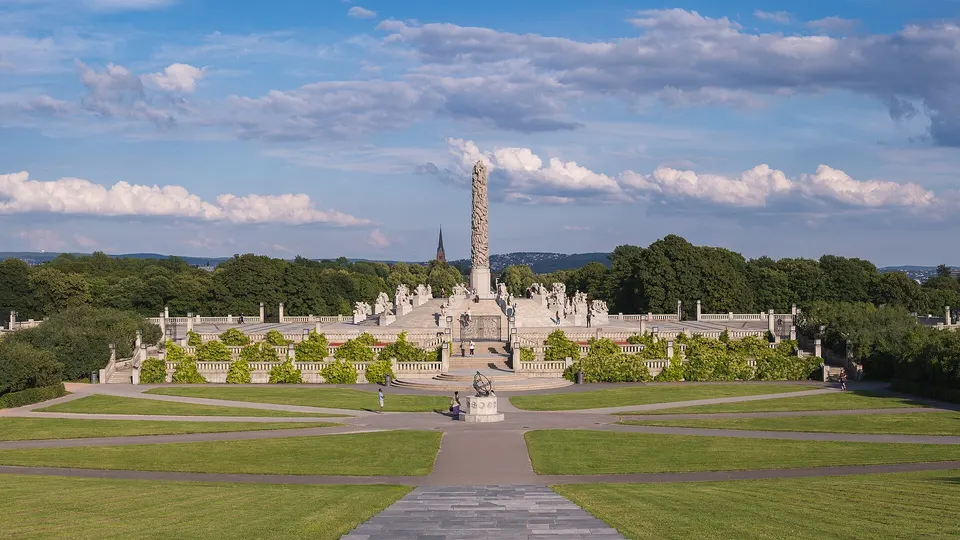
Vigelandsparken lies within Oslo's Frogner Park and brings together more than 200 sculptures designed by Gustav Vigeland (1869–1943), up to 212 according to the installation's own count, with more than 600 individual figures in bronze, granite and wrought iron. The sculptor also conceived the park's layout, its gates and its lamp posts. What to see at Vigeland Park begins with understanding its order: a monumental axis of about 850 metres, from east to west, linking the Main Gate, the Bridge, the Fountain, the Monolith plateau and the Wheel of Life.
The park's story begins with a conflict. In 1921 Oslo City Council decided to demolish the house where Vigeland lived to build a library and, after a long legal dispute, the city built him a new studio-home in exchange for the sculptor donating all his future work. That building is now the Vigeland Museum. In the park there are no gods, heroes or mythological or religious motifs: only men, women and children in the stages of life and the emotions that accompany them.
Highlights
- More than 200 sculptures by a single author, with more than 600 individual figures
- The 100-metre Bridge with 58 bronze figures and the Angry Boy
- The Fountain of the six giants on 1,800 square metres of mosaic
- The Monolith: 14.12 metres of granite with 121 intertwined figures
- The Wheel of Life, the close of the axis and a symbol of eternity
The story of Vigeland Park in Oslo is one of an obsession on the scale of a city. Gustav Vigeland personally designed each of the more than 200 sculptures in the ensemble, and also the layout itself, the gates and the lamp posts. The result is the largest collection of sculptures in the world created by a single artist, a straight route of about 850 metres through Frogner Park. Entry is free, access is open every day of the year at all hours, and the ensemble receives between one and two million visitors a year, which makes it Oslo’s most visited free attraction. The full experience, with the stories of each figure, is best enjoyed by walking it with the audio guide. Vigeland and Munch are Norway’s two great artists, and the work of the latter is gathered in the Munch Museum. To the west of the city also lies the Holmenkollen Ski Jump, and the Royal Palace is on the way to Frogner.
The gate where an entire life begins
Vigelandsparken
Summary of this stop
The Main Gate, of wrought iron and granite, marks the start of the axis. It consists of five large gates, two pedestrian wickets and two gatehouses topped with copper roofs, and its design dates from 1926, although it was built in 1942. From it opens the straight perspective of the whole ensemble.
Whoever crosses the gate measures up against the scale of the project: almost eight hundred metres ahead and the complete work of a single man. The axis strings together in a straight line the Bridge, the Fountain, the Monolith plateau and, at the far end, the Wheel of Life.
Behind that scale lies an unusual pact. In 1921 the city wanted to demolish the sculptor’s house, and the dispute ended with a new studio-home, occupied from 1924, in exchange for all his future work. The audio guide keeps the details of that agreement for this point.
The angry boy and his golden hand
Sinnataggen
Summary of this stop
The Bridge, 100 metres long and 15 wide, links the gate with the Fountain. It lines up 58 bronze sculptures showing children, women and men of all ages, in everyday and emotional scenes that are taken in one by one. The park’s more than 200 figures represent only human beings, with no mythological or religious motifs.
In the central stretch appears the park’s most famous sculpture: the Sinnataggen or “Angry Boy”, a naked bronze about one metre tall stamping with clenched fists. It was installed on the Bridge in 1940 and has become a kind of mascot of Oslo.
His left hand gleams, polished by the touch of visitors who for years have grabbed it for photos. That constant contact prevents the bronze’s natural oxidation and came to worry conservators: in June 2013 they covered the hand with a dark fluid so that it would stop shining and attracting hands. The paradox of a furious figure turned into an object of affection is completed in the audio guide.
Six giants hold up the whole of life
Fontenen
Summary of this stop
The Fountain, in bronze, is held up by six giants raising an enormous basin from which a curtain of water falls. It is surrounded by twenty tree groups telling the stages of life, from childhood to old age and death, and sixty bronze reliefs, all on a mosaic of black and white granite of 1,800 square metres laid out as a continuous labyrinth.
Here the park’s entire programme comes into view. And it hides a twist: Vigeland conceived it around 1906 for Eidsvolls plass, in front of the Norwegian Parliament, and the work kept growing for almost two decades. In 1919 the tall granite column was added and in 1924 the city decided to take it to Frogner Park, where it ended up as the seed of the whole ensemble.
Fourteen years behind a wooden fence
Monolitten
Summary of this stop
The Monolith rises at the highest point of the park, on a stepped plateau surrounded by 36 groups of granite figures representing, one by one, the cycles of human life. It is a 14.12-metre column carved with 121 intertwined human figures rising towards the top, which is crowned by children. Some sources, measuring it from the ground with its base, give it about 17 metres.
It was carved from a single block of Iddefjord granite, from which it takes its name. The block arrived at the park in 1927 and its carving, begun in 1929, occupied three stonecutters for fourteen years, until 1943. Throughout that time the work stayed hidden behind a wooden fence.
It was unveiled to the public at Christmas 1944, with Norway under German occupation. Vigeland had died in March 1943 and never saw his greatest work revealed. The names of the stonecutters and the rest of the episode are told by the audio guide on the plateau itself.
The wheel that never stops turning
Livshjulet
Summary of this stop
The Wheel of Life (Livshjulet) occupies the western end of the axis. It is a bronze garland of intertwined men, women and children that, as a symbol of eternity, sums up the theme of the whole park: the cycle of life from birth to death. Vigeland modelled it in 1933–34 and it was installed in 1949.
The ring closes the route in a full circle with the image of life as an endless turning. After the walk along the axis, this point leaves the idea that all that multitude of bodies came from the obsession of one man, and that the park, open at all hours and free of charge, remains there to be walked in full with the audio guide.