Balinese sacred forest
Sacred Monkey Forest Sanctuary Audio Guide (Mandala Suci Wenara Wana)
A sacred forest that belongs to a village, with three temples from around 1350 and more than a thousand long-tailed macaques that here are not a pest but guardians of the sanctuary. It is no zoo: it is the place where monkeys, gods and ancestors keep one another in balance.
- 75 min of audio
- Balinese Hindu temples
The Sacred Monkey Forest Sanctuary covers some 12.5 hectares of forest in Padangtegal, on the southern edge of Ubud, and has been considered sacred since the 14th century. It is owned by the village, whose residents sit on the council that governs it, and among its trees stand three temples raised around 1350: Pura Dalem Agung Padangtegal, Pura Beji and Pura Prajapati.
The same animal that raids the rice fields elsewhere in Bali is a guardian here. According to a documented tradition, the macaques of temple forests are held to be sacred, which is why villagers have protected them for centuries. The 2023 count put them at about 1,260, in five groups each with its own territory, beneath fig trees whose aerial roots form living columns beside the paths.
Highlights
- Pura Dalem Agung Padangtegal — the main temple, from around 1350, dedicated to Shiva and Durga
- Pura Beji — a bathing temple beside a sacred spring, at the bottom of a ravine
- Pura Prajapati — the cremation temple, with a communal cremation every five years
- More than a thousand long-tailed macaques — about 1,260 in the 2023 count, in five groups
- Figures of Rangda — the widow witch of Balinese drama, in stone beside the temple of the dead
On the southern edge of Ubud, the village of Padangtegal keeps a forest that has been considered sacred since the 14th century: the Sacred Monkey Forest Sanctuary, whose official name is Mandala Suci Wenara Wana. It covers some 12.5 hectares of shade where researchers working with Udayana University have identified 115 tree species, and where more than a thousand long-tailed Balinese macaques live: the 2023 count came to about 1,260.
The history of the Sacred Monkey Forest Sanctuary begins around 1350, when the three temples that still order the forest were raised: the main temple of the dead to the southwest, a bathing temple beside a sacred spring to the northwest, and the cremation temple to the northeast. What to see at the Sacred Monkey Forest Sanctuary comes down to a route that runs from the entrance, beneath the first fig trees, to the village cemetery, passing through the ravine of holy water. The idea that runs through it all is simple and powerful: this is no zoo, but the sacred ground of a village, where monkeys, gods and ancestors keep one another in balance. The full experience unfolds on the walk itself with the audio guide, stop by stop.
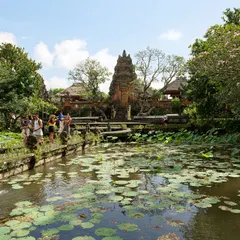
The sacred forest lies south of the Ubud Palace and Art Market, down through the centre of Ubud, and together with the lotus-pond temple of Pura Taman Saraswati it makes up a single walk through the village temples. About 3.1 km away lies Goa Gajah as well.
Beneath the banyan figs: a forest that belongs to a village
Forest entrance
Summary of this stop
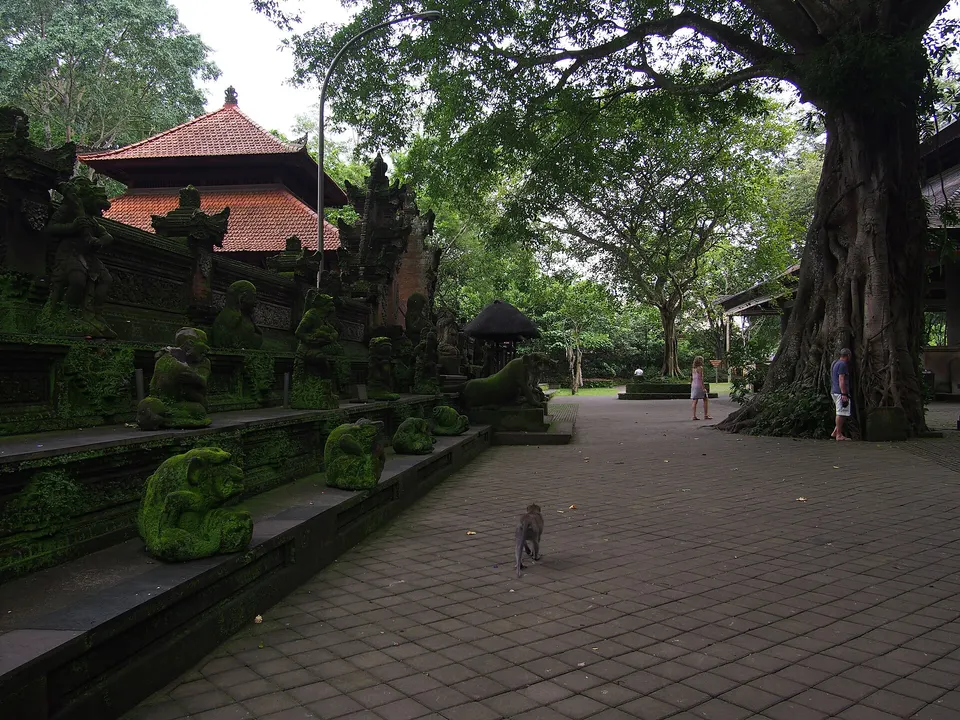
Just past the main entrance, the forest closes in over the paths. The great fig trees let aerial roots drop all the way to the ground, forming living columns, and on some trunks and statues the black-and-white checked poleng cloth appears, marking them as sacred. Beneath that canopy live 115 tree species identified by researchers linked to Udayana University.
The first thing that defines this place is its owner. The forest belongs to the village of Padangtegal: its residents sit on the council that governs it, and the site is run by the Mandala Suci Wenara Wana administration. The house rules are clear: visitors are asked not to touch or feed the monkeys, not to look them in the eye, and to keep loose belongings well stowed, because these are wild animals, not pets.
The macaques number more than a thousand, about 1,260 in the 2023 count, and their presence here has a meaning that goes beyond wildlife. The reason for that coexistence is revealed by listening to the narration on the spot, among the roots.
The great temple of the dead, facing the sea
Pura Dalem Agung
Summary of this stop
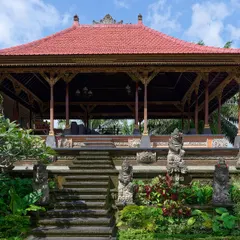
In the southwest of the forest stands Pura Dalem Agung Padangtegal, the main temple, built around 1350. Its carved stone gateway, with guardian figures, stays closed to anyone not there to pray, so the visit is experienced from the courtyard that opens in front of it.
A pura dalem is one of the three village temples of Balinese Hinduism, the so-called kahyangan tiga. It faces the sea and is dedicated to Shiva and Durga, the powers of dissolution: it is, quite literally, the temple of the dead, the heart of a forest held sacred since the 14th century.
Here the principle that governs the whole sanctuary makes sense, the Balinese Hindu Tri Hita Karana: the three causes of well-being, which are harmony between people and God, among people themselves, and between people and nature.
The sacred spring in the ravine
Pura Beji
Summary of this stop
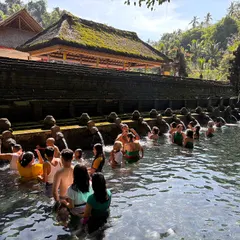
To the northwest, the ground drops into a deep ravine, with a stream and stone steps leading down to Pura Beji, the bathing temple raised around 1350 beside a sacred spring. It is the place of water and purification, in contrast to the solemn shade of the temple of the dead.
The bottom of the ravine is also a good place to understand the forest’s inhabitants. The species is Macaca fascicularis, the crab-eating or long-tailed macaque, whose tail is as long as its head and body together. They live in matrilineal groups, usually of thirty-five to fifty animals, and in this forest they are divided into five groups, each with its own territory. Staff give them sweet potatoes three times a day.
What looks like the chaotic comings and goings of monkeys is in fact a society with its own rules, and the audio guide unpacks them on the ground.
Fire, ashes and the cremation held every five years
Cremation temple
Summary of this stop
Towards the eastern edge of the forest, beside the village cemetery, stands Pura Prajapati, the cremation temple, also from around 1350. A communal cremation ceremony is held there once every five years, and the route thus closes its cycle: from the temple of the dead to the purifying water and, finally, to fire.
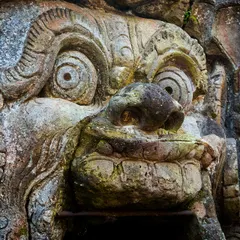
Beside the temple of the dead appear the stone statues of Rangda, the widow witch, with fangs and sagging breasts. According to Balinese tradition, Rangda is the great villain of the island’s drama, the one who confronts the Barong, a lion-like creature, and the sculptures show her devouring children: a witch guarding the gate of the dead.
Cemetery, cremation, stone demons and guardian monkeys all fit within the same balance of Tri Hita Karana. How that balance is sustained, and what place each piece of the forest holds in it, is what the narration reveals at this last stop.