Ubud royal palace
Ubud Palace and Art Market Audio Guide (Puri Saren Agung)
A small royal court, an earthquake and a handful of foreign painters turned a village of medicinal plants into the art capital of Bali. It all began at this crossroads, between the palace and the market.
- 40 min of audio
- Royal court and birthplace of Pita Maha
Puri Saren Agung, the royal palace of Ubud, took its present form in the traditional Balinese style during the reign of Tjokorda Putu Kandel, who ruled from 1800 to 1823. The 1917 earthquake badly damaged its buildings; as the royal residence, they were restored quickly, and in 1928 the palace opened its doors to foreign guests. Its walls and gates bear the stone carvings of I Gusti Nyoman Lempad, the great master of Ubud.
In 1936 Pita Maha was born here, the artists' association founded by Rudolf Bonnet, Walter Spies and Tjokorda Gde Agung Sukawati, of the Ubud royal family. It grew to some 150 members and faded with the Japanese invasion of 1942; its legacy is still in view just across the street, in the stalls of the art market.
Highlights
- Main gate — A tall roofed portal of carved stone facing the Jalan Raya Ubud crossroads
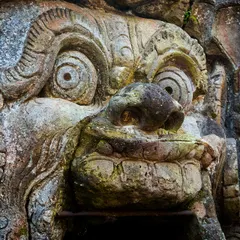
- Lempad carvings — Reliefs and guardian figures in soft stone along walls and gates
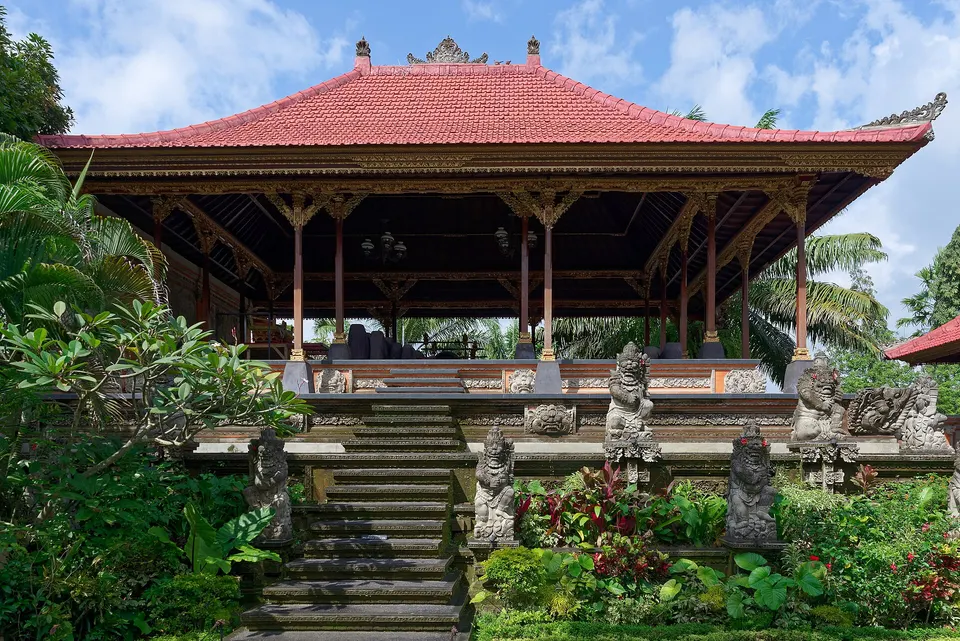
- Dance pavilion — A raised floor and golden doors for Balinese dances with gamelan
- Banyan tree — A great tree shading the palace's front courtyard
- Art market — Two floors of textiles, basketry and carvings opposite the palace
At the central crossroads of Ubud, on Jalan Raya Ubud, two worlds stand face to face: Puri Saren Agung, the royal palace, and the bustling art market. The history of the Ubud Palace and Art Market is that of a small court which, between an earthquake and the arrival of a handful of foreign painters, turned a village into the artistic capital of Bali. Even the name of the place has an origin: Ubud derives from the Balinese word ubad, “medicine”, after the medicinal plants gathered here.
The architecture of the Ubud Palace follows the traditional Balinese style in which it was raised in its present form under Tjokorda Putu Kandel, who reigned from 1800 to 1823. The 1917 earthquake badly damaged its buildings, which were soon restored because this was the royal residence, and in 1928 the palace opened to foreign guests. That same year the royal guesthouse of Tjampuhan opened, where the painter Walter Spies built his own house. From that meeting between the court and the artists who came from abroad the Pita Maha movement was born in 1936, and later, between 1954 and 1956, the Puri Lukisan Museum, the first art museum in Bali.
What to see at the Ubud Palace and Art Market includes the main gate of carved stone, the dance pavilion with its golden doors, the great banyan tree of the courtyard and the reliefs of I Gusti Nyoman Lempad. The audio guide covers the three stops in the same order in which they appear on foot, from the portal to the courtyard and from the courtyard to the market.
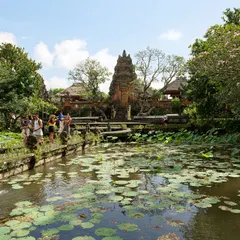
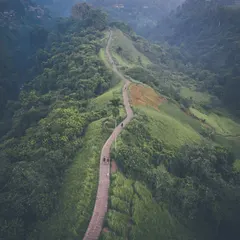
A few steps away, on the same main street, stands Pura Taman Saraswati, another work by Lempad. The Ubud of the artists continues on the Campuhan Ridge Walk, where the painters welcomed by the court settled, and the centre descends to the Sacred Monkey Forest Sanctuary.
The gate at the crossroads, where Ubud begins
Palace gate
Summary of this stop
From the pavement of Jalan Raya Ubud, the first image is a tall roofed portal of carved stone, with a protective wall behind it that guards the privacy of the royal house. It is the façade of a court set in the very heart of the town, at the crossroads where the life of Ubud converges.
This spot sums up three layers of history. That of the name, which goes back to ubad, the medicine of the plants gathered in the area. That of the palace raised in the Balinese style during the reign of Tjokorda Putu Kandel, between 1800 and 1823. And that of the 1917 earthquake, which left the buildings badly damaged and forced a quick restoration before, in 1928, the royal residence began receiving foreign guests.
What that turn towards outside visitors would end up unleashing in the village is the piece the narration keeps to be heard right there, in front of the gate.
The courtyard of Pita Maha, beneath the banyan
Palace courtyard
Summary of this stop
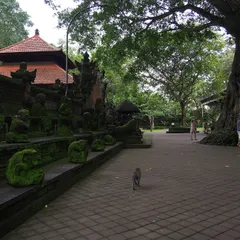
In the front courtyard, a great banyan tree shades the compound, facing the dance pavilion: an open space with a raised floor and golden doors where the dances are performed. The palace is best known for its evening performances of Balinese dance accompanied by gamelan orchestras. The complex also includes Pura Marajan Agung, the royal family’s private temple.
Along walls and gates run reliefs and guardian figures carved in soft stone. They are the work of I Gusti Nyoman Lempad, the master of Ubud, born around 1862 and died in 1978, a member of Pita Maha. That artists’ association was founded in 1936 by Rudolf Bonnet, Walter Spies and Tjokorda Gde Agung Sukawati, of the royal family; it brought together some 150 members and ended with the Japanese invasion of 1942. Sukawati and Bonnet would later drive the Puri Lukisan Museum, whose construction began in 1954 and which opened in 1956 as the first art museum in Bali.
Around Lempad there also runs a documented tradition: the Balinese believed that the sculptor chose the day of his own death, in 1978, at well over a hundred years old. How he bade farewell that day is left to the narration, beneath the banyan.
Across the street, the art market
Ubud Art Market
Summary of this stop
Right opposite the palace, also on Jalan Raya Ubud, stands Pasar Ubud: a two-storey market of textiles, basketry and carvings that looks straight at the royal house. It began as a market for farm produce and today combines the art and souvenir market with an early-rising food market.
Here art becomes commerce. The market mirrors the palace and lives off its legacy: that of a village which, since the days of Pita Maha, made carving and painting its signature. Its fame has even reached the cinema, as the Ubud art market appears in the film Eat Pray Love.
What links each stall to that courtyard of 1936 is the thread with which the audio guide closes the route, at the foot of the market.