9th-century sanctuary
Goa Gajah Audio Guide
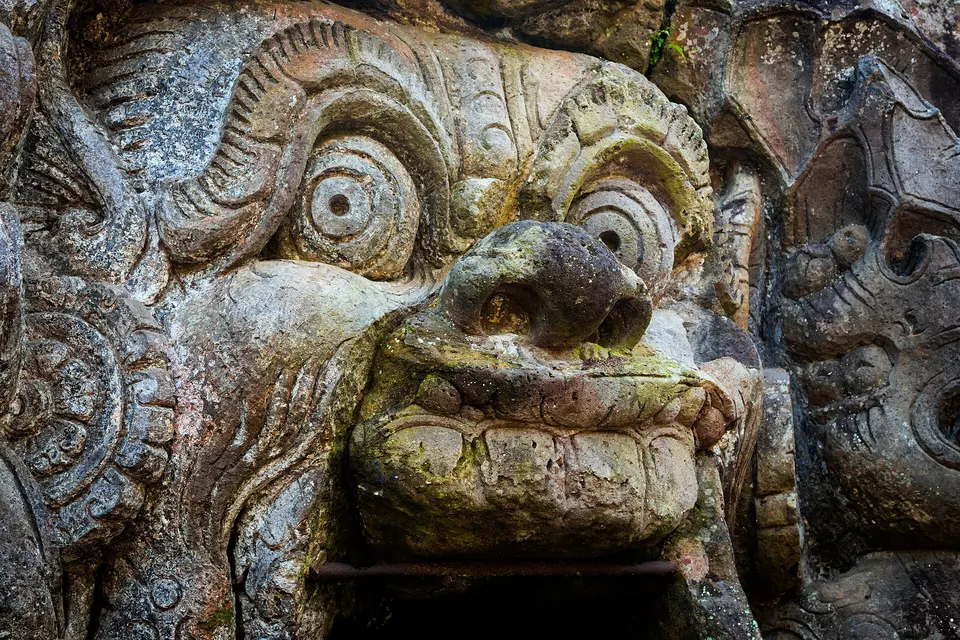
Below the road, at the bottom of a hollow, a giant face with bulging eyes opens its mouth so that visitors enter through it. There was never an elephant in the Elephant Cave, and in the same ravine Hindu and Buddhist Bali have shared the stone for a thousand years.
- 45 min of audio
- Hinduism and Buddhism
Goa Gajah, the Elephant Cave, is in the village of Bedulu, in the Blahbatuh district of the Gianyar regency, about 27 km from Denpasar and near the Petanu River. The cave is dated to the 9th century, although the sanctuary as a whole is attributed to the Balinese kingdom of the 11th century. In 1365 it already appeared under the name Lwa Gajah in the Desawarnana, the Javanese court poem also known as the Nagarakretagama.
The most astonishing part took a long time to come to light. Dutch archaeologists rediscovered the cave in 1923, but the bathing pool and its fountains stayed buried until 1954. The systematic excavations of J. L. Krijgsman, between 1954 and 1979, revealed female figures pouring water from their jars, and across the ravine waited Buddhist reliefs held to be older than the Hindu cave itself.
Highlights
- Giant's mouth — A bulging-eyed face carved in the rock, ringed with leaves, animals and figures, serving as the cave entrance
- Ganesha and the trilingga — The elephant-headed god in the west niche and three lingams of Shiva on a single base in the east one
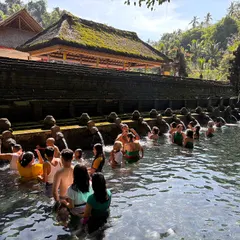
- Bathing pool — Buried until 1954, with female figures pouring water from their jars
- Hariti — The Buddhist protector of children, surrounded by small figures, in a pavilion beside the cave
- Buddhist remains — Fragments of stupas with umbrella-shaped finials at the bottom of the Tukad Pangkung ravine
Goa Gajah, the Elephant Cave, is a sanctuary hidden below the road in Bedulu, in the Gianyar regency, about 27 km from Denpasar and near the Petanu River. The history of Goa Gajah begins in the 9th century, the date attributed to the cave, although the sanctuary as a whole is associated with the Balinese kingdom of the 11th century. Its name was already in circulation in 1365: the Desawarnana, the Javanese court poem also known as the Nagarakretagama, mentions it as Lwa Gajah.
Then came oblivion. Dutch archaeologists rediscovered the cave in 1923, but the bathing pool and its fountains did not appear until 1954, and the systematic excavations led by J. L. Krijgsman continued until 1979. On 19 October 1995, Goa Gajah was placed on UNESCO’s World Heritage tentative list, from which it was withdrawn in 2015.
What to see at Goa Gajah is arranged in three stops: the descent into the hollow, the carved mouth of the giant with Ganesha and the lingams inside, and the bathing pool with the Buddhist remains of the ravine. The architecture of Goa Gajah tells, stone by stone, how two religions shared a single hollow for a thousand years, and that story makes full sense walking the site with the audio guide.
Among the ancient sanctuaries of the sacred river valleys is also the Tirta Empul Temple, and about 3.1 km away lies the Sacred Monkey Forest Sanctuary.
The descent into the hollow
Top of the stairs
Summary of this stop
At the top of the stairs, before going down, the sanctuary does not yet show itself: it lies below the road, in a hollow near the Petanu River. What waits below is a place with an age that is hard to take in. The cave is dated to the 9th century and the complex is linked to the Balinese kingdom of the 11th century; in 1365 a Javanese court poem, the Desawarnana, already named it as Lwa Gajah.
That name lies at the origin of a small riddle, because nobody agrees on why it is called the Elephant Cave. Popular belief says it comes from Lwa Gajah, the river of the elephant, as the Petanu would have been called in the old poem; others attribute it to the elephant-headed Ganesha kept inside, and others, simply, to the size of the face carved at the entrance. There was never an elephant here and yet it is the Elephant Cave.
The sanctuary spent centuries out of sight until Dutch archaeologists rediscovered it in 1923. And even then, an essential part stayed hidden for three more decades. What was found afterwards, and where, is revealed by the narration at the foot of the stairs.
The giant’s mouth
Cave entrance
Summary of this stop
In the courtyard, facing the entrance, the cave announces itself with a giant face with bulging eyes and an open mouth, ringed by a swirl of leaves, animals and carved figures. The mouth is the entrance itself: to pass inside, it has to be crossed. Even a fragment of the giant’s stone sword survives.
Inside, the cave forms a T. In the west niche sits Ganesha, the elephant-headed god; in the east one rise three lingams on a single base, a trilingga, the emblems of Shiva. It is the trace of a Shaivite retreat dug into the rock.
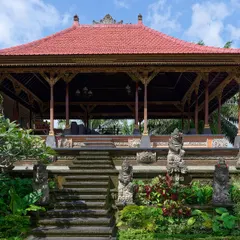
Very close, in a pavilion beside the cave, a worn statue of Hariti, the Buddhist protector of children, appears surrounded by seven small figures. Her presence beside a sanctuary of Shiva is the first clue that Goa Gajah holds more than one faith.
The pool and the other faith
Bathing pool
Summary of this stop
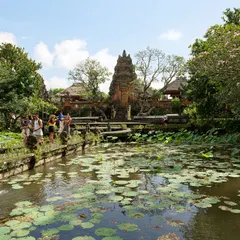
Beside the path that descends towards the ravine opens the bathing pool, a rectangular basin sunk into the ground. On its wall, female figures pour water from the jars they hold; the most widespread descriptions count seven, one of them destroyed by an earthquake, and identify them with the sacred rivers of India. This complex stayed buried even after the rediscovery of the cave in 1923: it did not come to light until 1954.
That year the systematic excavations of J. L. Krijgsman began, continuing until 1979 and revealing the bath complex with its water-spout figures. What seemed to be a Hindu sanctuary turned out to be only a part of the place.
Across the Tukad Pangkung ravine, beside the stream, lie fragments of Buddhist stupas with umbrella-shaped finials. The Buddhist reliefs on the south side are dated to the early 10th century and are held to be older than the Hindu cave, and the statue of Hariti with her small figures completes the picture. How those two religions fit into one hollow is the story the audio guide saves for the end of the route.