Lotus temple
Pura Taman Saraswati Audio Guide
A prince of Ubud and an old master raised, between 1951 and 1952, a garden of water and lotuses so that learning would have a home of its own. At the far end of the ponds waits a red brick gate and, beyond it, a golden throne that is empty on purpose.
- 30 min of audio
- Work of I Gusti Nyoman Lempad
Pura Taman Saraswati is the temple that the prince of Ubud, Cokorda Gede Agung Sukawati, commissioned from I Gusti Nyoman Lempad, sculptor and undagi, a traditional Balinese architect. Work began in 1951 and finished in 1952, and the result is dedicated to Saraswati, the Hindu goddess of learning, literature and the arts. Close to the Puri Lukisan museum, it is the best-known architectural work of Lempad, a master born around 1862 and died in 1978.
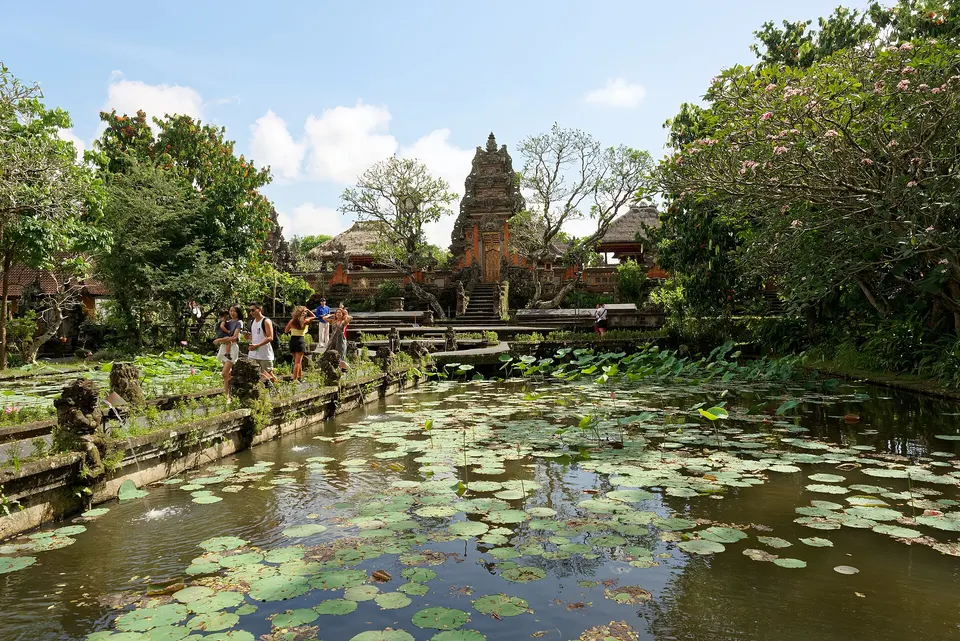
Here the temple announces itself as a garden: two rectangular ponds covered in lotuses, edged with frangipanis, and a stone causeway that splits them in two, flanked by gods and demons carved in volcanic tuff. Every morning small palm-leaf offerings, each with its stick of incense, appear on it, because even a temple conceived as a garden is fed daily.
Highlights
- Lotus pond — Two rectangular pools full of lotuses, separated by a stone causeway and fringed with frangipanis
- Causeway of statues — Figures from Hindu mythology in volcanic tuff flank the way to the gate
- Central kori agung — The largest of three red brick gate towers, with a demon face carved above the opening
- Aling-aling wall — A screen behind the gate with a three-metre statue of the rakshasa Jero Gede Mecaling
- Padmasana — A stone shrine crowned by an empty golden throne, the seat of the formless god
A few steps from Jalan Raya Ubud, the noise of the street is cut off by a lotus pond. It is the entrance to Pura Taman Saraswati, the water temple of Ubud, raised between 1951 and 1952 at the commission of Prince Cokorda Gede Agung Sukawati and designed by I Gusti Nyoman Lempad, sculptor and undagi, the traditional architect of Bali. It was consecrated to Saraswati, the Hindu goddess of learning, literature and the arts, and it is no accident that her home is a garden.
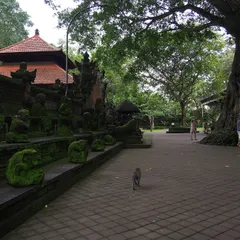
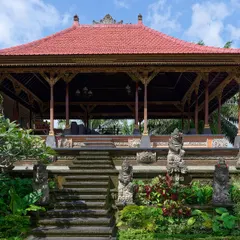
Anyone looking for what to see at Pura Taman Saraswati finds a short and very dense route: the ponds and their frangipanis, a causeway lined with mythological figures, three red brick gates and, on the other side, an inner courtyard where a golden throne remains empty. The history of Pura Taman Saraswati and the architecture of Pura Taman Saraswati are read together in those stones, and the audio guide unpacks them stop by stop, in the same order in which visitors walk them.
Very close by, on the main street of Ubud, stands the Ubud Palace and Art Market, with another work by Lempad, and the Sacred Monkey Forest Sanctuary, the village’s other great temple, is reached on foot.
A prince, a master and a goddess of learning
Pond entrance
Summary of this stop
The first stop is at the threshold, where the street opens onto the water garden. Three names meet here. That of the prince of Ubud, Cokorda Gede Agung Sukawati, who commissioned the work. That of I Gusti Nyoman Lempad, born around 1862 and died in 1978, for whom this temple, close to the Puri Lukisan museum, became his best-known architectural work. And that of Saraswati, the goddess of learning, literature and the arts, to whom it is dedicated.
Work began in 1951 and was finished in 1952. What surprises on arrival is the order of things: before walls or shrines, the first thing this temple offers is water and flowers. Why a place consecrated to knowledge presents itself as a garden is the question the narration answers right at this point.
The causeway between the ponds
Lotus causeway
Summary of this stop
Halfway along the causeway, the visitor stands between two rectangular ponds full of lotuses, with frangipanis along the edges. On both sides of the path are lined figures from Hindu mythology carved in volcanic tuff, gods and demons that accompany the way to the temple gate.
The titular goddess has her own iconography: Saraswati is shown with four arms, holding a vina, and with a swan or a goose as her mount. And the garden is not merely decoration. Every morning, by a documented tradition, small palm-leaf offerings, the canang sari, are set on the causeway, at the foot of the statues and on the steps of the gate, usually by the women of the household. They are accompanied by a stick of incense whose smoke, according to belief, carries the essence of the gift upwards. A temple is fed every day, even if it was built as a garden.
The red gate and the empty throne
Temple gate
Summary of this stop
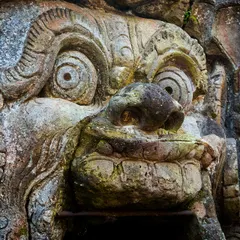
At the end of the causeway rise three red brick gates of the kori agung type, the largest in the centre. A kori agung, also called paduraksa, is a roofed gate tower marking the passage to the inner courtyard, the most sacred in a Balinese temple. Above the opening of the central one peers a carved demon face.
Behind the gate, a screen wall, the aling-aling, blocks the direct view into the interior; on its rear face stands a three-metre statue of the rakshasa Jero Gede Mecaling. Further on, in the inner courtyard, can be made out a padmasana shrine, several meru towers and a bale barong pavilion that keeps the barong figures used in exorcism rituals.
The padmasana is topped by an empty golden throne bearing the image of Acintya. In Balinese Hinduism, the supreme god, Sang Hyang Widhi Wasa or Acintya, has no form, and that unoccupied seat is his. The whole grammar of the temple, from gate to wall to throne, leads to that emptiness, and it is at this last stop that the audio guide finishes deciphering it.