Ridge trail
Campuhan Ridge Walk Audio Guide (Bukit Campuhan)
Ubud was born where two rivers meet, and above that confluence stretches a ridge of tall grass to which the town keeps returning to catch its breath.
- 60 min of audio
- A walk between two valleys
Campuhan means confluence of two rivers in Balinese: this is where the two arms of the Wos join. According to tradition, in the 8th century the Javanese priest Rsi Markandya meditated at this spot and founded the temple of Pura Gunung Lebah, and the very name of Ubud comes from ubad, medicine, after the healing plants gathered on its banks.
In 1927 the German painter and musician Walter Spies settled beside this confluence and lived there for nine years. Charlie Chaplin, Margaret Mead and Noël Coward passed through his house, and it is said that on this hillside the image of Bali as a paradise, which the West still holds, was invented.
Highlights
- Wos confluence — the meeting of two rivers that gives Campuhan its name
- Pura Gunung Lebah — a temple of tiered meru towers attributed to Rsi Markandya, 8th century
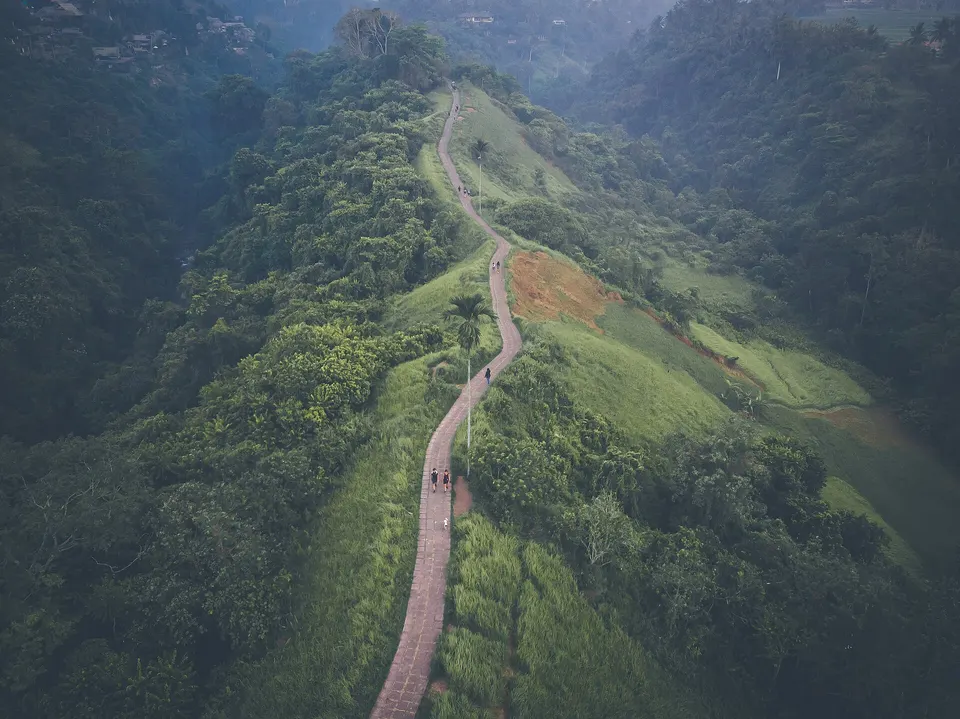
- Grass ridge — 1.7 km of paved path between two river valleys
- Walter Spies's house — a two-storey home that still stands among the hotel villas
- Dutch-era suspension bridge — now disused, beside the road bridge
The history of the Campuhan Ridge Walk begins below, in the water. Campuhan is the Balinese word for the confluence of two rivers, and the district takes its name from the point where the two arms of the Wos meet, at the foot of the ridge. There, according to tradition, a Javanese priest named Rsi Markandya meditated in the 8th century and founded Pura Gunung Lebah. And the name of the town is no accident either: Ubud comes from ubad, medicine, after the healing plants gathered along its rivers.
Centuries later another outsider arrived. In 1927 the German painter and musician Walter Spies settled at this confluence, and he is credited with fixing the image of Bali that many Westerners still carry in their heads. The path, about 1.7 kilometres one way, joins the three layers of that story: the river, the temple and the grassy ridge. Walking it with the audio guide makes it possible to hear each chapter at the exact spot where it happened.
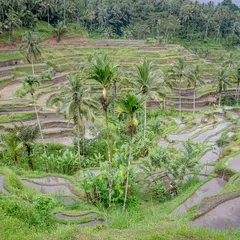
The story of the artists who came to this ridge is better understood from the Ubud Palace and Art Market, whose princes welcomed them. Outside the village, the paddies of the Tegallalang Rice Terraces show the same landscape and the Tri Hita Karana philosophy.
Where the waters meet
Campuhan Bridge
Summary of this stop
The route starts over the confluence, where the two channels of the Wos merge in a rocky bed beneath the bridge. Beside the modern road bridge survives an old Dutch-era suspension bridge, now disused.
This spot explains almost everything that follows. The meeting of the rivers gives Campuhan its name, the medicinal plants of its banks gave Ubud its name, and it was precisely here that, according to tradition, Rsi Markandya stopped to meditate. What that meditation left standing waits a few metres further up, and the narration reveals it on the ground.
The priest’s temple
Pura Gunung Lebah
Summary of this stop
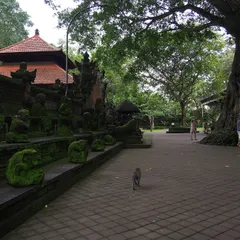
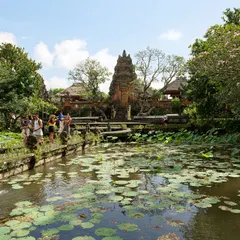
On a spur overlooking the confluence rises Pura Gunung Lebah, with its tiered meru towers and carved gates. Its foundation is attributed to Rsi Markandya, the priest who came from Java in the 8th century.
The place is also a doorway to Tri Hita Karana, the Balinese philosophy of harmony between people and God, among people themselves, and between people and nature, which lies behind the way the island manages its water and its land. Beside the temple, near the entrance of the Ibah hotel, the ridge path begins.
A backbone of grass
The ridge
Summary of this stop
From here the paved path runs along the spine of the ridge, with river valleys on both sides and slopes covered in tall grass, as far as the village of Bangkiang Sidem. The most pleasant and busiest hours are sunrise and the end of the afternoon, before and after the heat.
This hillside is also Walter Spies’s. He lived for nine years at the confluence. The Tjampuhan guesthouse opened in 1928 as the royal lodging of the Ubud palace, and within the compound Spies built his own two-storey house, which still stands among the hotel villas. He co-founded the Pita Maha artists’ cooperative and received numerous Western visitors in the 1930s: according to a documented tradition, Charlie Chaplin, Margaret Mead and Noël Coward passed through his sitting room, and it is said that on this hill the Western dream of Bali as a paradise was invented.
The end of that story came far from here, on 19 January 1942, when a Japanese bomb struck the ship carrying him with other German internees from the Dutch East Indies. What remains of that paradise, and why the town keeps climbing this ridge to catch its breath, is told in the audio guide while walking the hill.