Sacred mountain
Tianmen Mountain Audio Guide (Tianmen Shan)
A mountain that has spent almost two millennia reading a hole in the rock as a sign from heaven. From the centre of Zhangjiajie a cable car climbs to the summit, and in the cliff opens a 131-metre arch that pierces it from side to side.
- 120 min of audio
- 131 m natural arch
Tianmen Mountain owes its name to a gap: according to local accounts, in the year 263 it suddenly opened in the cliff, and Sun Xiu, ruler of Wu in the Three Kingdoms era, took it for a good omen and called it Tianmen Dong, “the cave of the Heavenly Gate”. On the summit, a temple founded in 870 as Lingquan Yuan became the Buddhist centre of western Hunan. Since 2005, the cable car that leaves the city and the 99-bend road have opened the sacred mountain to tourism.
What is called a cave is really a natural limestone bridge at about 1,300 metres of altitude, and its worldwide fame came not from monks but from pilots: on 11 December 1999 a group of stunt planes, with the Hungarian Péter Besenyei the first to cross, flew through it, the first time a plane had passed through a natural arch. Then came a rope-free climber, a man in a wingsuit and two car brands determined to climb its staircase.
Highlights
- Tianmen cable car — 98 cabins and 7,455 metres of cable from the city centre to the summit
- Coiling Dragon Cliff — A 2016 glass walkway above the 99 bends of the Tongtian road
- Tianmen Shan Temple — Founded in 870 as Lingquan Yuan, vanished and consecrated again in 2009
- Heavenly Gate — A natural arch 131.5 metres high that a plane flew through in 1999
- Stairway to Heaven — 999 steps at about 45 degrees up to the mouth of the arch
Above the city of Zhangjiajie rises Tianmen Mountain, known locally as Tianmen Shan (天门山), a mass of vertical walls with a gap opened in the middle of the rock. That gap gives it its name and silhouette. According to accounts gathered by local tradition, in the year 263, in the middle of the Three Kingdoms era, the mountain suddenly opened, and Sun Xiu, ruler of Wu, took the phenomenon for a good omen and baptised the hole Tianmen Dong, “the cave of the Heavenly Gate”. The name passed to the whole mountain. How that collapse came about still has no agreed geological explanation, and it is listed among the unsolved mysteries of the place.
The history of Tianmen Mountain passes through a monastery founded in 870, in the Tang period, with the name Lingquan Yuan, which in the Ming period was renamed Tianmenshan Si and became the Buddhist centre of western Hunan; through its designation as a national forest park in 1992; through the handing over of the mountain in 2001, for 50 years, to the private company Tianjin Ningfa; and through the opening of the site to the public on 6 September 2005. In between, stunt pilots, wingsuit jumpers, a rope-free climber and two car brands have wanted to cross it, climb it or conquer it, each in their own way.
The mountain also has its own catalogue of enigmas, the so-called six mysteries of Tianmen. Legend has it that in the Guigu cave, the “Ghost Valley cave”, opened in a side wall, Guiguzi, the wise strategist of the Warring States, lived in retreat, and that a photograph taken by cavers lowered on ropes from the top of the cliff showed in the rock the profile of an old man that nobody has managed to capture again. It is also said that, once every ten years or more, a torrent suddenly pours from the western side of the arch and lasts barely 15 to 45 minutes, the “Tianmen fanshui”, read by popular belief as an omen; and older locals claim that the Gate has turned, because seventy or eighty years ago it could be seen from the south quay of the river and today it only appears from Dayongqiao park.
What to see on Tianmen Mountain is arranged in five stops: the cable car that leaves the city, the glass viewpoint above the 99-bend road, the summit temple, the Heavenly Gate arch and the 999-step staircase that leads up to it. Its architecture is almost all vertigo: suspended cabins, walkways of planks and glass fixed to the cliff, escalators excavated inside the mountain itself and a temple with Tang-style bell and drum towers. The complete route, from the lower station to the foot of the arch, makes full sense with the audio guide.
From the highest pavilion of Puguang Temple, in the urban centre, one looks straight at this mountain, and in the same city the Tujia Folk Custom Park gathers the memory of the Tujia minority. Zhangjiajie’s other great sandstone landscape, the pillar forest of Zhangjiajie National Forest Park, lies some 25 kilometres to the north.
A sacred mountain that starts at the kerb
Tianmen Shan cable car
Summary of this stop
The climb to Tianmen does not start on a mountain path, but in the middle of the city. From the lower station, in the centre of Zhangjiajie, the closed cabins of the cable car leave in a long line towards the cliff, above the city, the fields and the hairpins of the road. The installation was built in 2005 by the French company Poma: 98 cabins cover 7,455 metres and climb 1,279 metres of elevation to the summit.
The figures have nuances. Some sources give 1,277 metres of elevation, and the title of “longest cable car in the world” that usually accompanies this line is a promotional formula with small print: the longest within its type, or among high-mountain passenger lines, depending on who is counting. What is beyond dispute is the scene, a sacred mountain climbed from the city centre.
Those cabins were the key that opened Tianmen to tourism barely two decades ago. Declared a national forest park in 1992, the mountain was handed over in 2001 for 50 years to the private company Tianjin Ningfa for tourist development, and the site opened to the public on 6 September 2005. What that change of hands meant for a mountain venerated for centuries is told by the narration at the station itself.
Glass vertigo and bend 84
Coiling Dragon Cliff
Summary of this stop
At the top, the walkways of planks and railing are fixed to the vertical wall of the summit, with stretches of glass floor over the void. One of them, the glass walk hanging from the cliff, is 60 metres long and reaches 1,430 metres of altitude at its highest point. In August 2016 the Coiling Dragon Cliff walkway was added, a transparent viewpoint leaning steeply over the Tongtian road.
From there the “Avenue to Heaven” looks like a ribbon of asphalt twisted into chained hairpins: 10.77 kilometres and 99 bends that climb from 200 to 1,300 metres between vertical walls. Those same walls turned Tianmen into a stage for wingsuit jumps. In 2011 the American Jeb Corliss jumped from a helicopter and flew through the mountain’s arch in a wingsuit, the first to do so.
The vertigo also holds a specific memory. On 8 October 2013, at around three in the afternoon, the Hungarian Viktor Kováts jumped on a test flight before the second World Wingsuit Championship, scheduled on the mountain from 11 to 13 October. His parachute did not open and he fell beside bend 84 of the road; nearly 200 firefighters and police searched for him, and his body was found the next morning at the foot of a 100-metre drop. In January 2017 the Canadian Graham Dickinson also died, training alone beside the eastern glass walk. Where that bend lies, seen from above, is pointed out by the narration at the same viewpoint.
The temple that was reborn on the summit
Tianmen Shan Temple
Summary of this stop
On the summit stretches the Tianmen Shan temple, a Buddhist complex with a main hall (Daxiongbao), a Guanyin pavilion and Tang-style bell and drum towers. Its origin goes back to the year 870, in the Tang period, when it was founded under the name Lingquan Yuan; in the Ming period it was renamed Tianmenshan Si and became the Buddhist centre of western Hunan.
What one walks on today, however, is recent. The old temple disappeared in the first half of the 20th century and, according to the local press, its reconstruction was driven in 1997 by the singer Li Na and other devotees, directed from 1999 by the monk Huaifan and consecrated in 2009. The dates are not unanimous: other sources place the start of the new temple in 1949 or shortly after, and the dating of the old temple oscillates between its Tang foundation and its consideration as a Ming-period temple. A Tang-style sanctuary, in short, consecrated in the 21st century.
Around it, the landscape holds another enigma. Local tradition says that in the winter of 1648 Li Guo, one of the generals of the rebel leader Li Zicheng, shaved his head on this mountain and became a monk under the name Yefu, and that, seeing the dream of rising again lost, before dying he distributed his army’s treasure among several secret hiding places on the summit. Centuries of searching have turned up nothing, and “Yefu’s treasure” is listed among the six mysteries of Tianmen. What is told of that general turned monk is unpicked in the narration, in the temple courtyard.
A 131-metre window in the rock
Tianmen Cave (Tianmen Dong)
Summary of this stop
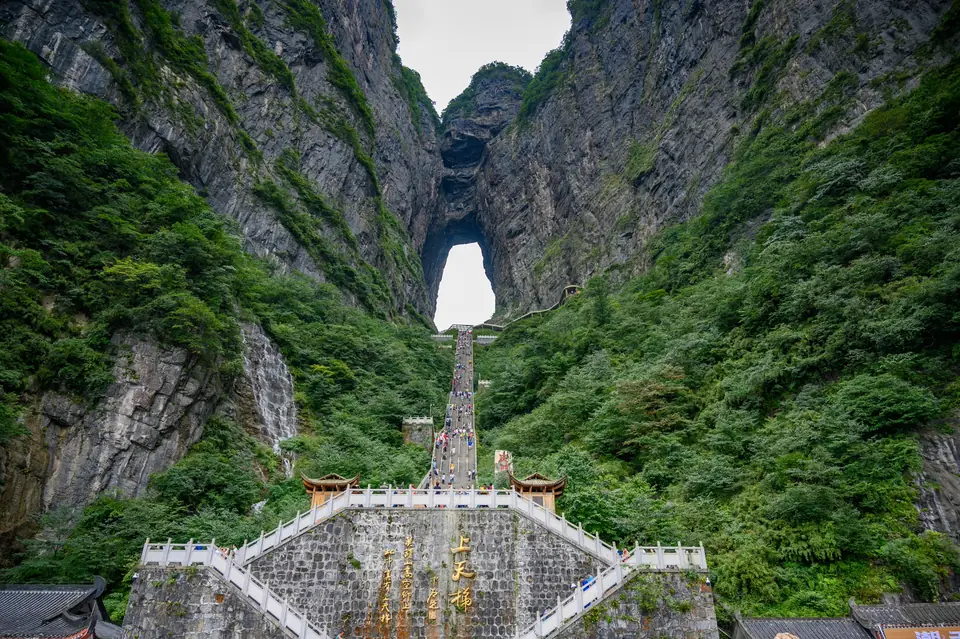
Beneath the arch, the scale becomes hard to take in. The Tianmen Dong pierces the mountain from side to side: 131.5 metres high and 60 deep, with a width that sources cannot quite settle, 57 metres in some and about 30 in others. From below it looks like a window to the sky in the middle of the cliff. It can also be reached from the summit by flights of escalators excavated inside the mountain, an alternative to the staircase.
Its name says cave, but geology says otherwise: it is a natural bridge in limestone, opened at about 1,300 metres above sea level. The tradition gathered in local accounts gives it a birth date, the year 263, when the gap would have opened all at once and Sun Xiu, ruler of Wu, would have taken it for a good omen. The mechanism of that collapse still has no agreed explanation.
Worldwide fame came through the air. On 11 December 1999 a group of stunt pilots flew a plane through the Tianmen Dong, with the Hungarian Péter Besenyei the first to cross: it was the first time a plane had passed inside a natural arch, and the mountain went around the world. What that flight changed for Tianmen is revealed by the narration, beneath the arch itself.
The Stairway to Heaven and its conquerors
Stairway to Heaven (999 steps)
Summary of this stop
From the square at the foot of the arch, the Stairway to Heaven climbs wedged between walls to the mouth of the Tianmen Dong: 999 steps at an incline of about 45 degrees. Seen from below, the staircase and the gap in the rock form a single line towards the sky.
Beside it rises the vertical rock face under the arch. In 2007 the French climber Alain Robert climbed it without ropes or protection, and a plaque commemorates the feat. Years later, the conquest changed medium: in 2018, in Land Rover’s so-called “Dragon Challenge”, the Formula E driver Ho-Pin Tung drove a plug-in hybrid Range Rover Sport up the 99 bends of the road and then the 999 steps, to the mouth of the arch. It was the first vehicle to reach the Heavenly Gate.
The feat had a sequel with much worse luck. In November 2025 a Chery Fulwin X3L hybrid SUV tried to climb the staircase, lost traction halfway up and knocked down part of the side wall; the brand apologised and promised to repair it. What those steps say about a mountain that everyone has wanted to conquer, from the ruler of Wu to the car brands, closes the route in the narration, at the foot of the stairs.